
Featured Cable Tray & Structural Support Systems
Procure certified industrial-grade cable containment, strut framing members, and cold-formed support hardware directly from Shanghai manufacturing lines.
Aluminium Unistrut Channel: Structural Metallurgy & Performance Physics
Understanding the mechanical differentiation of architectural and structural aluminium alloys under high cyclic vibration, dynamic seismic shears, and severe electrochemical environments.
Alloy Selection & Temper Kinetics
Extruded aluminium strut channels operate primarily within the 6000-series (Al-Mg-Si) metallurgical envelope. While traditional framing utilizes standard 6063-T6 (Yield Strength ~170 MPa) for architectural applications, structural high-load projects require 6005A-T61 or structural-grade 6082-T6 (Yield Strength ≥255 MPa, Tensile Strength ≥295 MPa). Solution heat-treatment and artificial aging ensure optimal grain boundary orientation, virtually eliminating stress-corrosion cracking (SCC) under heavy sustained static loads.
Strength-to-Mass Ratio Optimization
Aluminium possesses a density of approximately 2.70 g/cm³, representing roughly 34% the mass of structural carbon steel (7.85 g/cm³). Despite an elasticity modulus of approximately 69 GPa (compared to 200 GPa for structural steel), precision-engineered profile geometries featuring thickened returns, inturned serrated lips, and internal reinforcing webs deliver structural rigidity that significantly reduces deadweight loads on overhead concrete slabs, seismic trapezes, and offshore module superstructures.
Passivation & Micro-Crack Resilience
Upon ambient atmospheric exposure, aluminium instigates instantaneous self-passivation, synthesizing a cohesive, amorphous aluminium oxide ($Al_2O_3$) barrier layer measuring 2.5 to 5 nanometers. For aggressive C4 and C5 industrial-marine zones (ISO 12944), architectural anodization (Class I, ≥18 μm thickness per AAMA 611 / MIL-A-8625 Type II) forms an impenetrable anodic barrier that prevents pitting corrosion, galvanic degradation, and atmospheric chemical leaching over a 50+ year service life.
| Performance Metric / Property | Extruded Aluminium 6063-T6 | Structural Aluminium 6082-T6 | HDG Mild Steel (Q235/SS400) | Stainless Steel 316L (EN 1.4404) |
|---|---|---|---|---|
| Density ($\rho$) | 2.70 g/cm³ (Lightweight) | 2.71 g/cm³ (Lightweight) | 7.85 g/cm³ (High mass) | 8.00 g/cm³ (High mass) |
| Yield Strength ($R_{p0.2}$) | 170 - 190 MPa | 255 - 270 MPa | 235 - 260 MPa | 220 - 240 MPa |
| Modulus of Elasticity ($E$) | 69 GPa | 70 GPa | 205 GPa | 193 GPa |
| Corrosion Mechanism | Self-healing $Al_2O_3$ film | Enhanced passivating film | Sacrificial Zinc oxidation | $Cr_2O_3$ passive layer |
| Magnetic Permeability ($\mu_r$) | 1.000000 (Non-Magnetic) | 1.000000 (Non-Magnetic) | Ferromagnetic (>100) | 1.005 - 1.015 (Slightly para) |
| Spark Resistance (ATEX) | Zero spark generation | Zero spark generation | Mechanical spark risk | Low risk with tooling |
Strategic Procurement Drivers Across Macro Industries
Enterprise EPC contractors, system integrators, and infrastructure developers specify precision extruded aluminium channels to resolve severe site-specific constraints.
Semiconductor FABs & Cleanrooms
Microchip manufacturing environments (ISO 14644-1 Class 1 through Class 5) prohibit zinc whiskers, microscopic iron oxide flaking, and volatile organic outgassing. Anodized 6063-T6 Unistrut channels provide non-shedding, chemically inert modular framing for overhead HEPA fan filter units (FFU), ultra-pure water (UPW) stainless piping, and cleanroom wall panels without contaminating sterile production air streams.
Hyperscale AI Data Centers
With compute densities exceeding 40 kW to 100 kW per server rack, hyperscale facilities cannot tolerate excess ceiling dead-load from traditional structural steel. Extruded aluminium channel systems reduce ceiling grid suspension mass by up to 60%, allowing rapid deployment of overhead high-ampacity busway systems, heavy fiber-optic wire basket raceways, and direct-to-chip liquid cooling manifolds.
Offshore LNG & Coastal Marine
Marine environments characterized by constant sodium chloride aerosol concentration induce rapid corrosion in carbon steels. High-grade 6082-T6 marine aluminium channels resist chloride pitting and require zero hot-dip galvanizing maintenance shutdowns on offshore platforms, FLNG vessels, and coastal regasification facilities, substantially lowering 30-year lifecycle expenditure (LCC).
EV Gigafactories & Battery Plants
Lithium-ion cell manufacturing requires strictly non-magnetic and non-sparking infrastructure to avoid catastrophic runaway risks in slurry mixing, electrolyte filling, and formation dry-rooms. Aluminium Unistrut profiles exhibit zero ferromagnetic permeability ($\mu_r \approx 1$), eliminating electromagnetic eddy current induction and shielding sensitive automation sensors from RF distortion.
Global Factory Capacity & Quality Engineering
Headquartered in Songjiang District, Shanghai, Shanghai Qiongkai Industry Co., Ltd. operates state-of-the-art multi-axis extrusion lines, automated punching stations, and precision finishing lines under strict ISO 9001 quality management.
Standard Dimensions, Section Properties & Beam Capacities
Comprehensive engineering dimensional data for continuous slotted, plain, and welded combination aluminium channels compliant with MFMA-4 specifications.
Standard Deep Profile: 41×41 mm (1-5/8" × 1-5/8")
The universal industrial framing standard. Manufactured in continuous lengths of 3.0m, 5.8m (container optimization), and 6.0m. Features inturned retaining lips with cold-formed serrations designed to mechanically grip channel nut teeth, delivering up to 6.5 kN slip resistance per fixing node. Standard wall thickness: 2.5mm to 3.0mm in structural aluminium.
Shallow Profile: 41×21 mm (1-5/8" × 13/16")
Designed for compact, space-restricted ceiling voids, modular equipment enclosures, and secondary trapeze runs. Provides high lateral torsional stability while reducing vertical footprint by 50%. Ideal for lightweight conduit clamping, direct wall-mount raceways, and sub-distribution panel framing assemblies.
Back-to-Back Welded: 41×82 mm (1-5/8" × 3-1/4")
Two 41×41 mm sections structurally joined via automated continuous robotic seam welding or mechanical punch-lock clinching at regular 150mm pitches. Multiplies section modulus ($Z_x$) and moment of inertia ($I_x$), permitting extended support spans up to 4.5 meters without exceeding standard $L/200$ deflection thresholds.
| Profile Model | Material / Temper | Wall Thickness | Beam Span (1.0 m) Max Load | Beam Span (1.5 m) Max Load | Beam Span (2.0 m) Max Load | Max Deflection Criteria |
|---|---|---|---|---|---|---|
| QK-AL-4121 (Shallow) | 6063-T6 Extruded | 2.0 mm | 285 kg / m (Uniform) | 126 kg / m (Uniform) | 71 kg / m (Uniform) | $L / 200$ |
| QK-AL-4141 (Deep Standard) | 6063-T6 Extruded | 2.5 mm | 780 kg / m (Uniform) | 346 kg / m (Uniform) | 195 kg / m (Uniform) | $L / 200$ |
| QK-AL-4141-HD (Heavy Duty) | 6082-T6 Structural | 3.0 mm | 1,140 kg / m (Uniform) | 508 kg / m (Uniform) | 285 kg / m (Uniform) | $L / 200$ |
| QK-AL-4182 (Back-to-Back) | 6063-T6 Structural | 2.5 mm × 2 | 2,420 kg / m (Uniform) | 1,075 kg / m (Uniform) | 605 kg / m (Uniform) | $L / 200$ |
Technology Roadmap (2026–2035) & Global Compliance Framework
Driving modular MEP infrastructure forward with zero-carbon primary metallurgy, digitalized factory fabrication, and internationally harmonized safety testing.
Low-Carbon "Green" Aluminium Extrusions
By shifting to 100% renewably powered smelting (hydropowered electrolysis) and incorporating up to 65% certified post-industrial scrap, Qiongkai reduces embodied carbon from 14.0 kg CO₂e/kg Al to below 4.0 kg CO₂e/kg Al. Complete Environmental Product Declarations (EPD) empower projects to secure maximum LEED v4.1 and BREEAM decarbonization credits.
Automated CNC Stamping & Precision Slotting
High-speed progressive punch presses produce uniform slot dimensions (e.g., 9/16" × 1-1/8" or 14 × 28 mm slots on precise 50mm centers) with zero structural burrs or microscopic edge tearing. Slot radius geometry is engineered via FEA to eliminate micro-notch stress concentration under intense transverse seismic acceleration (ICC-ES AC156 compliance).
International Certification Architecture
All Qiongkai aluminium channels, channel nuts, angle brackets, and beam clamps are manufactured in full accordance with MFMA-4 (Metal Framing Manufacturers Association), BS 6946 (Metal Channel Cable Support Systems), AS/NZS 1866, and UL 2239 safety requirements, guaranteeing full engineering sign-off with global consultants and municipal building authorities.
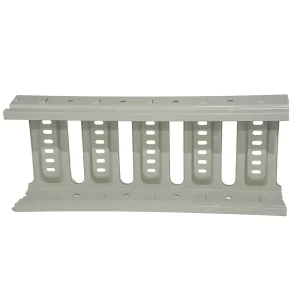
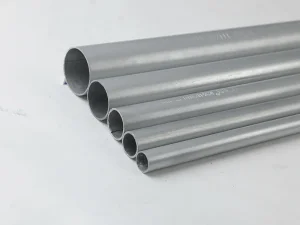
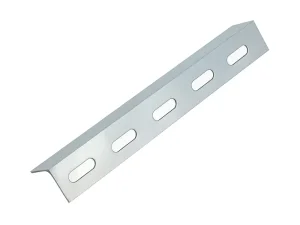
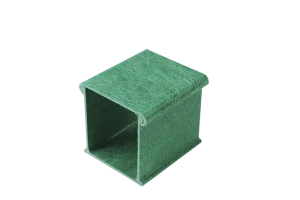
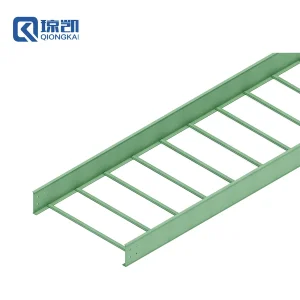
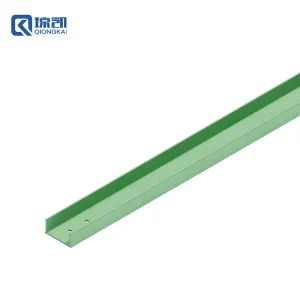
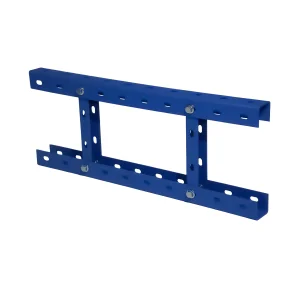
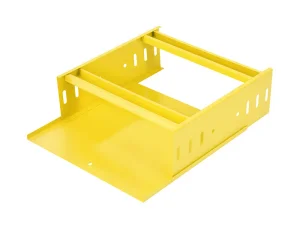
FRP, Stainless Steel & Heavy-Duty Structural Trapeze Lines
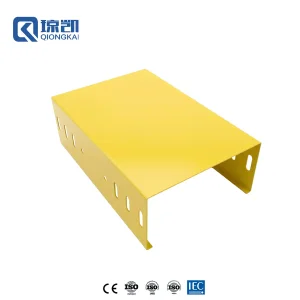
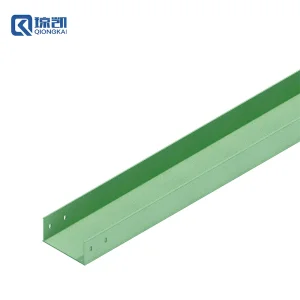
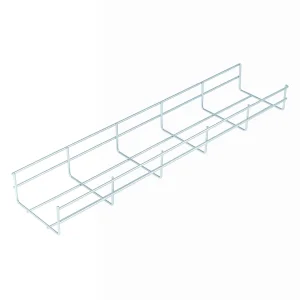
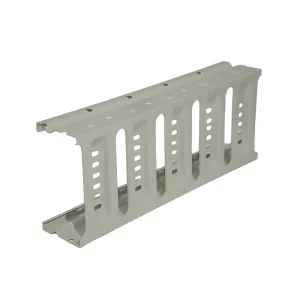
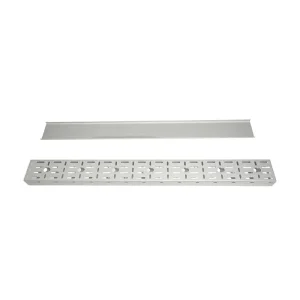
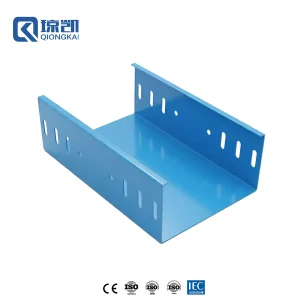
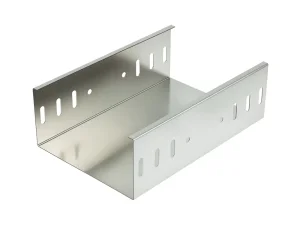
Discover complementary industrial cable management profiles manufactured to interface seamlessly with our aluminium Unistrut support systems.
Frequently Asked Questions for Project Engineers & Buyers
Definitive technical clarity regarding galvanic isolation, seismic calculations, connection hardware, and custom profile extrusion parameters.
How do you mitigate galvanic corrosion when fastening aluminium Unistrut to dissimilar metals?
1. Hardware Compatibility: We recommend using Type 316 Stainless Steel fasteners, spring channel nuts, and hex bolts fitted with non-conductive, UV-stabilized nylon/EPDM insulating washers and isolation bushings.
2. Structural Concrete Attachments: In trapeze suspensions using threaded steel drop rods, specify hot-dip galvanized rods equipped with heavy-duty neoprene isolators or non-metallic polyamide isolation gaskets that break galvanic continuity.
3. Protective Powder/Anodized Barriers: Anodized surfaces (≥18 μm) provide substantial dielectric breakdown resistance, effectively eliminating micro-galvanic current transfer in non-immersed atmospheric environments.
What are the key load calculation differences between Aluminium and Steel channels?
When sizing spans, deflection ($y = \frac{5 w L^4}{384 E I}$) must not exceed $L/200$ for standard industrial piping or $L/360$ for sensitive data center busbar runs. Specifiers can achieve identical load capacities to 2.5mm carbon steel by utilizing a slightly increased section depth (e.g., opting for 41×41mm or 41×82mm profiles) or specifying our reinforced 3.0mm structural 6082-T6 alloy series.
Can Qiongkai manufacture bespoke extrusion dies and custom punch patterns?
How does extruded aluminium strut perform under thermal expansion cycles?
Qiongkai supplies slotted expansion splice plates and slotted channel connection fittings with torque-controlled shoulder bolts to facilitate axial movement without buckling the support grid.
What third-party testing reports and mill certs accompany international export shipments?
Global Project Delivery, Port Proximity & Technical Support
From custom BOQ structural optimization to bonded port logistics, our engineering teams ensure seamless delivery from Shanghai directly to overseas jobsites.
1-on-1 Dedicated Account Engineers
Eliminate procurement intermediaries and costly communication bottlenecks. A single structural application engineer oversees your specifications from initial design review, span deflection calculations, and factory pilot extrusion all the way through to final container dunnage and export documentation.
Rapid Deep-Water Port Logistics
Situated within the Shanghai industrial corridor, our facilities enjoy immediate highway transit to Yangshan Deep-Water Terminal and Waigaoqiao Port. High-volume containerized shipments (20GP, 40HQ open-top, and flat-rack out-of-gauge orders) clear customs smoothly with standard lead times of 10 to 20 calendar days.
Full BOQ Optimization & Submittals
Email your CAD drawings, BIM models, or project Bills of Quantities (BOQ). Our engineering department returns a fully itemized proposal within 24 hours, including channel counts, torque-rated spring nuts, pre-fabricated 90-degree gussets, and load-span verification sheets ready for consultant submittal.