
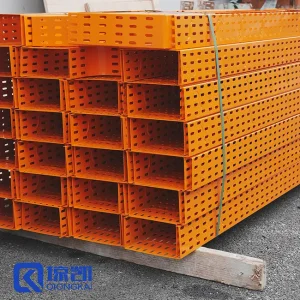
Direct-From-Factory Engineered Trays (Top Series)
Explore heavy-duty perforated, wire mesh, and ribbed cable containment units designed for high-voltage feeder routing, substations, and industrial manufacturing plants worldwide.
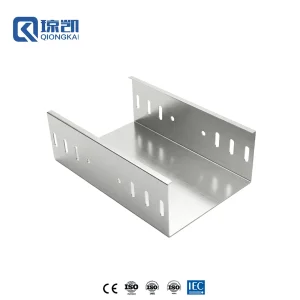
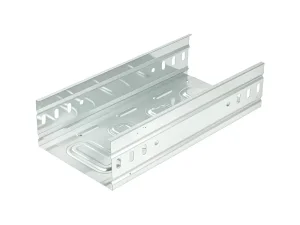
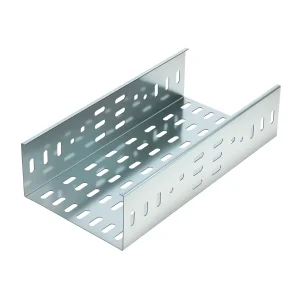
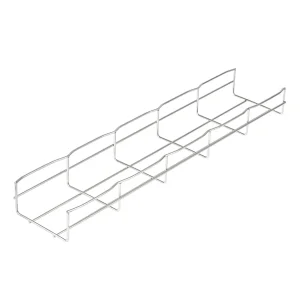
Global Enterprise Procurement Dynamics for High Voltage Systems
Strategic cable containment for High Voltage (HV: 35kV to 230kV) and Extra High Voltage (EHV: up to 500kV) systems requires an engineering paradigm fundamentally distinct from low-voltage wire routing.
Dynamic Fault Containment
High voltage lines carry massive prospective short-circuit currents ranging from 40kA to 63kA RMS for 1 to 3 seconds. The resulting electromagnetic repelling forces can tear apart substandard containment trays.
- Engineered rung-to-rail welded joints resisting dynamic shear.
- Trefoil cleat integration with pre-calibrated deflection limits.
- Compliance with IEC 61914 short-circuit withstand standards.
Thermal Ampacity Derating
Continuous thermal loading causes significant resistance losses. Conductor thermal dissipation directly dictates the current-carrying capacity of expensive cross-linked polyethylene (XLPE) or EPR insulated cables.
- Ladder open-area geometry exceeding 70% air circulation.
- Elimination of localized thermal hot-spots inside enclosed vaults.
- Validated through IEC 60287 ampacity calculation guidelines.
Eddy Current Mitigation
Single-core alternating current (AC) cables induce circulating eddy currents in surrounding metallic enclosures, causing parasitic heating and structural degradation in closed ferromagnetic circuits.
- Non-magnetic stainless steel (SS316) or composite FRP options.
- Aluminum ladder systems interrupting magnetic loop circuits.
- Engineered dielectric isolation pads and nylon-sleeved hardware.
Engineering Whitepaper Insight: The Physics of Trefoil Clamping
In three-phase HV cable arrangements, three single-core cables are bundled in trefoil formation to balance magnetic flux. During a prospective short circuit, peak repulsive forces between centers are computed by F = 0.2 × (Ipeak)2 / S (where F is in N/m, I in kA, and S is center-to-center distance in meters). Qiongkai heavy-duty ladder rungs are engineered with reinforced return flanges to support mechanical cleat anchoring without rung buckling or structural dislodgement.
Macro-Industry Solutions for Heavy-Duty High-Voltage Infrastructure
Deploying cable containment in extreme industrial environments requires system coordination across trays, 41-series strut channels, seismic bracing, and hardware accessories.
Grid Substations & GIS
Gas-Insulated Switchgear (GIS) and Air-Insulated Switchgear (AIS) yards require continuous ground-fault bonding, zero burr edges to protect high-voltage cable sheathing, and NEMA Class 20C heavy-span capacity.
Hyperscale AI Data Hubs
Modern AI compute clusters feature multi-megawatt substation feeds stepping down from 110kV/35kV to 415V. Trays require anti-harmonic stability, organized ladder risers, and color-coded powder coating for system tracing.
Offshore Wind & LNG
Corrosive C5-M marine zones and offshore natural gas extraction (such as Qiongkai's custom profiled sections for Qatar LNG) demand fiberglass pultruded FRP or pickling-passivated marine-grade SS316L.
Smelters & Petrochemical
Exposure to hydrogen sulfide, sulfur dioxide, and intense heat in chemical processing plants calls for FRP-lined steel trays, thick hot-dip galvanizing (>85μm), and reinforced medium/heavy-duty profiles.
Proven Project Reference: Hongqiao International Airport to Qatar LNG
Shanghai Qiongkai Industry Co., Ltd. has served as a critical supplier for flagship infrastructure landmarks worldwide. When Shanghai Hongqiao International Airport expanded its electrical distribution grid, Qiongkai's corrosion-resistant CT series trunking and ladder systems were chosen for their seamless dimensional tolerance and electro-galvanized / hot-dip galvanized finish continuity.
In the Middle East, our technical team engineered custom profiled section support brackets and FRP composite cable trays capable of enduring 55°C ambient temperatures, aggressive saline winds, and UV radiation for an offshore LNG facility in Qatar. Across Europe, phased shipments of HDG ladder trays to Italian utilities continue to validate our European EN ISO 1461 compliance.
Material Selection Matrix & ISO 12944 Environmental Grading
Premature failure of high-voltage cable runs is overwhelmingly driven by incorrect finish selection. Match your site conditions with our metallurgical matrix before drafting project procurement specifications.
| Material / Coating System | Standard Specification | Corrosion Category (ISO 12944) | Tensile Strength (MPa) | Electromagnetic Behavior | Ideal Procurement Environment |
|---|---|---|---|---|---|
| Pre-Galvanized Steel (PG / GI) | EN 10346 / ASTM A653 (Z275, ~20μm) | C1 - C2 (Dry Indoor) | 350 - 450 | Ferromagnetic (Shielding) | Commercial ceilings, indoor IT halls, control rooms |
| Hot-Dip Galvanized (HDG) | ISO 1461 / ASTM A123 (>65-85μm) | C3 - C4 (Industrial Outdoor) | 400 - 550 | Ferromagnetic (High Zinc Barrier) | Utility switchyards, outdoor substations, mining corridors |
| Stainless Steel (SS304 / SS316L) | ASTM A240 / EN 10088-2 | C5-I / C5-M (Marine Coastal) | 520 - 750 | Austenitic (Non-Magnetic / Low μ) | Desalination plants, offshore platforms, chemical scrubbers |
| Pultruded FRP / GRP Composite | ASTM D3917 / UL 94 V-0 (Halogen Free) | CX (Extreme Chemical / Marine) | 280 - 400 (Flexural) | Completely Dielectric (Zero Eddy) | Acidic wastewater, battery energy storage (BESS), marine docks |
| Powder Coated / Epoxy Coated | ISO 12944-6 / RAL Standard Colors | C2 - C3 (Engineered Indoor) | Varies by Substrate | Insulating Topcoat Layer | Telecom corridors, system circuit identification, architectural fit-out |
Galvanic Corrosion & Hardware Compatibility
When fastening cable trays, pairing dissimilar metals (e.g., carbon steel zinc-plated bolts on stainless steel trays) initiates rapid galvanic cell oxidation. Qiongkai supplies fully coordinated bolt packs, serrated flange nuts, and ground straps matching the parent metal metallurgy exactly.
Passivation & Heavy Zinc Deposition
Our in-house post-weld hot-dip galvanizing adheres strictly to ISO 1461, achieving coating weights exceeding 610 g/m² (85μm nominal thickness). For SS316, automated acid pickling and chemical passivation remove free ferrite to restore chromium oxide self-healing films.
Technical Roadmap: Load Mechanics, Spans & Seismic Bracing
High voltage cables are among the heaviest physical infrastructure items installed in commercial and industrial structures. Deflection must be strictly constrained to prevent joint disconnection and cable jacket rupture.
NEMA VE 1 / IEC 61537 Deflection
Trays are rated according to load classes. For a 6-meter span with heavy HV single cores (up to 120 kg/m), side rail depths of 100mm, 150mm, or 200mm with reinforced rolled flanges ensure L/200 deflection limits are maintained without permanent plastic strain.
Seismic Bracing & Strut Channels
Earthquake zones require multi-axis stabilization. Qiongkai produces heavy-duty 41x41, 41x62, and 41x82 back-to-back (BTB) cold-formed unistrut channels with seismic serrated teeth to prevent fastener slippage during seismic acceleration shocks.
Future Integration: Smart IoT Monitoring
Our upcoming generation of containment frameworks includes integrated DTS (Distributed Temperature Sensing) fiber-optic brackets, partial discharge acoustic sensor clamps, and corrosion micro-probes for predictive asset monitoring.
| Tray Profile Series | Side Rail Depth (H) | Usable Widths (W) | Recommended Support Span | Working Load Capacity (SWL) | Primary Structural Application |
|---|---|---|---|---|---|
| Reinforced Medium Duty (PG/HDG) | 50 mm - 100 mm | 150 mm - 400 mm | 1.5 m - 2.5 m | 75 kg/m - 120 kg/m | Substation auxiliary feeds, industrial automation raceways |
| Heavy-Duty Welded Ladder (HDG) | 100 mm - 150 mm | 200 mm - 900 mm | 3.0 m - 6.0 m | 150 kg/m - 260 kg/m | EHV single-core trefoil groupings, main power distribution |
| Corrosion-Resistant CT Trunking | 100 mm - 200 mm | 200 mm - 600 mm | 2.0 m - 3.0 m | 100 kg/m - 180 kg/m | Total physical protection, underground tunnels, airport concourses |
| Pultruded GRP/FRP High Load | 100 mm - 200 mm | 150 mm - 800 mm | 2.5 m - 4.5 m | 110 kg/m - 210 kg/m | Highly corrosive coastal power plants, chemical plants, LNG terminals |
Direct-From-Manufacturer Logistics & Strategic Economics
Purchasing directly from Shanghai Qiongkai Industry Co., Ltd. eliminates middleman price inflations, avoids technical miscommunications, and ensures traceable material certifications from ingot to final crate.
Port Proximity & Freight Optimization
Headquartered in Songjiang Port Science and Technology City of Shanghai, Qiongkai sits minutes from Shanghai Yangshan Deepwater Port and Waigaoqiao Port. We engineer tray nestability to maximize 40ft HQ container cube utilization, reducing international ocean shipping costs by up to 25%.
Turnkey Direct-Factory Pricing
Contractors dealing with trading companies face 15% to 30% markups and blurred liability. By engaging our 3 factories and 60+ heavy-duty press lines, you secure factory-direct mill pricing with unified warranty coverage across trays, struts, fittings, and fasteners.
1-on-1 Senior Engineer Assignment
Every tender, bill of quantities (BOQ), or schematic is assigned a dedicated electrical-structural application engineer. From custom radius elbows (300mm to 900mm bending radius for stiff HV cables) to custom punching holes, revisions are confirmed within 24 hours.
Regulatory Compliance, Auditing & Localized Support
Qiongkai’s manufacturing and test protocols conform to international quality and electrical management codes, ensuring effortless consultant approvals on Tier-1 global projects.
IEC 61537 & CE Marking
Full conformance to European standards governing cable management systems, ensuring electrical continuity (less than 0.05 ohms across splices) and precise safe working load (SWL) verification.
NEMA VE 1 & NEMA VE 2
Manufactured to North American National Electrical Manufacturers Association standards for metal cable tray systems and field installation practices, including expansion joint engineering.
ISO 9001 & 14001 Audited
Continuous quality assurance systems from raw steel spectrometer analysis to magnetic coating thickness checks, salt spray testing (ASTM B117), and full traceability heat certificates.
Shop Drawings & BIM Models
Our engineering office delivers complimentary CAD layouts, Revit BIM family files, structural calculation reports, and seismic support takeoff schedules based directly on your project electrical drawings.
Complete Cable Management, Trunking & Composite Systems
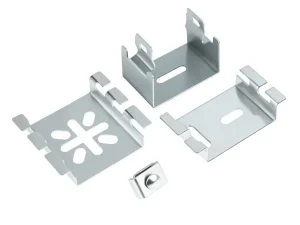
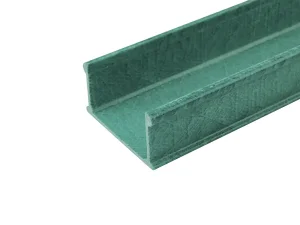
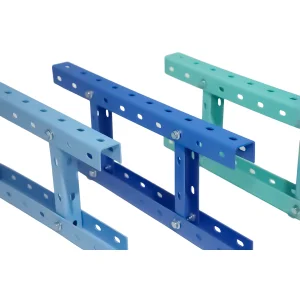
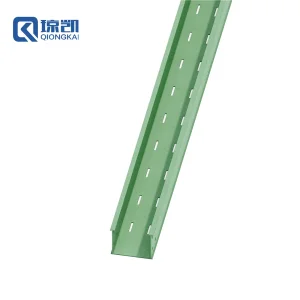
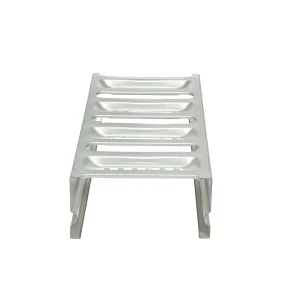
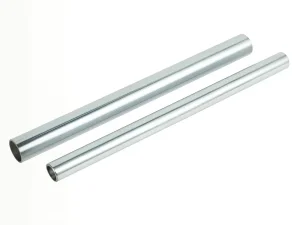
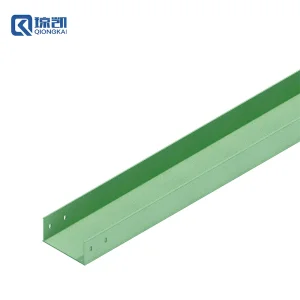
Integrate matching spare parts, FRP composite channels, heavy-duty perforated runs, and conduit systems to construct a certified, gap-free containment pathway.
Technical & Procurement FAQ for Engineering Consultants
In-depth answers addressing structural calculations, installation best practices, material certifications, and export coordination for high-voltage cable trays.
Why is ladder cable tray preferred over solid-bottom trunking for high-voltage cables?
Ladder-type cable trays provide superior natural convective air circulation, which is vital for high-voltage single-core cables operating under high current loads. Solid bottom or enclosed trunking traps heat, causing significant thermal resistance build-up and forcing electrical engineers to derate cable ampacity (sometimes by 15% to 30% according to IEC 60287). Furthermore, ladder rungs provide continuous, solid anchor points for securing mechanical trefoil cable cleats engineered to withstand electromagnetic forces during short-circuit faults.
How should cable cleats be spaced along high-voltage cable tray runs?
Cleat spacing is governed by the peak prospective short-circuit fault current (Ipeak) and cable diameter, not simply uniform structural distance. In utility switchyards subject to 50kA prospective faults, cleats are typically spaced at 300mm to 600mm centers near terminal equipment and bends, expanding to 900mm to 1200mm along straight horizontal ladder sections. Qiongkai ladder trays feature heavy-gauge rungs welded to side rails to absorb dynamic outward thrust loads without deflection or weld failure.
What finish is recommended for high-voltage trays installed in coastal or chemical environments?
For outdoor marine coastal locations (ISO 12944 Category C5-M / CX), Hot-Dip Galvanized steel (HDG) with a minimum coating thickness of 85 microns provides 25+ years of sacrificial zinc protection. For extreme saline or acidic environments (such as offshore oil & gas platforms, chemical plants, or desalination projects), Stainless Steel 316/316L or pultruded Fiberglass Reinforced Polymer (FRP/GRP) is strongly advised. FRP offers zero risk of corrosion and complete dielectric safety, fully eliminating eddy currents induced by high-ampacity alternating current cables.
How does Qiongkai ensure electrical bonding and earth continuity across tray splices?
Under IEC 61537 and NEMA VE 1, metal cable trays can function as an equipment grounding conductor (EGC) when properly bonded. Qiongkai supplies engineered splice plates featuring pre-punched grounding holes, serrated flanged lock nuts that pierce non-conductive zinc oxide layers, and flexible tinned-copper bonding jumpers. Across joint connections, resistance remains consistently below 0.05 ohms, ensuring earth fault currents safely trigger protection relays without localized arcing.
What is the minimum bending radius required for high-voltage cable tray fittings?
High voltage cables have large outside diameters (OD) and rigid lead or aluminum sheathing, demanding generous minimum bending radiuses (typically 15 to 20 times the overall cable diameter). Standard low-voltage 300mm radius elbows will pinch or damage HV insulation. Qiongkai manufactures custom horizontal elbows, vertical outside bends, and tee fittings with inside bend radiuses of 450mm, 600mm, and 900mm to ensure smooth pulling tension and code compliance with IEEE 1185.
Can Qiongkai supply custom-profiled support strut channels and seismic brackets?
Yes. As a direct manufacturer operating 12 automated roll-forming lines and over 60 heavy-duty stamping presses, we produce strut channel in 41x21, 41x41, 41x62, and 41x82 back-to-back dimensions, in plain or slotted profiles with regular and anti-seismic return flanges. We also manufacture 3D seismic trapeze brackets, cantilever arms, threaded rod assemblies, and beam clamps engineered to satisfy seismic design categories C through F under the International Building Code (IBC).
What are the lead times and container loading arrangements for large overseas infrastructure projects?
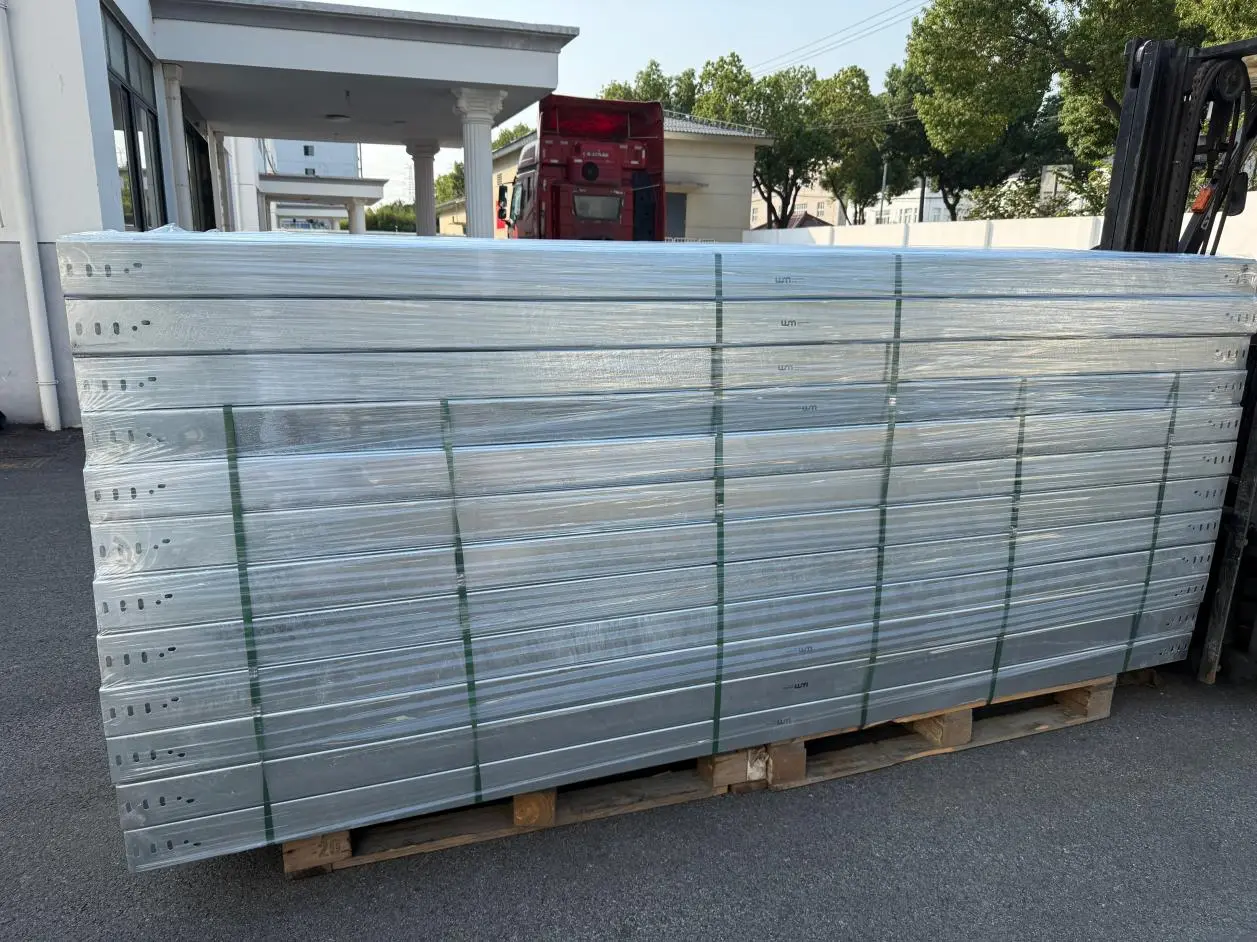
Standard profile production typically runs 10 to 20 days per 40ft container load. For major EPC projects requiring hundreds of kilometers of tray, production is scheduled in phased roll-outs aligned with project installation milestones. Located in Shanghai, near Yangshan Deepwater Port, our logistics team packs trays nested by size with heavy-duty export pallet strapping, anti-chafing corner guards, and desiccants to prevent transit corrosion during long maritime voyages.
Ready to Engineer Your High-Voltage Cable Containment Pathway?
Collaborate directly with Shanghai Qiongkai Industry Co., Ltd. Send your project layouts, single-line diagrams, or BOQ takeoffs to receive structural load calculation sheets, full CAD/BIM models, and an itemized direct-factory price quotation.