
Featured Ab Cope Compatible Cable Trays & Ladder Systems
Engineered to exact NEMA load classes with verified deflection standards. High-strength structural channels, ladder racks, and precision accessories directly from the manufacturing line.
Global Landscape of Ab Cope Cable Tray Specifications
Analyzing the adoption of Cope-profile raceway architectures across international energy, heavy infrastructure, and industrial fabrication sectors.
In global electrical raceway engineering, the Ab Cope cable tray catalogue standard represents the quintessential structural benchmark for high-ampacity power routing and mission-critical instrumentation. Originally developed in North America and codified under NEMA VE 1 / CSA C22.2 No. 126.1 guidelines, Cope-style geometries—characterized by hat-shaped cold-formed rungs, robust I-beam or C-channel side rails, and high structural load capacities—have transitioned into a global design vocabulary used by EPC (Engineering, Procurement, and Construction) conglomerates from North America to the Gulf Cooperation Council (GCC) and Southeast Asia.
Today's international industrial landscape requires electrical pathways capable of withstanding severe static cable loads, catastrophic short-circuit electromagnetic forces, dynamic seismic harmonics, and extreme atmospheric corrosion. Whether routing massive 500 kcmil triplex power feeds in petroleum refineries or low-voltage control loops across automated gigafactories, specifying the proper side-rail depth, rung interval, and metallurgical grade determines facility reliability across a multi-decade operational lifecycle.
North American Industrial Modernization
Heavy reliance on NEMA 12C, 16C, and 20C load classes in mining, automotive manufacturing, and petrochemical retrofits where replacement parts must directly mate with existing Ab Cope catalogues.
Middle East LNG & Desalination
Strict demand for heavy-gauge Hot-Dip Galvanized (ASTM A123) and high-molybdenum SS316L cable trays designed to resist continuous salt spray, high ambient thermal cycling, and high-intensity UV exposure.
Pan-European & APAC High-Tech Centers
Accelerating demand for custom perforated cable trays and powder-coated cable runways for massive hyperscale data centers requiring zero zinc whiskers and precise RAL color coding for system separation.
China Factory Efficiency: Re-Engineering Global Cable Tray Supply
How state-of-the-art cold roll-forming lines, automated robotic welding, and coastal port integration deliver significant total project cost advantages.
Sourcing Ab Cope-compatible cable tray catalogues directly from leading Chinese industrial manufacturers offers decisive commercial advantages that extend well beyond baseline FOB unit pricing. Operating within consolidated industrial hubs like Shanghai's Songjiang Port Science and Technology corridor, modern facilities integrate precision coil slitting, continuous tandem roll-forming, automated robotic TIG/MIG welding, and adjacent hot-dip galvanizing kettles into one synchronized production stream.
In traditional North American and European procurement pipelines, cable trays flow through an extended intermediary sequence: primary mill rolling, secondary distribution centers, regional stocking fabricators, and territorial electrical supply brokers. Each tier compounds markups, inflates lead times, and complicates engineering revisions. Direct integration with specialized Chinese manufacturing operations decouples large EPC infrastructure orders from local distributor margins, delivering 35% to 55% Capex reductions on bulk bill-of-materials (BOQs).
| Evaluation Parameter | Western Regional Distribution Tier | Direct Chinese Factory Integration (Qiongkai) | Strategic EPC Project Benefit |
|---|---|---|---|
| Pricing Architecture | Multi-tiered margin stacking (40%-65% markup) | Direct Factory FOB / CIF Base | Saves 35% to 55% on total structural electrical BOQ |
| Custom Engineering & Tooling | High non-standard tooling fees, 10-14 wk setup | In-house CNC Tooling & Mold Workshop | Custom rungs, depths, and gauges ready in 7-10 days |
| Zinc Coating Flexibility | Rigid stock limits (typically 380g/m² - 450g/m²) | Controlled HDG from 450g/m² to 900g/m² | Customized corrosion protection for 30+ year design life |
| Logistics & Deep-Water Freight | High regional domestic flatbed freight costs | Direct Yangshan / Waigaoqiao Port Loading | Containerized nesting optimizes shipping volume by 60% |
| QA / Traceability | Mixed subcontractor origins, slow paperwork | EN 10204 3.1 MTC, XRF metallurgy, full NDT | Direct engineering liaison eliminates drawing discrepancies |
Engineering Deployments: Harsh Industrial & Infrastructure Projects
Proven execution across international international airports, hyperscale data centers, offshore LNG liquefaction, and chemical agriculture facilities.
Shanghai Hongqiao International Airport
Deployment: Heavy-duty CT Series Cable Trunking & HDG Supports.
Challenge: Continuous vibration from jet taxiing and high seismic transit requirements.
Result: Zero maintenance over 15 years with 100% cable retention integrity.
Offshore LNG Terminal Expansion, Qatar
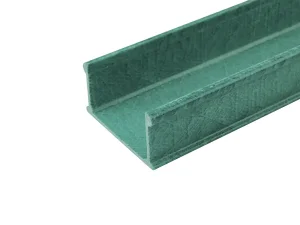
Deployment: Custom Profiled SS316L Cable Trays & FRP Support Beams.
Challenge: 55°C ambient temperatures with hyper-saline maritime condensation.
Result: Passed 3,000-hour ASTM B117 salt spray chamber validation with zero pitting.
Hyperscale Cloud Data Center, Malaysia
Deployment: RAL 5015 Powder-Coated Perforated Ladder Trays.
Challenge: Strict electrostatic discharge (ESD) standards and high airflow heat dissipation.
Result: 42% faster snap-in installation, optimizing cooling efficiency across server halls.
Industrial Livestock Facility, Paraguay
Deployment: Heavy-Duty Molded Pre-Galvanized Reinforced Cable Trays.
Challenge: High ambient ammonia gases and strict procurement budget limits.
Result: Delivered a cost-optimized structural raceway with a certified 15-year functional life.
Next-Generation Raceways: Engineering Trends Shaping the Industry
From Building Information Modeling (BIM) to seismic-resilient bracing and green metallurgy, cable tray specifications are undergoing a technical evolution.
The global cable tray sector is moving away from generic metal fabrication toward high-precision structural assemblies. Engineers no longer view cable trays as passive steel racks; they are mission-critical pathways that directly affect project schedules, installation safety, and overall electrical system resilience.
1. BIM LOD 400 Integration
Modern electrical contractors require native Revit and IFC 3D parametric components with exact bend radii, tee offsets, and splice plate allowances for virtual clash detection before breaking ground on-site.
2. Boltless & Quick-Click Splices
Rising on-site electrical labor rates have made rapid-assembly snap-in splice connections standard. Replacing standard nuts and bolts with quick-lock hardware slashes field installation hours by up to 40%.
3. Unified Seismic & Wind Bracing
In accordance with ASCE 7-16 and IBC compliance codes, cable tray systems are engineered with dynamic strut channel trapeze hangers and 45-degree lateral seismic sway braces capable of handling Zone 4 ground acceleration.
Global Enterprise Procurement: Cost Drivers & Technical Evaluation
Understanding the pricing metrics of Ab Cope cable trays: raw metallurgy, structural profiling, coating thickness, and freight efficiency.
When engineering and procurement teams evaluate wholesale Ab Cope catalogue pricing, comparing simple linear meter or per-foot rates without technical context can lead to major budget overruns. Cable tray pricing depends on four primary engineering variables:
1. Steel & Alloy Base Indices: Hot-rolled carbon steel coils (Q235B / ASTM A1011) fluctuate based on global commodity markets. High-performance stainless steels (SS304, SS316, SS316L) include price adjustments for nickel and molybdenum surcharges. Factory-direct partners protect long-term project budgets through forward hedging and raw coil inventory reserves.
2. Structural Side Rail Profile & Steel Gauge: Thicker steel sheet (1.5mm vs. 2.0mm vs. 2.5mm) increases load capacity, allowing wider support spans and fewer expensive support brackets. A slightly more robust side-rail geometry can significantly reduce total project hardware costs.
3. Protective Coating Grammage & Chemistry: Standard pre-galvanized finishes (Z120–Z275) suit climate-controlled indoor runs. Heavy industrial environments require true post-fabrication Hot-Dip Galvanizing (HDG) per ASTM A123 / ISO 1461, with a minimum 65–85 µm (450–610 g/m²) zinc thickness, or marine-grade thermoset powder coatings.
4. Nested Container Logistics: Factory-level nesting design is often overlooked. Alternating ladder trays of varying widths allows multiple units to pack inside one another for shipment. This nesting method triples the linear footage per 40ft High Cube container, lowering per-meter ocean freight costs by more than 60%.
Need a Tailored BOQ Cost Analysis?
Submit your electrical layout drawings or bill of materials. Our engineering team will return a comprehensive system proposal complete with span-load calculations, bracket schedules, and optimized container packing configurations.
Heavy-Duty Raceways, Trunking & Installation Accessories
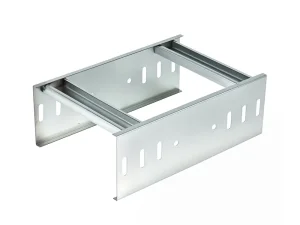
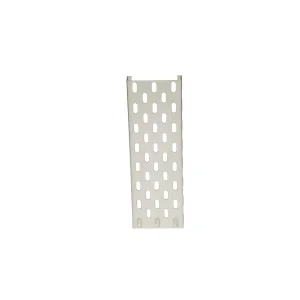
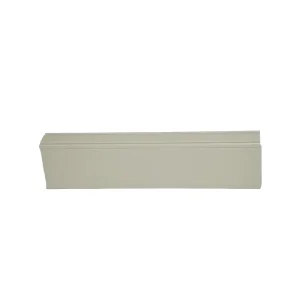
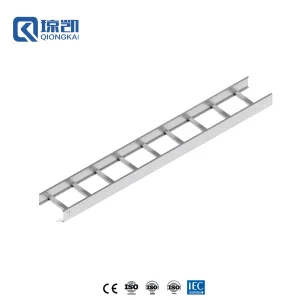
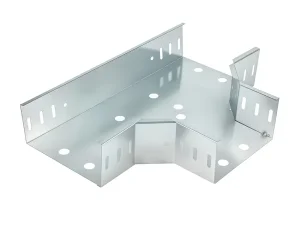
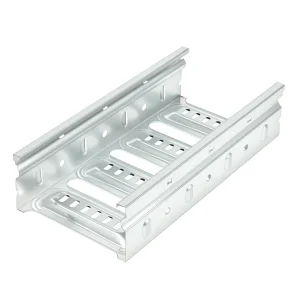
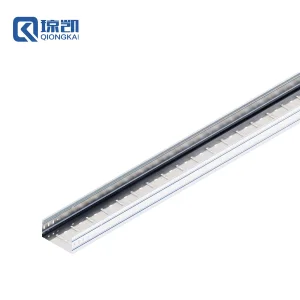
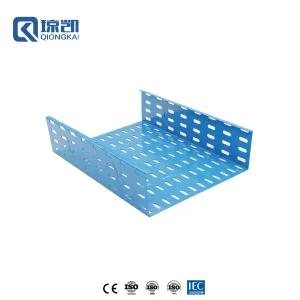
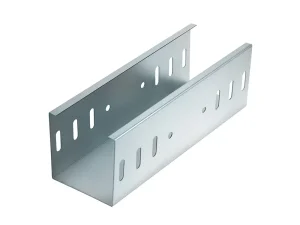
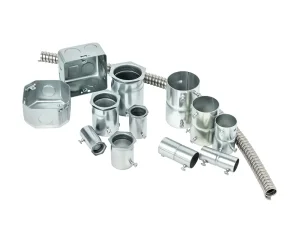
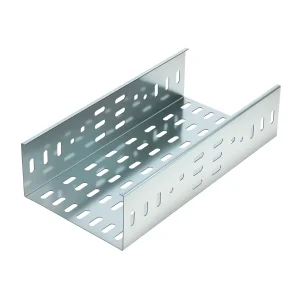
Complete your cable installation with matched fittings: reinforced splice plates, horizontal tees, engineered junction units, and heavy-load pre-galvanized trays.
Technical & Commercial FAQ: Ab Cope Cable Tray Solutions
Direct engineering answers addressing standard equivalencies, load classifications, metallurgy selections, and volume supply chain inquiries.
Our manufacturing profiles directly mirror standard Cope specifications—including hat-channel and tubular rungs with 6, 9, 12, and 18-inch spacing, matched with 4, 5, 6, and 7-inch side rail depths. We provide seamless interchangeability across splice plates, horizontal bends, tees, and reducers.
We manufacture and certify trays across all primary NEMA classes: 8A, 12A, 12B, 12C, 16A, 16B, 16C, 20B, and 20C. Load capacity testing uses a 1.5 safety factor, and full certified deflection curves (L/200 and L/360) are provided with every submittal package.
Hot-Dip Galvanized steel (ASTM A123, 65-85µm) is the standard for general industrial, outdoor substation, and rooftop cable runs. Marine, petrochemical, and acid-wash plants require pickling-passivated SS316/SS316L, while FRP composite trunking is preferred for severe chemical vapors and caustic washdown areas.
Every order includes complete quality documentation: EN 10204 Type 3.1 Mill Test Certificates (MTC), magnetic gauge coating thickness reports, tensile and yield test records, salt spray corrosion test logs (ASTM B117), and full dimensional inspection certificates.
Trays are packaged using custom nesting fixtures, protective plastic edge guards, and high-tensile steel banding on fumigated solid timber skids. Structural ladder side rails nest together smoothly, preventing transit friction damage and maximizing 40HQ container space.
Standard project runs of 2,000 to 5,000 linear meters typically ship within 14 to 21 business days. Emergency replacement runs or custom fittings can be expedited via our rapid-prototyping CNC lines in as few as 7 business days.