
Featured Cable Trays & Fire-Ready Containment Profiles
Manufactured across 12 automated lines in Shanghai. Precision-formed pultruded fiberglass, heavy-duty hot-dip galvanized steel, and modular pathways engineered for rapid firestop barrier integration.
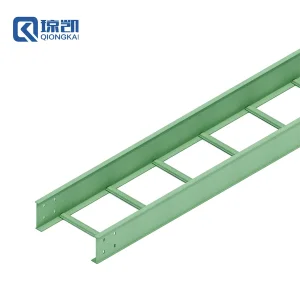
Buy FRP Ladder Type Cable Tray 400*150 Supplier, Factory
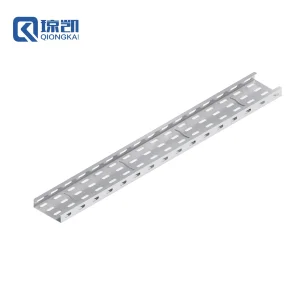
Wholesale Reinforced Medium duty Pre-galvanized Hot-dip-galvanized Perforated Cable Tray 100*25 Factory, Price
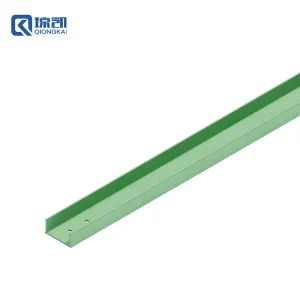
Wholesale FRP Cable Trunking Trough Type Channel 100*50 Manufacturer, Factories
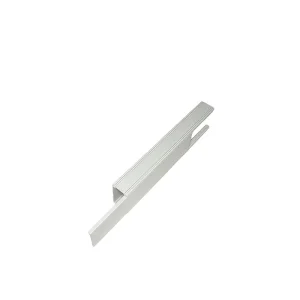
Wholesale UPVC Cable Trunking Thermal Insulated Anti-corrosion Resistance Manufacturers, Price
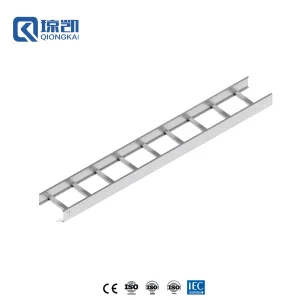
Buy Pre Galvanized Ladder Type Cable Tray 300*100 Factory, Factories
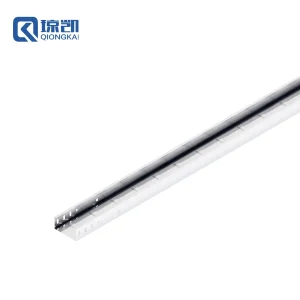
Wholesale Heavy Duty Cost Saving Reinforced Molded Pre Galvanized Cable Trunking Trough Type Channel 100*50
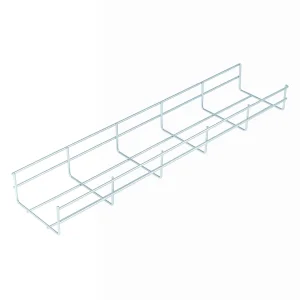
Wholesale Pre Galvanized grid Cable tray 100mm*50mm Suppliers, Factory
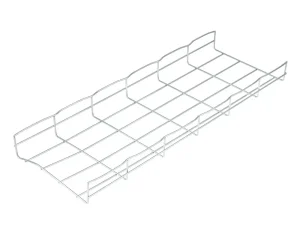
Wholesale Pre Galvanized grid cable tray 100mm Supplier, Factories
Engineering Passive Fire Containment in High-Density Cable Runs
Continuous cable tray pathways present significant risk during industrial fire events. Without engineered fire barriers, horizontal cable trays act as combustion highways and vertical risers function as convective chimneys, spreading flame, smoke, and toxic halides between fire zones.
Intumescent Firestop Barriers
Formulated with graphite matrices that expand 25x to 40x when exposed to temperatures exceeding 180°C. They crush burning plastic cable jackets, choke off oxygen migration, and preserve 120-minute to 180-minute compartmental integrity (EI120/EI180) across wall and slab penetrations.
Endothermic Enclosure Blankets
Multi-layered ceramic fiber and silicate wraps chemically release bound water molecules during flash-over events. This actively absorbs thermal energy, maintaining cable operating temperatures below 140°C even under external fire loads reaching 1,100°C per ASTM E1725 hydrocarbon curves.
Circuit Integrity Preservation
Designed to safeguard emergency shutdown systems, toxic gas scrubbers, smoke extract fans, and sprinkler pumps. Ensures uninterrupted electrical continuity for up to 90 minutes (DIN 4102-12 E30-E90 / IEC 60331) during localized catastrophic thermal failures.
Eliminating the Chimney Effect Across Multi-Level Risers
In vertical electrical shafts, buoyant hot gas currents produce intense pressure differentials known as the stack effect. Unsealed ladder trays and open perforations accelerate flame propagation rates from 0.4 m/min to over 6.2 m/min. Qiongkai supplies high-density elastomeric fire barrier blocks combined with calcium silicate internal baffles, segmenting risers at every floor slab to arrest vertical draft and restrict convective smoke leakage to under 0.01 cfm/sq ft (UL 1479 L-Rating compliance).
Global Standards, Building Codes & Commercial Reality
Compliance with international building codes is mandatory for Tier III/IV data halls, marine oil & gas rigs, and nuclear installations. Specifying wholesale cable tray fire barriers requires cross-referencing regional certification regimes.
North American Framework (NFPA / UL)
Governed by NEC 300.21, requiring all electrical penetrations through fire-rated partitions to maintain the structural assembly’s original fire resistance. Tested per ASTM E814 / UL 1479 for F-Rating (flame barrier, 1-4 hrs), T-Rating (thermal transmission), and Hose Stream impact endurance.
European Union Framework (EN / IEC)
Mandates harmonized standards under the Construction Products Regulation (CPR). Fire stopping assemblies conform to EN 1366-3 (penetration seals) and EN 13501-2 classifications for Integrity (E) and Thermal Insulation (I). Cable circuit integrity is rigorously benchmarked via DIN 4102-12.
Middle East & APAC Civil Defense
Demands robust third-party listings (such as Dubai Civil Defense & Singapore SCDF) combined with high resistance to atmospheric humidity, salt fog, and ambient solar loads. Fire barriers must not degrade or release corrosive halogens in environments exceeding 50°C and 90% RH.
| Fire Barrier System Type | Certified Fire Rating | Ampacity Derating Factor | Re-Penetration Flexibility | Primary Industrial Use Case |
|---|---|---|---|---|
| Pre-Formed Intumescent Transit Blocks | 0% (Penetration Only) | Excellent (Modular Snap-in) | Data Centers, Cleanrooms, Hospitals | |
| Continuous Ceramic Endothermic Wrap | 18% - 32% (Per IEEE 835) | Moderate (Requires Re-wrapping) | Nuclear Power, Refinery Cable Runs | |
| Coated Mineral Fiber Bulkhead Boards | 0% (Local Barrier) | Good (Sealant Recoating) | Commercial Risers, Industrial Plants | |
| Pultruded FRP Fire-Baffle Dividers | < 3% Derating | High (Adjustable Bracketed) | Offshore Platforms, Chemical Plants |
Thermal Derating Calculations & Material Science
Enclosing a power-carrying cable tray inside a continuous thermal fire barrier severely restricts heat dissipation. Electrical engineers must calculate ampacity reduction factors to avoid accelerated insulation aging and catastrophic copper over-temperature failures.
Heat Dissipation Physics in Protected Trays
Under continuous load, power conductors generate Joule heating ($I^2R$). An open ladder or perforated tray allows natural convective cooling and radiative dissipation. Applying an insulated 1-hour or 2-hour thermal barrier wrap restricts convective airflow, elevating internal equilibrium temperatures by 25°C to 45°C.
Intumescent Formulation & Zero Halogen Safety
Our proprietary barrier matrices rely on expandable exfoliated graphite, ammonium polyphosphate, and pentaerythritol bound within elastomeric polymers. Upon activation, the material forms a rigid, multi-cellular carbonaceous char with ultra-low thermal conductivity ($\lambda < 0.05 \text{ W/m}\cdot\text{K}$).
Shanghai Qiongkai Industry: 20+ Years of Production Precision
Headquartered in the Songjiang Port Science and Technology City of Shanghai, Qiongkai operates 3 dedicated manufacturing hubs spanning 30,000 m² of workshop space, engineered for international project deliveries.
12 Automated Roll-Forming Lines
Our heavy-duty production machinery produces cable trays, continuous trunking, strut channels (41x21 to 41x82), and fire-barrier structural backing plates with micron-level dimensional tolerances, ensuring zero-gap field fit-up.
Certified Metallurgical Protection
Batch hot-dip galvanizing exceeds ASTM A123 / ISO 1461 with average zinc coatings over 85 µm. Stainless steel (SS304/SS316L) and fire-retardant pultruded FRP formulations undergo rigorous spectrographic and flame chamber validation.
Direct Port Export Logistics
Direct proximity to Shanghai Yangshan and Waigaoqiao container terminals ensures seamless multimodal freight dispatch. Every export batch is packed in moisture-resistant fumigated timber crates with anti-corrosion barrier wrapping.
Engineered Implementations in Global Mega-Projects
From international aviation terminals to harsh offshore LNG extraction platforms, Qiongkai cable management and fire barrier systems safeguard critical electrical infrastructure across the globe.
Shanghai Hongqiao International Airport
Supplied extensive corrosion-resistant CT series cable trunking integrated with horizontal fire-partition bulkheads, safeguarding primary radar and passenger terminal power corridors.
Offshore LNG Processing, Qatar
Engineered custom-profiled support sections and 316L stainless steel & flame-retardant FRP ladder trays capable of withstanding extreme marine salinity and intense thermal radiation.
Outdoor Petrochem Expansion, Thailand
Delivered high-load FRP-lined heavy-duty steel cable trays paired with intumescent firestop collars for vertical penetration seals across chemical processing zones.
Mega Livestock Complex, Paraguay
Manufactured cost-optimized heavy-duty pre-galvanized and powder-coated cable tray networks with fire barrier partition walls to protect high-density power and feed automation lines.
The Future of Intelligent Passive Fire Defense
Cable management is transforming from static structural steel into active, sensor-integrated containment systems that prevent thermal events before ignition occurs.
Nano-Engineered Endothermic Wraps
Development of ultra-thin (under 6 mm) aerogel and nano-ceramic hybrid wraps that deliver 2-hour hydrocarbon fire ratings while cutting thermal ampacity derating penalty from 30% down to under 6%.
Integrated IoT Distributed Temperature Sensing
Factory-formed cable tray profiles embedded with optical fiber channels and continuous RFID temperature sensors, continuously transmitting real-time heat maps to building management systems (BMS).
Pre-Engineered Snap-In Fire Modules
Moving away from messy site-applied chemical mastics toward precision CNC factory-molded modular firestop cassettes that latch directly into strut channel assemblies with 65% faster install times.
Frequently Asked Engineering Questions
In-depth technical answers addressing fire codes, thermal derating calculations, seismic structural interfaces, and procurement specifications.
What are the essential differences between a Cable Fire Barrier and a Penetration Firestop?
A penetration firestop (governed by ASTM E814 / UL 1479 / EN 1366-3) seals the localized annular space where a cable tray passes through a fire-rated wall or floor assembly. Its function is to prevent flame, hot gases, and smoke from migrating between building compartments. In contrast, an enclosure fire barrier system (evaluated under ASTM E1725 / UL 263 / DIN 4102-12) continuously encases the cable tray along its entire run to protect the electrical circuit itself from external fire exposure, preserving circuit integrity (E30 to E90) for emergency operational continuity.
How does enclosing a cable tray with a fire barrier impact electrical cable ampacity?
Encapsulating a cable tray inside an insulating firewrap or solid baffle impedes the natural convective airflow and radiative heat transfer essential for cooling loaded conductors. According to IEEE 835 and ICEA P-54-441 standards, applying a certified thermal fire barrier generally requires an ampacity derating penalty between 15% and 35%. Failure to account for this derating factor results in conductor overheating, dielectric breakdown of cable jacketing, and premature insulation failure. Our engineering team provides detailed ampacity recalculation datasheets based on your planned fill ratio and ambient parameters.
Can fire barriers be seamlessly retrofitted onto existing cable tray installations?
Yes. Retrofitting is standard in operational data facilities and brownfield industrial plants. We supply split-frame transit systems, elastomeric intumescent pillow assemblies, and flexible composite blankets that wrap around existing ladder or basket trays without disconnecting conductors or causing service downtime. Pre-cast intumescent blocks can be easily trimmed around existing cables and re-sealed with fire-rated elastomeric mastic.
How does Qiongkai coordinate cable tray structural supports with seismic and fire loads?
Fire barriers add significant dead weight (typically 8 to 22 kg per linear meter) to the cable management assembly. Under elevated temperatures during a fire, structural steel experiences a reduction in yield strength (losing roughly 50% capacity at 550°C). Qiongkai integrates heavy-duty 41x62 and 41x82 back-to-back strut channels with certified anti-seismic bracing and seismic sway brackets, calculated according to ASCE 7 and IBC seismic design categories to ensure the tray system does not collapse under combined seismic and thermal loads.
Which tray material is superior for offshore and coastal fire-hazard environments?
For coastal and marine offshore environments with high airborne chlorides and hydrocarbon fire risks, Pultruded FRP (Fiberglass Reinforced Polymer) formulated with vinyl ester fire-retardant resins (UL 94 V-0 / ASTM E84 Class 1) or marine-grade Stainless Steel 316L are superior. Hot-dip galvanized steel, while highly durable in general industrial atmospheres, can suffer accelerated galvanic corrosion when in contact with acidic intumescent binders in high-humidity saline environments.
What lead times and OEM capabilities does Shanghai Qiongkai support for wholesale orders?
Operating 12 continuous assembly lines and roughly 60 heavy-duty forming and stamping units across 3 production facilities, standard container orders are manufactured and prepared for export within 15 to 25 business days. We support full custom engineering: non-standard tray widths (up to 1,200 mm), side rail heights (50 to 200 mm), custom gauge thicknesses (1.0 to 3.0 mm), specific punch ventilation configurations, and customized RAL color architectural powder coatings.
Heavy Duty & Perforated Trays, Strut Channels & Racks
Precision engineered to complement fire barrier installations. Featuring reinforced ribs for extreme load spans, powder-coated finishes for circuit identification, and pre-galvanized framing solutions.
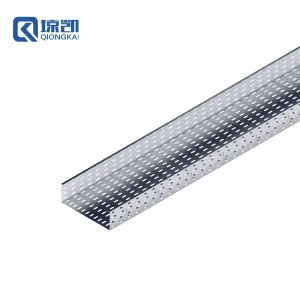
Wholesale Reinforced Medium duty Pre-galvanized Hot-dip-galvanized Perforated Cable Tray 300*100 Manufacturer, Factories
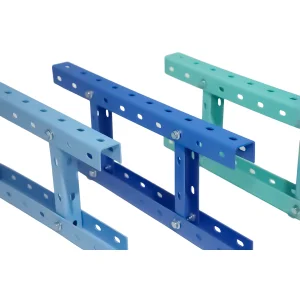
Wholesale Durable Powder Coated Telecom Cable Management Rack Supplier, Factory
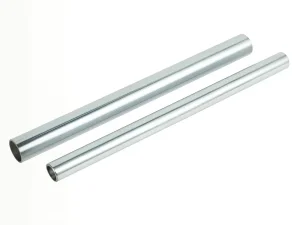
Wholesale Pre Galvanized conduit Supplier, Suppliers
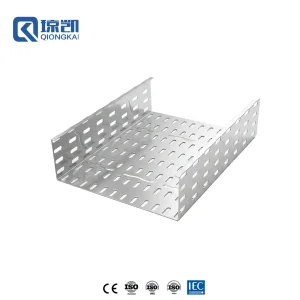
Buy Carbon Steel Pre Galvanized PG Hot Dip Galvanized HDG Cable Tray with Reinforce Ribs 300*100 Supplier
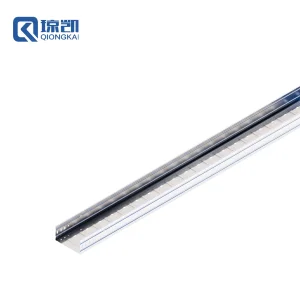
Wholesale Cost Saving Heavy Duty Reinforced Molded Pre Galvanized Cable Tray with less perforation 200*100
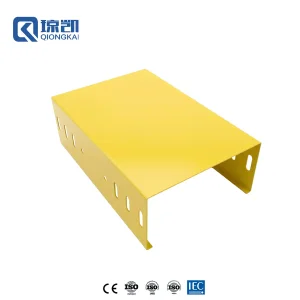
Buy Powder Coated Carbon Steel PG Pre Galvanized Cable Trunking Trough Type Channel - RAL1080 Yellow 200*100
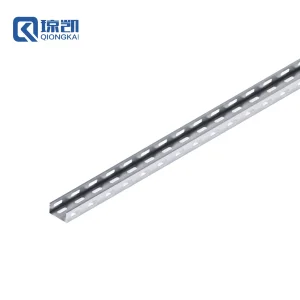
Wholesale PG HDG Perforated Cable Tray 50*25 Supplier, Price
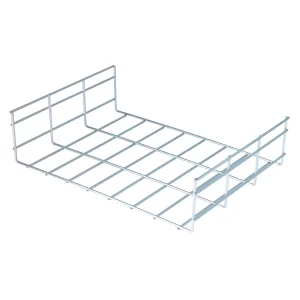
Wholesale Pre Galvanized grid Cable tray 500mm Manufacturers, Supplier
Plan Your Project With Qiongkai’s Technical Team
Submit your cable routing layouts, BOQ schedules, or penetration fire resistance requirements. Receive a comprehensive structural proposal covering cable trays, seismic strut channels, fire barrier penetration wraps, and thermal ampacity calculations.