
Featured Cable Trays & Structural Systems
Direct factory production lines covering specialized powder coating, FRP pultruded composites, seismic fittings, and high-tensile pre-galvanized profiles for heavy commercial and industrial containment.
Years of Manufacturing Experience Since 2005
Floor Area Across 3 Specialized Production Facilities
Automated Roll-Forming & Continuous Welding Lines
Heavy-Duty Automated Hydraulic & CNC Press Units
Macro Engineering Solutions: Why Ladder Cable Trays Dominate High-Amperage Architecture
Thermal dissipation dynamics, cantilever load mechanics, and lifecycle structural resilience dictate modern raceway selection in multi-gigawatt facilities and critical industrial infrastructure.
Engineering Analysis: Free-Air Ampacity & Heat Dissipation Optimization
In contemporary industrial electrification, cable conductors generate substantial Joule heating ($I^2R$ energy loss). Enclosing high-voltage or primary distribution feeders inside solid-bottom ducting or unventilated channels incurs a major derating penalty according to IEC 60364-5-52 and NEC Article 392 standards. When conductors run within solid trunking, thermal entrapment forces electrical designers to either decrease allowable current throughput or drastically upsize copper and aluminum conductor cross-sections, inflating material expenditures by 18% to 34%.
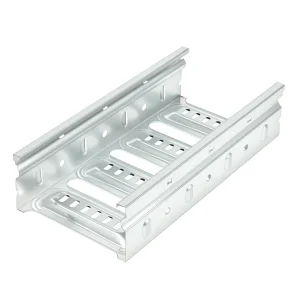
Ladder cable trays eliminate boundary thermal boundaries by providing maximum longitudinal ventilation. With rung spacings optimized at 150mm, 200mm, 250mm, or 300mm, airflow moves unrestricted across the cable jackets, permitting conductors to be operated at peak free-air current ratings. Furthermore, ladder side-rails serve as structural beam girders, transferring bending moments directly to strut supports and cantilever brackets across long continuous spans up to 6 meters.
Short-Circuit Fault Bracing
Under sub-cycle electrical faults, magnetic repulsion induces violent mechanical displacement between adjacent phases. Our welded rungs and ribbed ladder side-rails withstand high electromagnetic torque when secured with trefoil cleat arrangements, preventing catastrophic tray deformation during short-circuit events exceeding 50kA.
Long-Span Deflection Control
Manufactured under NEMA VE 1 / CSA C22.2 No. 126.1 and IEC 61537 testing parameters, our engineered side rail profiles maintain a safety factor of 1.5 against ultimate tensile load, limiting center-span deflection to less than 1/200th of the span distance even under heavy multi-layer industrial power cable loading.
Debris & Moisture Elimination
Solid bottom systems tend to accumulate condensation, combustible dust, and industrial processing residue. The open rungs of ladder trays promote self-draining performance and immediate wash-down egress, making them the standard specification in harsh, wet, or chemically contaminated operating environments.
Global Market Realities & Wholesale Pricing Matrix
Wholesale pricing for cable ladder systems depends directly on global raw coil commodities (LME/SHFE index), post-fabrication galvanizing baths, structural gauge selection, and volume economics.
| Material / Metallurgy | Yield Strength ($R_{eH}$) | Corrosion Rating (ISO 12944) | Estimated Factory FOB Price (Meter) | Best Architectural Application |
|---|---|---|---|---|
| Pre-Galvanized Steel (GI) | 250 - 320 MPa | C1 - C2 Interior | $8.50 – $18.00 / m | HVAC risers, commercial switchgear rooms, retail ceilings |
| Hot-Dip Galvanized (HDG) | 275 - 355 MPa | C3 - C4 Industrial | $14.00 – $36.00 / m | Rooftop solar, power generation, petrochemical sites |
| Stainless Steel (SS304) | 205 - 290 MPa | C4 Industrial Clean | $28.00 – $65.00 / m | Food & beverage processing, breweries, dairy plants |
| Marine Grade (SS316 / 316L) | 220 - 310 MPa | C5-M Marine Coastal | $42.00 – $98.00 / m | Offshore oil & gas, coastal substations, desalination plants |
| Fiberglass Reinforced Polymer (FRP) | 180 - 240 MPa (Flex) | Extreme Chemical / Acid | $24.00 – $58.00 / m | Battery manufacturing halls, chemical pickling lines, wet cooling towers |
Cost Optimization Principles for EPC Contractors
Wholesale procurement prices reflect steel coil gauge, ladder height (50mm, 75mm, 100mm, 150mm), and rung configuration. By utilizing Qiongkai's continuous roll-forming lines, contractor designs can shave up to 14% of raw weight while meeting deflection specs via cold-formed stiffener flanges, lowering freight costs per container cubic meter.
Localized Engineering Support & Compliance Verification
From seismic shock validation in earthquake-prone belts to mill test certificates conforming to EN 10204 3.1, our global engineering unit provides field-ready documentation for tier-one project submittals.
Code Compliance Submittals
Complete calculation packages verifying load performance according to IEC 61537, NEMA VE 1, and UL 568. Electrical continuity tests confirm grounding bonding capabilities across all spliced ladder junctions.
Sea Freight Container Nesting
Export-optimized nested bundles reduce freight dead-space. Customized timber skidding, moisture-barrier wrapping, and corner steel protectors ensure HDG coatings and precision weld rungs arrive without transit abrasion.
Traceability & Material MTRs
Raw steel batches from certified tier-one mills are tracked via barcode serialization. Metallurgical certificates and coating thickness reports (ASTM A123 / ISO 1461) accompany every shipping container released from Shanghai.
Global Project Applications & Case Histories
From major airport transport hubs to high-temperature desert processing centers and coastal marine environments, our engineered tray systems support infrastructure across five continents.
Shanghai Hongqiao Int'l Airport
Supplied corrosion-resistant CT series cable trunking and matching ladder containment across basement substation arteries, ensuring continuous uninterruptible power distribution for critical civil aviation terminal operations.
Offshore LNG Processing, Qatar
Custom-profiled section cable ladders and heavy structural support channels built to withstand scorching 50°C desert ambient heat combined with severe offshore marine salt-spray fog and volatile hydrocarbons.
High-Heat Outdoor Arrays, Thailand
Engineered high-load FRP-lined hybrid steel trays designed to survive tropical UV index extremes and torrential monsoon cycles without coating embrittlement, delamination, or electrical grounding degradation.
Commercial Livestock Mega-Facility, Paraguay
Delivered a cost-optimized, high-span reinforced galvanized ladder system configured to resist severe organic ammonia fumes and frequent high-pressure disinfectant chemical sanitation cycles.
EU Industrial Plant Upgrades, Italy
Manufactured and shipped ISO 1461 hot-dip galvanized cable ladder trays, custom horizontal tees, internal reducers, and cantilever wall arms fully aligned with European CE harmonized safety declarations.
Hyperscale Cloud Data Halls
Supplied RAL 9005 powder-coated cable runway ladder grids installed above high-density server racks, promoting laminar airflow in hot/cold aisle containment corridors while accelerating optical fiber routing speed.
Technology Roadmap: Next-Generation Cable Support Engineering
Embracing low-carbon metallurgical substrates, modular snap-lock joints, seismic modeling, and smart sensor integration to modernize structural electrical pathways.
Zinc-Aluminum-Magnesium
Shifting conventional HDG toward next-gen Zn-Al-Mg (ZAM) alloy coatings that deliver self-healing corrosion resistance on cut edges with a 30% reduction in carbon footprint during bath processing.
Tool-Free Fast-Splice
Developing auto-locking splice plates and tool-less spring-clamp rung joints that eliminate up to 60% of field bolt assembly labor, cutting installation costs for EPC field teams.
BIM & Digital Twin Libraries
Expanding native Revit, IFC, and Tekla BIM parametric families with integrated finite element deflection formulas, streamlining spatial coordination across complex clash-detection models.
IoT Structural Health Sensors
Integrating optical fiber Bragg strain sensors and passive RFID temperature tags directly into ladder rungs for real-time monitoring of cable weight sag, overload risks, and overheating in nuclear and petrochemical plants.
Frequently Asked Technical & Commercial Questions
Detailed technical answers to support EPC electrical consultants, procurement estimators, and project site managers in specification and purchase planning.
What distinguishes ladder cable trays from wire mesh basket and solid bottom trunking?
How do you determine the correct rung spacing for a ladder cable tray run?
What factors have the greatest influence on wholesale ladder cable tray prices?
Can Qiongkai manufacture custom profiles, specific rung punch patterns, or customized fittings?
How do ladder cable trays comply with grounding and electrical bonding standards?
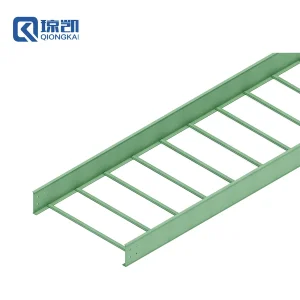
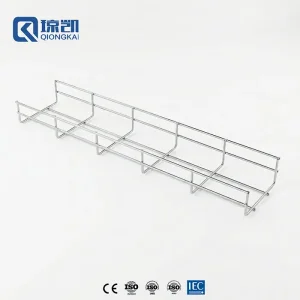
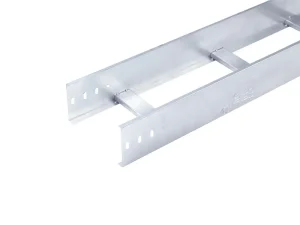
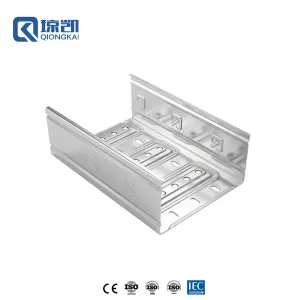
Engineered Trays, Wire Mesh & Heavy-Duty Profiles
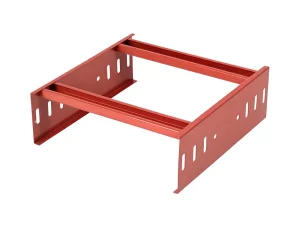
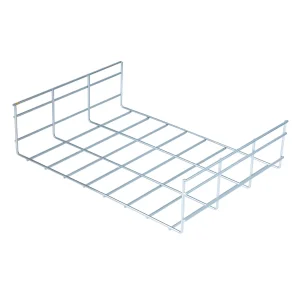
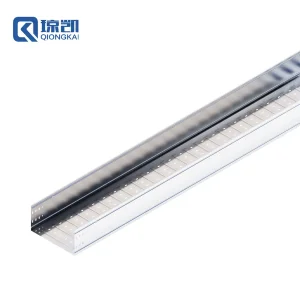
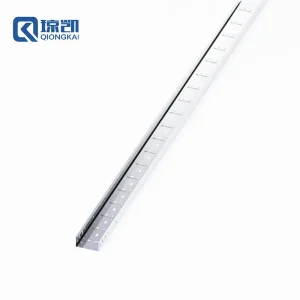
Complete factory portfolio including heavy-duty reinforced molded channel profiles, stainless wire baskets, FRP non-conductive ladders, and powder-coated architectural systems.
Looking for Certified Ladder Trays for an Upcoming Project?
Submit your Bill of Quantities (BOQ), schematic single-line layouts, or custom profile specifications directly to our engineering department in Shanghai for an itemized factory-direct quote.