
High-Precision Cable Tray Fittings & Critical Spare Parts
Standardized connection systems manufactured with robotic progressive stamping dies for exact dimensional alignment with European tray profiles, guaranteeing structural integrity and electrical bonding.
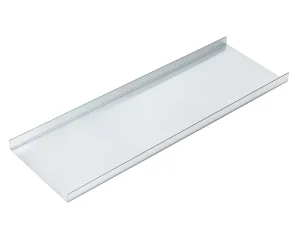
Pre-Galvanized Cable Tray Cover (Italy High-Speed Rail & Substation Spec)
Snap-on and bolted protective tray covers designed to defend high-voltage power conduits against UV degradation, mechanical impact, and debris ingress.
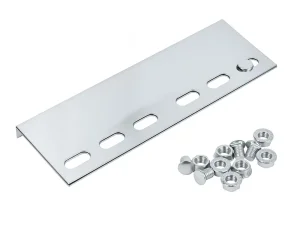
Cable Tray Connections & Spare Parts (Milan Data Hall Rapid-Coupler Series)
High-strength connection plates and fishplates engineered with pre-punched grounding tabs to guarantee electrical continuity under CEI EN 61537 testing.
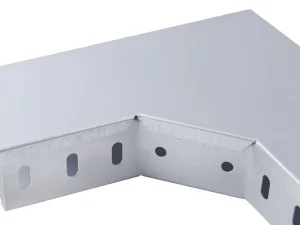
Elbow / Tee / Cross Modular Fittings (Torino Smart Factory Cable System)
Precision-radius horizontal branching fittings supplied with matched flush-fitting covers to preserve cable minimum bending radii in automated plants.
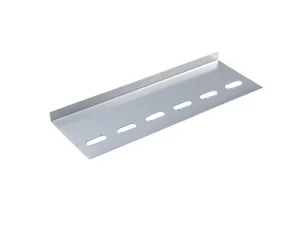
Pre-Galvanized Connections & Splice Plates (Bologna Logistics Interlink)
Reinforced side-coupler splices and angle brackets certified for high-span automated warehouse raceways with heavy dynamic cable loads.
Cable Containment Accessories in Italy: Commercial & Industrial Landscape
As Europe's second-largest manufacturing powerhouse, Italy's transition driven by the PNRR (Piano Nazionale di Ripresa e Resilienza) is catalyzing unprecedented demand for high-spec, compliant cable support infrastructure.
CEI EN 61537 & CE Norms
Every cable tray accessory—from splice plates to hold-down clamps—installed within Italian borders must strictly satisfy CEI EN 61537. This dictates safe working load (SWL) deflection ratios (typically L/200), mechanical impact resistance (up to IK10), and verified electrical impedance (<50 mΩ across couplers) to prevent static buildup or shock hazards.
PNRR Modernization Surge
Italy’s €190+ billion recovery funding is powering massive investments in electrified high-speed railways (RFI), mega-scale battery gigafactories, automated pharmaceutical plants, and green hydrogen hubs. These critical installations require certified containment accessories capable of 30+ year maintenance-free design lifespans.
Aggressive Microclimates
Italy features diverse environmental corrosion zones: C5-M marine exposure in coastal ports (Genoa, Taranto, Trieste), high atmospheric sulfur and humidity in the industrial Po Valley, and stringent hygienic washdown regimes in Emilia-Romagna’s food corridors. Material specification must be engineered to match ISO 12944 classifications.
| ISO 12944 Class | Italian Environmental Context | Recommended Material & Finish | Average Coating / Alloy Spec | Target Lifespan |
|---|---|---|---|---|
| C1 & C2 | Heated indoor commercial buildings, Milan office towers, dry warehouses | Pre-Galvanized Carbon Steel (PG) | EN 10346 DX51D+Z275 (≥20 µm zinc) | 25+ Years |
| C3 | Po Valley light manufacturing, automotive workshops, suburban substations | Post-Galvanized / Electro-Galvanized + Powder | Continuous hot-dip / RAL Polyester coating (60-80 µm) | 20+ Years |
| C4 | Chemical processing plants, coastal processing, high-traffic rail tunnels | Batch Hot-Dip Galvanized (HDG) | ISO 1461 / ASTM A123 (≥65–85 µm zinc) | 30+ Years |
| C5-M / C5-I | Offshore platforms, Fincantieri naval docks, petrochemicals, brine pools | Austenitic Stainless Steel (AISI 316 / 316L) | EN 1.4404 pickled & passivated with 2.5% Molybdenum | 50+ Years |
| Extreme Chemical | Sardinian mining, pickling tanks, wastewater sludge drying basins | Fiberglass Reinforced Polymer (FRP/GRP) | Isophthalic / Vinyl Ester resin pultrusion | 40+ Years |
Global Supply Chains & The Shanghai Qiongkai Manufacturing Edge
Bridging the gap between European design demands and high-throughput production: how our 3 manufacturing bases, 12 assembly lines, and precision tooling deliver structural containment accessories with zero defect tolerance.
European Supply Bottlenecks vs. Chinese Factory Scalability
Contractors and major electrical wholesalers (Grossisti di Materiale Elettrico) across Italy face rising raw material costs, prolonged lead times (often 12–18 weeks for non-standard bends), and strict minimum order quantities from traditional local fabricators. Our Songjiang manufacturing cluster addresses this directly:
- High-Speed Multi-Stage Pressing: 60+ heavy-duty pneumatic punch presses (up to 400T) producing 45,000+ precision splice brackets and hold-down clamps daily with tight dimensional tolerances within ±0.15mm.
- Automated Roll-Forming & In-Line Robotic Welding: Fully automatic punching and continuous profiling ensure all cable tray covers and channels interlock without on-site reaming.
- Integrated Hot-Dip Galvanizing & Slitting: Raw steel direct from top mills (Baosteel/Shougang) guarantees stable chemical composition, low silicon content (preventing brittle Sandelin effect coatings), and consistent zinc adhesion exceeding ISO 1461.
- Landed Cost Optimization: Factory-direct shipping through Yangshan and Ningbo ports lowers unit procurement costs by 28% to 42% compared to domestic EU production, even after shipping and import tariffs.
Complete Quality Verification & Traceability
We do not treat accessories as secondary components. A failure in a single cantilever bracket or seismic clamp compromises the entire electrical backbone. Every export batch sent to European destinations carries documented quality assurance:
Standard Export Documentation Package:
• EN 10204 Type 3.1 Inspection Certificates with heat numbers and tensile/yield analysis.
• Magnetic eddy-current coating thickness measurements (ISO 2178).
• Continuous neutral salt spray testing (NSS per ISO 9227 / ASTM B117) up to 1,000 hours.
• Factory batch electrical resistance validation across joined splices (<0.05 Ω).
Localized Application Scenarios Across Italian Industry Hubs
From automated robotic manufacturing in Lombardy to the aggressive marine shipyards of Liguria, each application demands distinct structural metallurgy, load calculations, and accessory configurations.
Automotive & Robotics (Turin & Modena)
Modern electric vehicle assembly lines and robotics plants require dynamic vibration-resistant cable support. Cantilever brackets must incorporate spring-nut hardware, serrated channel lips, and locking splice connectors that resist cyclic mechanical oscillations from robotic welding cells.
Food & Pharma (Emilia-Romagna & Latina)
In Italy’s "Food Valley" and pharmaceutical packaging centers, wire basket trays and open perforated accessories in electropolished AISI 304 or 316L are mandatory. Brackets feature rounded self-draining contours without horizontal pockets to prevent bacterial accumulation during clean-in-place (CIP) washdowns.
Naval, Offshore & Port Terminals (Genoa & Trieste)
Naval shipyards, passenger cruise docks, and oil bunkering wharves endure intense saline salt spray and deck wave action. Accessories demand deep-galvanized HDG (coating thickness ≥85 µm) or 316L stainless steel hardware resistant to pitting and crevice corrosion under constant chloride assault.
Utility-Scale Solar PV (Sicily & Apulia)
Southern Italy leads the nation's solar boom. Ground-mounted tracking and rooftop arrays require ventilated covers to block intense solar radiation while allowing convection airflow, combined with thermal expansion guide splices that absorb daily 40°C temperature deltas without buckling.
Hyper-Scale Data Centers (Milan Cluster)
Settimo Milanese and the greater Milan metropolitan area represent Italy’s booming cloud hub. Overhead basket raceways require screwless fast-snap junction clamps, smooth radius drop-out plates to preserve fiber optic integrity, and color-coded epoxy powder coating to segregate redundant circuits.
Railways & Metro Infrastructure (RFI / Italferr)
Underground metro networks and railway corridors in Rome, Naples, and Milan enforce zero-halogen, non-flammable containment components. Heavy-duty bolted fishplates and seismic bracing rods guarantee structural retention during train-induced air surges and seismic tremors (NTC 2018).
Engineering Trends Shaping the Cable Management Industry
Technological innovation in cable containment is moving rapidly from passive metal bending to intelligent, labor-saving, modular structural ecosystems.
Toolless Click-Fit Systems
With on-site European electrical labor costs averaging €45–€70/hour, EPC contractors prioritize accessories that install without power drills. Screwless spring-steel couplers and tool-free cover clamps reduce installation time by up to 60%, delivering substantial net cost savings across large-scale projects.
BIM & Digital Twin Libraries
Modern Italian engineering firms (Studi Tecnici) design projects entirely in Autodesk Revit. Qiongkai provides native BIM families (LOD 300/350) for all trays, bends, tees, and cantilever brackets, enabling millimeter-level clash detection in complex multi-discipline MEP models prior to steel cutting.
Advanced Zinc-Alloy Chemistries
Rising beyond standard post-galvanizing, forward-thinking projects adopt next-generation Zinc-Aluminum-Magnesium (ZAM) coated sheets. Providing cut-edge self-healing protection via zinc hydroxychloride migration, ZAM delivers 3x the corrosion endurance of traditional PG steel in humid ambient environments.
Global Procurement Checklist: Vetting Cable Tray Accessories
A practical guide for corporate purchasing managers, general contractors, and MEP estimators shortlisting offshore manufacturing partners.
1. Mechanical Deflection & Safe Working Load (SWL)
Always verify accessories under coupled load conditions. A cable tray run is only as rigid as its splice connections. Request continuous beam bending test reports matching your exact support span (typically 1.5m, 2.0m, or 3.0m in Italian plants) confirming that deflection remains under L/200 without plastic deformation of the side splices.
2. Equipotential Bonding & Electrical Continuity
Under CEI EN 61537 clause 11.1, cable tray systems serving as protective conductors or EMI shielding must demonstrate minimal joint resistance. Accessories must feature sharp knurled bonding washers, serrated grounding pads, or dedicated copper bonding strap points to pass building commissioning inspections.
3. Container Nesting & Export Packaging Protocol
Accessories such as elbows, tees, and heavy cantilever arms often incur high shipping freight if packaged inefficiently. Qiongkai engineers flat-pack nested assemblies with custom heavy-duty steel pallets and desiccant-infused vapor barrier shrink wrap, maximizing container space utilization (up to 26 metric tons per 40ft HC) while preventing white rust during ocean transit.
4. Fasteners, Torque Ratings & Galvanic Compatibility
Mismatched metals cause catastrophic galvanic corrosion. Hot-dip galvanized trays require Grade 8.8 hot-dip galvanized or Geomet-coated fasteners. Stainless steel trays require matching A2-70 or A4-70 hardware with anti-galling wax coatings. We supply all hardware pre-sorted and bagged per assembly unit.
Engineered Accessories, Brackets, Screws & Specialized Profiles
Direct factory manufacturing across steel, high-grade stainless, and composite pultrusions. Guaranteed interoperability with standard European and global cable support dimensions.
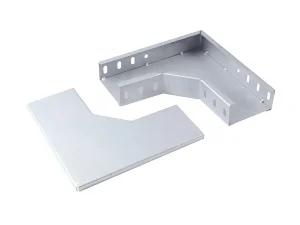
Pre-Galvanized Elbow Cable Tray (Po Valley Factory Automation Turn)
Smooth radiused 90-degree horizontal bends that protect low-voltage control and high-voltage power lines from insulation pinching during pulling.
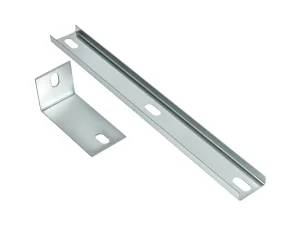
L-Shaped Cantilever Bracket (Wall & Channel Mounting for Italian Plants)
Heavy-gauge cold-formed mounting arms with pre-punched slotted baseplates designed for rapid anchoring into concrete walls or 41x41 strut profiles.
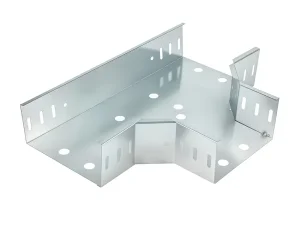
Pre-Galvanized Horizontal TEE (Taranto Industrial Power Routing)
Three-way modular intersection fitting manufactured with reinforced gussets, delivering superior load distribution for primary and secondary feeder lines.
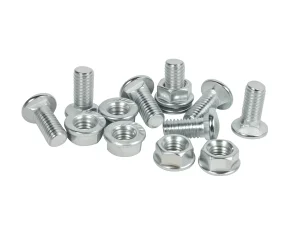
Bridge Frame Screws & Flange Nuts (CEI EN 61537 Grounding Hardware)
Truss-head square-neck carriage bolts featuring serrated flanged locknuts to ensure permanent vibrational retention and positive grounding contact.
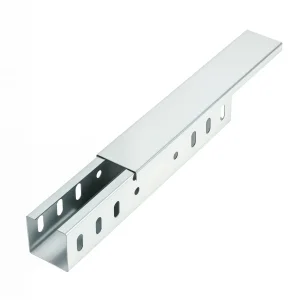
Pre-Galvanized Cable Trunking Series (Commercial Fitout & Cleanrooms)
Solid-bottom enclosed trunking system with tool-free snap-action lids for maximum dust shielding and electromagnetic isolation in sensitive facilities.
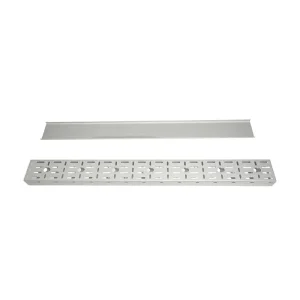
SS316 / 316L Max Perforated Cable Trays (Liguria Marine & Offshore)
Ultra-corrosion-resistant austenitic stainless steel trays with optimized perforation geometry for thermal heat dissipation and rapid marine cable tying.
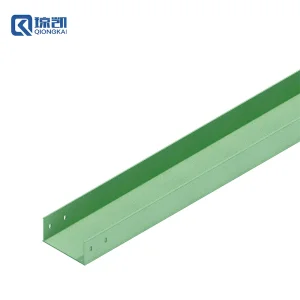
FRP Cable Trunking Trough Channel 400×200 (Sicily Chemical Corrosive Spec)
Non-conductive pultruded fiberglass trough channels impervious to acid fumes, hydrogen sulfide gas, and heavy coastal moisture in chemical plants.
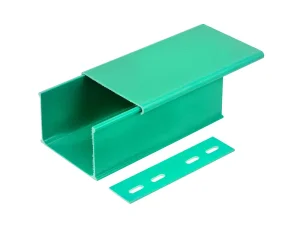
FRP Cable Tray 100mm Series (Venice Lagoon & Water Treatment Spec)
Lightweight, fire-retardant (ASTM E84 Class 1) structural composite cable tray engineered for wastewater aeration galleries and damp coastal utility tunnels.
Frequently Asked Technical & Procurement Questions
Direct answers to the structural, metallurgic, and supply chain queries raised by European engineering directors, project estimators, and site supervisors.
What specific certificates does Qiongkai provide for cable tray accessories entering the Italian market?
Every commercial consignment exported to Italy and the wider European Union is accompanied by a full technical compliance dossier. This includes CE declaration of conformity under the Low Voltage Directive (LVD 2014/35/EU), EN 10204 Type 3.1 Mill Test Certificates verifying raw material mechanical and chemical properties, third-party test reports validating structural Safe Working Load (SWL) and electrical continuity under CEI EN 61537, and coating thickness reports (ISO 2178) confirming compliance with ISO 1461 for hot-dip galvanized parts or EN 10346 for pre-galvanized components.
How do Qiongkai connection plates ensure electrical continuity across tray joints without copper bonding jumpers?
Our pre-galvanized and post-galvanized splice plates are engineered with serrated friction ribs and matched with Class 8.8 serrated-flange locking carriage bolts. When tightened to the recommended torque (typically 25–30 Nm for M8 hardware), the hardened serrations pierce the superficial zinc oxide patina, creating direct metal-to-metal contact with the underlying steel substrate. Under CEI EN 61537 testing, our joint impedance consistently registers below 15 mΩ, well within the standard’s stringent 50 mΩ maximum threshold.
Can Qiongkai customize accessory hole patterns and dimensions to match existing Italian tray brands?
Yes. Many renovation and expansion projects in Italy require connecting to existing raceways from brands like Legrand, Vergokan, or Gewiss. Utilizing our in-house CNC tool and die shop, we fabricate custom universal adaptor plates, transition reducers, and offset bends engineered to exact hole pitches (such as 25x7mm or 30x9mm European slots) and side-wall return flange heights (50mm, 60mm, 75mm, 100mm), ensuring seamless on-site mechanical mating without drilling or hot-cutting.
What is the difference in longevity between Pre-Galvanized (PG) and Hot-Dip Galvanized (HDG) accessories in Italy?
Pre-galvanized accessories (EN 10346 Z275) feature a smooth, automated mill-applied coating of approximately 20 µm. They are optimized for dry indoor architectural environments (ISO 12944 C1/C2), providing 20–30 years of protection in enclosed data centers and commercial buildings. For industrial plants, outdoor solar farms, coastal facilities, or humid environments like the Po Valley (C3/C4/C5), batch Hot-Dip Galvanized (HDG) after fabrication (ISO 1461) is required. The molten zinc bath creates an alloyed metallurgical bond with a thickness of 65 to 85+ µm, delivering over 40 years of maintenance-free service even when exposed to salt-laden sea air or chemical fumes.
How are cable tray accessories packed to ensure zero transit damage during sea freight to Genoa or Trieste?
Export packaging is structured around logistics density and moisture protection. Fittings such as flat elbows, tees, and covers are nested into rigid bundles, secured with heavy-duty polyester or steel banding, corner-protected with recycled composite angle boards, and vacuum-sealed within heavy-gauge polyethylene film containing industrial silica-gel desiccants to prevent humid condensation ("white rust") during the 25–35 day ocean voyage. The bundles are loaded on heat-treated, fumigated ISPM-15 compliant hardwood or steel pallets, dimensioned for automated forklift unloading into Italian logistics hubs.
What are the lead times for full container load (FCL) shipments from Shanghai to Italian ports?
Standard accessory orders (splice plates, brackets, covers, screws) have a manufacturing lead time of 15 to 20 calendar days from drawing sign-off. Ocean transit time from Shanghai / Ningbo to main Italian ports (Genoa, La Spezia, Naples, Trieste) typically ranges between 28 and 38 days depending on the selected shipping line and route. For urgent construction site schedules, we maintain an inventory of standard connection hardware ready for immediate consolidation.
Fast Technical Proposal · Custom Tooling Available · Comprehensive 3.1 Mill Certs Included