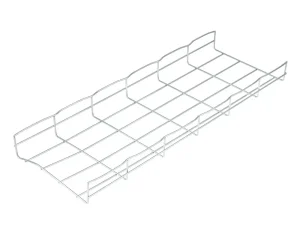
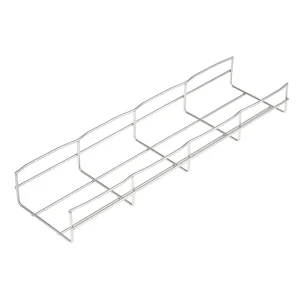
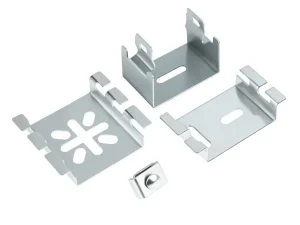
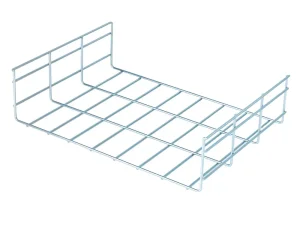
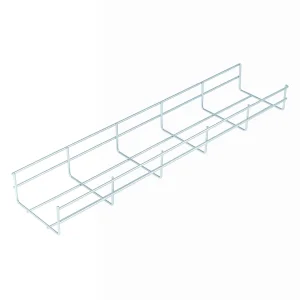
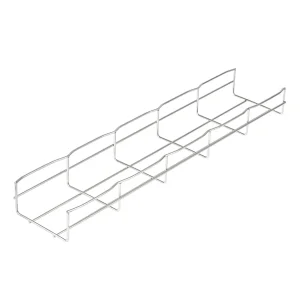
Boston Pre-Galvanized Grid & Wire Mesh Tray Series
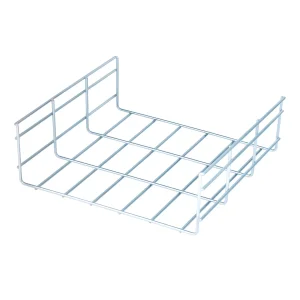
ASTM A653 zinc coating (15-20µm). Optimized for indoor commercial ceilings and high-density telecom rooms.
Explore Specification & DrawingsHeavy-gauge welded grid pathways engineered to comply with Massachusetts Electrical Code (527 CMR 12.00 / NEC 392) for data, life science, and automated manufacturing installations.
ASTM A653 zinc coating (15-20µm). Optimized for indoor commercial ceilings and high-density telecom rooms.
Explore Specification & Drawings
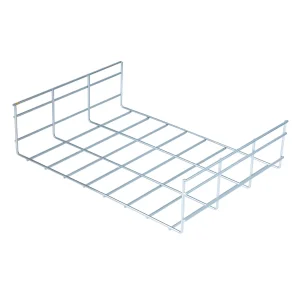
Electropolished finish. Wash-down resistant for BSL-2/3 biotech laboratories and aseptic pharmaceutical manufacturing.
Explore Specification & Drawings
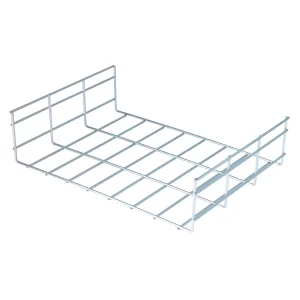
Tool-free quick-splice clips, hold-down clamps, and grounding lugs tested for Zone 2A seismic resistance across New England.
Explore Specification & Drawings
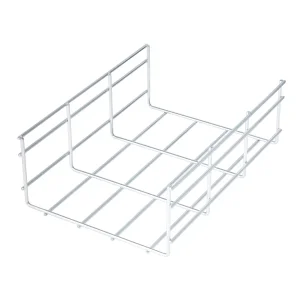
5.0mm structural wire diameter. Engineered for high-density fiber-optic trunks and Cat6A network backbones.
Explore Specification & DrawingsThe Greater Boston metropolitan area presents an exceptionally demanding convergence of structural retrofits, cutting-edge biomedical facilities, and extreme coastal weather patterns. From the densely packed academic and commercial laboratories of Cambridge's Kendall Square to the rapid-expansion tech belt along Route 128 (I-95) and the Seaport Innovation District, electrical contractors cannot afford standard, off-the-shelf cable raceway compromises.
A key regional hurdle is retrofitting historic 19th-century industrial brick-and-beam mills in Somerville, South Boston, and Waltham into high-capacity clean technology incubators. These historic structures feature restrictive ceiling clearances, irregular structural bay spans, and limited dead-load capacities. Conventional heavy ladder trays or rigid steel conduit assemblies add excessive structural dead-weight and demand labor-intensive field threading that inflates project labor budgets in a region marked by premier electrical union wage structures.
In high-density Boston urban core construction, labor represents over 60% of total electrical pathway costs. Compared with rigid enclosed conduit or proprietary strut-hung raceways, Qiongkai welded wire mesh trays provide:
*Validated through field benchmarks across 120,000 sq ft R&D fit-outs along Route 128 (Waltham/Burlington submarkets).
Modern electrical distribution requires an architectural balance between electrical performance, thermal dissipation, life-cycle carbon footprints, and continuous cable containment integrity.
The AI revolution has elevated data center rack power densities from 8 kW to over 45 kW per enclosure. Dense copper power conduits induce severe mutual heating when bundled in closed channels. Our open-mesh wire geometry delivers 100% free-air ventilation, preventing thermal cable derating under NEC Section 310.15(C)(1) and driving down cooling energy loads (PUE).
Kendall Square and Greater Boston life science hubs require strict compliance with cGMP and ISO 14644 cleanroom classifications. Solid-bottom trays collect biological fallout, airborne particulate, and wash-down condensate. Our precision electropolished stainless steel basket trays eliminate horizontal dead-zones, preventing microbial growth and enabling rapid wipe-downs.
Automated fulfillment centers near Logan International Airport and Worcester rail logistics yards utilize high-vibration robotic sorting grids and conveyor pathways. Qiongkai wire mesh systems incorporate cold-drawn carbon wire with cold-resistance-welded transverse junctions, withstanding harmonic cyclic resonance without joint shear failure.
Understanding micro-metallurgical phenomena is paramount when designing cable raceways suspended directly above pressurized raised floors and open-frame server racks.
| Material / Finish Grade | Yield Strength (Mpa) | Corrosion Resistance | Zinc Whisker Risk | Optimal Boston Project Environment |
|---|---|---|---|---|
| Pre-Galvanized (PG) Carbon Steel ASTM A653 / Continuous Mill Coil |
≥ 345 MPa | Indoor Commercial / Low Humidity | Low-to-Moderate | Commercial Office Tenant Fit-Outs (Back Bay, Financial District) |
| Hot-Dip Galvanized (HDG) Post-Weld ASTM A123 / ISO 1461 (60-85µm) |
≥ 380 MPa | Exceptional (Industrial & Coastal Salt Air) | Controlled (Not for Data Subfloor) | Harborside Infrastructure, Logan Airport, Rooftop HVAC Mechanical Trays |
| Electropolished Stainless Steel 304 AISI 304 / 18-8 Austenitic |
≥ 515 MPa | High Chemical & Moisture Resistance | Zero Risk (Whiskers Impossible) | Food & Beverage Processing, Educational Chemistry R&D (Cambridge) |
| Marine-Grade Stainless Steel 316L AISI 316L (2-3% Molybdenum) |
≥ 485 MPa | Superior (Chloride, Acid & Marine Atmosphere) | Zero Risk (Whiskers Impossible) | Aseptic Biopharma Cleanrooms, Subsea Interconnect Terminals, Offshore Wind |
| Architectural Polymer Powder-Coated Thermoset Polyester over PG / EG |
≥ 345 MPa | Enhanced Scratch & Dielectric Insulation | Encapsulated (Zero Flaking) | Hyperscale Colocations, Telecommunications Pathways, High-Visibility Architectural Retail |
Electrical specification submittals in the Commonwealth of Massachusetts face intense scrutiny by local municipal electrical inspectors (ISD). Shanghai Qiongkai manufactures cable tray assemblies engineered to satisfy both nationwide standards and state-specific statutory requirements without requiring expensive job-site modifications.
Under NEC Article 392.60, Qiongkai wire mesh cable trays are UL Classified as an Equipment Grounding Conductor. Our engineered splice plates maintain electrical ground path continuity below the strict 0.00033 ohms/meter boundary, eliminating the need for independent continuous bare copper ground conductors when coupled with certified bonding hardware.
The Massachusetts State Building Code (780 CMR) enforces seismic design category (SDC) B and C considerations across the Boston sedimentary basin. Our engineering group supplies comprehensive seismic sway brace calculations, engineered trapeze strut kits, and rigid seismic bracket assemblies capable of absorbing lateral seismic accelerations without pathway disconnection.
Tailored engineering implementations delivering proven reliability across specialized commercial, institutional, and infrastructure installations throughout Massachusetts.
Challenge: Corrosive vapor decontamination cycles utilizing vaporized hydrogen peroxide (VHP) alongside dense overhead laboratory HVAC, medical gas piping, and power feeds in an 8-story Cambridge research lab.
Solution: Custom-specified electropolished SS316L wire basket trays suspended via center-hung stainless threaded rods. Zero particulate collection surfaces with 100% resistance to oxidative chemical washings.
Challenge: Overhead multi-tier cable distribution for 100G/400G OM5 fiber trunks and high-density shielded twisted-pair (STP) copper bundles prone to alien crosstalk and macro-bend signal degradation.
Solution: Powder-coated black pre-galvanized wire mesh trays with factory-formed radiused waterfall dropouts and bottom protective liners, preserving certified Category 6A/8 transmission performance.
Challenge: Heavy vehicular exhaust particulates, sub-zero oceanic drafts, and constant mechanical vibration from ground support transport vehicles on exposed baggage conveyance levels.
Solution: Heavy-gauge post-weld Hot-Dip Galvanized (HDG) wire mesh trays fitted with double-bolted structural splice plates and vibration-dampening strut brackets for maintenance-free 25-year service life.
Advancing containment sustainability, smart facility monitoring, and automated manufacturing precision through 2030.
Full integration of Revit and IFC parametric 3D models with true-scale wire mesh physical geometries. Enables Boston MEP engineering firms to conduct automated virtual clash detection against complex fire protection sprinkler piping and variable air volume (VAV) duct runs prior to job-site container delivery.
Boston's Building Emissions Reduction and Disclosure Ordinance (BERDO 2.0) requires deep embodied carbon accounting. Our steel wire is synthesized utilizing up to 85% recycled electric arc furnace (EAF) feedstock, accompanied by ISO 14025 verified Environmental Product Declarations (EPDs).
Piloting active cable pathway monitoring systems featuring integrated distributed temperature sensing (DTS) fiber strands clipped directly into the wire mesh matrix. Provides 24/7 localized infrared hotspot alerting directly to facility SCADA platforms before cable insulation degradation occurs.
Complete sizing versatility from narrow telecom secondary drops to wide industrial feeder baskets. Manufactured under rigid ISO 9001 tolerance standards.
Compact footprint for tight ceiling plenum drops, security camera cabling, and peripheral sensors.
Explore Specification & Drawings
The industry standard for primary office communication backbones and commercial data drops.
Explore Specification & Drawings
Engineered cross-wire geometry carrying dense power distribution and high-voltage building feeds.
Explore Specification & Drawings
Optimized wire spacing offering maximum rigidity with minimal weight for overhead server rack mounting.
Explore Specification & Drawings
Massive cable carrying volume for central telecom entrance facilities (MPOE) and colocation distribution halls.
Explore Specification & Drawings
50mm sidewall engineered specifically for shallow subfloor tiles and restricted ceiling interstitial spaces.
Explore Specification & Drawings
Electropolished stainless steel offering superior salt air and acid-vapor corrosion resistance.
Explore Specification & Drawings
Deep-fill containment designed for GMP pharmaceutical cleanrooms and aseptic research environments.
Explore Specification & DrawingsStraightforward, technically defensible answers tailored for MEP consulting engineers, commercial estimators, and electrical project managers.
Under Massachusetts 527 CMR 12.00 / NEC Article 392.60, wire mesh trays can be utilized as an Equipment Grounding Conductor (EGC) when they are UL Classified and properly identified with the cross-sectional area of metal. Shanghai Qiongkai wire mesh systems feature UL Classification (E363842). When bonded using our certified mechanical splice washers and tightened to the specified torque rating (18-22 ft-lbs), electrical continuity is preserved across the raceway without necessitating an auxiliary external green-insulated ground jumper wire along straight horizontal runs.
Zinc whiskers are conductive microscopic crystalline zinc filaments that precipitate from electro-plated (electro-galvanized) surfaces under internal molecular stress over 5 to 10 years. In data centers, these break free, enter the HVAC airflow, and cause catastrophic micro-circuit shorts inside server blades. For critical mission computing halls in Marlborough and Waltham, we recommend either powder-coated pre-galvanized steel (which completely encapsulates the zinc boundary layer) or austenitic stainless steel (SS304/SS316), which contains zero zinc and definitively eliminates whisker risks.
For installations situated within 5 miles of Boston Harbor, East Boston, or Quincy, atmospheric airborne salt (chlorides) rapidly degrades electro-plated zinc finishes (5-10µm thickness), often causing red rust within 18 to 24 months. For unconditioned spaces or rooftop mechanical equipment penthouses, engineers must specify Hot-Dip Galvanized post-weld (ASTM A123, 65-85µm coating) or Marine-Grade Stainless Steel 316L. 316L contains 2-3% Molybdenum, providing crucial resistance to chloride-induced pitting and crevice corrosion.

Yes. One of the primary advantages of wire mesh over rigid ladder or channel trays is field fabricability. Horizontal bends, tees, crosses, and elevation reducers are fabricated directly on-site by clipping specific bottom and side wire grids with asymmetrical offset bolt cutters, bending the tray to the required radius, and clamping the junction with our quick-splice connectors. All structural load characteristics are maintained in accordance with NEMA VE 1 installation instructions.
Shanghai Qiongkai operates 3 dedicated manufacturing plants spanning 30,000 m² close to the Port of Shanghai. Standard containerized ocean freight to Boston Conley Container Terminal or nearby Port of New York/New Jersey transit hubs averages 24 to 28 sailing days. We maintain container load-optimization protocols (nesting mesh baskets by size) to reduce ocean freight costs by up to 35% compared to pre-assembled ladder systems. For urgent phased projects, partial air-freight hardware deliveries can be coordinated within 5 business days.
Unlike totally enclosed steel trunking or solid-bottom raceways, wire mesh offers an open surface area exceeding 90%. Under NEC 392.80, cables laid in open ventilated wire mesh trays benefit from unimpeded convective air cooling. This significantly reduces mutual heating between adjacent conductors, allowing electrical engineers to avoid costly cable conductor size up-gauging normally mandated by thermal derating correction factors.
Connect directly with our senior application engineering team for bill-of-materials takeoffs, custom fabrication drawings, NEMA load curve validation, and direct-factory pricing for your upcoming Boston metro project.