
Engineered Cable Containment & Structural Strut Systems
Explore our precision-manufactured containment products and heavy-duty channels engineered for continuous mechanical support, seamless bolt-connection integration, and certified anti-corrosion finishes.
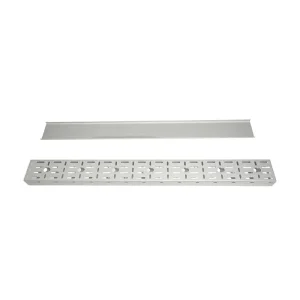
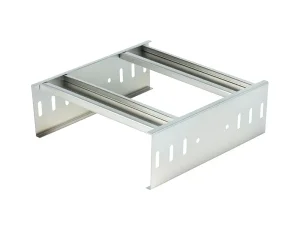
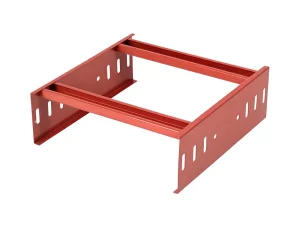
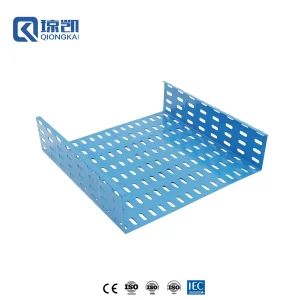
Global Enterprise Procurement Demand: Eliminating Intermediary Risk
When international engineering, procurement, and construction (EPC) conglomerates seek to buy electrical channel strut manufacturers & factories solutions, they confront a bifurcated market. On one side are commercial export traders with high markup and fragmented quality visibility; on the other are authentic original equipment manufacturers (OEMs) possessing dedicated roll-forming mills, in-house metallurgical testing laboratories, and end-to-end quality assurance.
Total Cost of Ownership (TCO) Optimization
Channel strut systems constitute up to 18% of mechanical and electrical support capital expenditure, yet improperly galvanized or dimensionally erratic struts can multiply job-site labor costs by 45%. Shanghai Qiongkai Industry eliminates re-drilling, field welding, and site modifications by providing factory-cut, slotted, and deburred C-channel profiles with strictly controlled inturned serrations that deliver maximum spring-nut grip integrity.
Supply Chain Resilience & Hedging
Global procurement requires stability in raw material pricing and dependable container dispatch. Operating out of the Songjiang Science and Technology City near Shanghai’s deep-water ports (Yangshan and Waigaoqiao), Qiongkai maintains raw coil strategic reserves exceeding 12,000 metric tons across premium structural carbon steels (Q235B, Q355B) and austenitic stainless steels (SS304, SS316/316L).
Dedicated Engineering Interface
Unlike third-party distributors who hand off specifications down an untraceable subcontractor chain, Qiongkai assigns a senior mechanical structural engineer to every enterprise account. We review loading deflection criteria ($L/200, L/360$), calculate moment of inertia ($I_x, I_y$), check dynamic seismic load allowances, and customize slotted geometry per project specifications.
Technical Blueprint: Electrical Channel Strut Profiles & Coatings
Electrical metal framing strut channels are standardized cold-formed steel sections engineered for mounting, bracing, supporting, and connecting lightweight structural and electrical loads. The table below delineates the baseline metallurgical properties, protective finishes, and structural cross-sections manufactured across Qiongkai’s 3 specialized manufacturing campuses.
| Profile Specification | Dimensions (W × H) | Standard Gauges (Thickness) | Yield Strength ($R_e$) | Protective Finish Options | Relevant Industry Standards |
|---|---|---|---|---|---|
| 41×21 Shallow Channel | 41.3 mm × 20.6 mm (1-5/8" × 13/16") | 1.5 mm, 2.0 mm, 2.5 mm (12–16 Ga) | $\ge 235 \text{ to } 355 \text{ MPa}$ | Pre-Galv (PG), HDG, Electro-Galv, Epoxy | BS 6946, ASTM A1011, EN 10346 |
| 41×41 Standard Channel | 41.3 mm × 41.3 mm (1-5/8" × 1-5/8") | 1.5 mm, 2.0 mm, 2.5 mm, 2.7 mm | $\ge 235 \text{ to } 355 \text{ MPa}$ | PG, HDG, SS304, SS316, Powder Coat | NEMA VE-1, ASTM A123, ISO 1461 |
| 41×62 Deep Channel | 41.3 mm × 62.0 mm (1-5/8" × 2-7/16") | 2.0 mm, 2.5 mm (12–14 Ga) | $\ge 355 \text{ MPa}$ | Hot-Dip Galvanized, Pre-Galv, SS316 | MFMA-4, ASTM A653, BS EN 10025 |
| 41×82 Extra-Deep Channel | 41.3 mm × 82.5 mm (1-5/8" × 3-1/4") | 2.5 mm (12 Ga) | $\ge 355 \text{ MPa}$ | Hot-Dip Galvanized (HDG), SS316L | AISC Spec, EN 1993-1-3 (Eurocode 3) |
| 41×82 Back-to-Back (Double) | 41.3 mm × 82.6 mm (Welded Pair) | 2.0 mm, 2.5 mm each profile | $\ge 355 \text{ MPa}$ | Continuous Seam/Spot Welded HDG/SS | NEMA VE-2, AWS D1.1/D1.3 Structural |
| Serrated Anti-Seismic Flange | 41×41 / 41×82 Custom Inturned | 2.0 mm, 2.5 mm CNC Serrated | $\ge 355 \text{ MPa}$ | HDG (≥85μm), Geomet, Fluoropolymer | GB 50981, ASCE 7-22, FM 1950 |
Inturned Lip Geometries & Pull-Out Slip Resistance
The core structural differentiator of an authentic strut manufacturer lies in the accuracy of the inturned flange profile. Qiongkai’s 12 automated cold-roll forming lines utilize a sequential 16-stand progressive roller cluster that shapes steel strip incrementally, eliminating micro-fissuring along the internal radius of the channel.
For seismic-rated applications, the inturned lips undergo continuous CNC serration embossing. These serrations physically interlock with the heat-treated teeth of Qiongkai channel nuts, boosting horizontal slip resistance from a typical 4.5 kN to upwards of 11.2 kN, completely eliminating structural slippage under vibrating or seismic acceleration.
- Inturned Lip Tolerance: Strict $\pm 0.15\text{mm}$ clearance ensures standard spring nuts seat perpendicular without bind.
- Uniform Slot Geometry: CNC slotted configurations (14×28mm, 11×25mm) punched at 50mm centers with zero edge deformation.
- Weld Integrity: Back-to-back channels joined via automated resistance spot-welding at 150mm intervals or continuous robotic TIG.
Corrosion Lifecycle Protection Across Harsh Environments
A channel strut’s operational longevity is determined by its surface passivation. Deploying the wrong coating in humid, coastal, or chemically corrosive industrial spaces causes galvanic degradation and catastrophic structural failure.
Qiongkai controls four specialized anti-corrosion lines in-house or via dedicated industrial hot-dip kettles operating strictly in conformance with ISO 1461 and ASTM A123 standards:
- Hot-Dip Galvanized (HDG): Immersion in 450°C molten zinc bath producing metallurgically bonded iron-zinc alloy layers (≥65 to 85+ μm thickness) for 40+ year life in C3-C4 environments.
- Marine Stainless Steel (SS316/316L): 2–3% molybdenum alloying, fully pickling passivated, resisting pitting in offshore and desalination plants.
- Electrostatic Architectural Coating: Pre-galvanized substrates coated with RAL-specified epoxy or UV-resistant polyester powder coats for cleanrooms and data halls.
Macro Industry Solutions: Mission-Critical Deployment Scenarios
Modern engineering infrastructures require modular MEP (Mechanical, Electrical, and Plumbing) framing that eliminates hazardous on-site hot work, cuts installation schedules, and guarantees compliance with local building safety codes. Here is how Qiongkai channel struts empower four primary global industries.
Hyperscale Data Centers
High-density server halls demand overhead multi-tier trapeze grids supporting fiber raceways, busway trunking, and power cables. Qiongkai supplies color-coded powder-coated 41×41 and 41×62 back-to-back channel struts paired with drop rods, providing deflection limits below 2mm under continuous 350 kg/m dynamic live cabling loads.
Solar Photovoltaic & Renewables
Ground-mount solar trackers and rooftop PV installations depend on rigid strut channels for panel purlin support. Our continuous high-yield pre-galvanized (Z275/Z600) and hot-dip galvanized struts withstand extreme cyclical wind uplifts and corrosive outdoor humidity without torsional twisting, ensuring 25-year structural warranties.
Offshore Oil, Gas & Marine LNG
Operating in aggressive C5-M marine atmospheric environments demands uncompromising material integrity. As proven in our supply to the offshore LNG mega-projects in Qatar, Qiongkai fabricates custom heavy-duty profiled channels in SS316L and pultruded FRP composite structures resistant to airborne chlorides and acidic sour gas.
Civil Transit & Aviation Infrastructure
In high-traffic transport terminals like Shanghai Hongqiao International Airport, fire-retardant and seismic-braced channel supports are mandated by law. Our seismic bracing struts feature certified dynamic load absorption, preserving the integrity of emergency power feeds, life-safety conduits, and ventilation ducts during seismic events.
Technical Roadmap: Next-Generation Smart Framing & Prefabrication
Channel struts are transitioning from static structural components to digitally integrated, modular prefabrication building blocks. Shanghai Qiongkai Industry is pioneering several transformative industry developments.
BIM Level 3 & Digital Twin Libraries
We provide full Revit and AutoCAD MEP parametric BIM model families with pre-calculated moment capacities and load deflection attributes. EPC contractors can import Qiongkai 3D components directly into digital twins to run clash-detection simulations, streamline bill-of-materials generation, and reduce project change-orders to zero.
Off-Site Modular DfMA Prefabrication
By shifting field labor into our controlled Shanghai manufacturing facilities, Qiongkai delivers pre-assembled, factory-kitted trapeze hanger assemblies. Each module arrives tagged, cut to exact span, fitted with brackets, and packaged per construction grid level—slashing on-site MEP installation labor by up to 60%.
Green Steel & Decarbonized Galvanizing
Aligning with Scope 3 corporate decarbonization targets, Qiongkai is introducing EAF (Electric Arc Furnace) low-embodied-carbon steel coils, combined with closed-loop eco-galvanizing lines that recycle 98% of flux chemistry and reduce direct greenhouse gas manufacturing emissions by 34% per metric ton produced.
Localized Engineering Support & Global Compliance Assurance
International procurement is meaningless without guaranteed structural compliance and frictionless port clearance. Shanghai Qiongkai Industry enforces rigid quality gates certified to international cross-border frameworks.
EN 10204 3.1 Certified Mill Testing
Every shipment is accompanied by authenticated chemical analysis and physical tensile elongation certificates traceable to the original steel melt heat number. Spectrometric verification ensures exact carbon, manganese, phosphorus, sulfur, and alloy levels match contract thresholds.
Third-Party Inspection Direct Access
We routinely host independent verification agencies including SGS, Bureau Veritas (BV), and TÜV Rheinland at our Shanghai workshops. Inspectors conduct random coupon tensile tests, dry film thickness (DFT) magnetic gauge readings, and ASTM B117 neutral salt spray chamber verifications.
Seaworthy VCI Export Packaging
To eliminate white rust (wet storage stain) during multi-week ocean transit through tropical equatorial zones, all channel strut bundles receive automated plastic stretch wrapping with volatile corrosion inhibitor (VCI) desiccants, heavy-gauge steel banding, and heavy ISPM-15 fumigated timber skids.
Frequently Asked Technical Questions: Purchasing Electrical Strut
Direct answers to the structural, metallurgical, and commercial inquiries raised by EPC procurement directors and consulting engineers before issuing a purchase order.
A 12-gauge channel (nominal thickness 2.5 mm) offers an approximate 35% higher section modulus ($S_x$) and moment of inertia ($I_x$) compared to a 14-gauge channel (nominal thickness 2.0 mm). On a standard 1,500 mm span with a center point load, a 12-gauge standard carbon steel strut safely accommodates approximately 4.8 kN of load before reaching an $L/200$ deflection limit, whereas a 14-gauge channel reaches maximum allowable deflection at approximately 3.2 kN.
Slip resistance is the force required to slide a tightened channel nut horizontally along the inside flanges of the strut channel. In high-vibration environments (such as near industrial pumps, chiller rooms, or seismic sway zones), smooth inturned lips rely purely on friction and can slip under 3.5 to 5.0 kN of lateral shear. Qiongkai's CNC roll-embossed serrations bite into the channel nut's grooves, establishing a mechanical interlock that raises slip resistance above 11.0 kN.
Pre-galvanized (PG) channels are roll-formed from steel coil that has been continuously hot-dipped at the mill, delivering a smooth, uniform zinc coating between 14 and 20 microns (Z140–Z275). It is engineered strictly for dry, climate-controlled indoor spaces. Hot-dip galvanizing after fabrication (HDG) immerses the fully cut, punched, and deburred channel into a molten zinc bath at 450°C, yielding an alloy coating of 65 to 85+ microns that hermetically seals all punched slot edges, making it essential for outdoor, humid, and industrial environments.
Unlike small fabricators who use intermittent manual arc tacking, Qiongkai utilizes automated resistance spot welding or continuous robotic longitudinal fillet seams. Spot welds are applied at uniform 150 mm spacing along the back spine. This produces a structural composite section that complies with AWS D1.1/D1.3 structural steel welding codes, ensuring the joined channels act as a single, unified beam under high bending stresses.
Yes. With 12 automated roll-forming lines integrated with high-speed hydraulic CNC punching systems, we routinely produce custom slot dimensions (e.g., 14×28mm, 11×25mm, or circular 13mm holes) at custom intervals. While our standard export lengths are 3.0 meters (10 ft) and 6.0 meters (20 ft) to maximize 20GP/40HQ shipping container cube utilization, we can precision-cut custom lengths from 300 mm to 8.0 meters to meet your specific bill of materials.
Our standard production turnaround for high-volume orders (e.g., 2 to 5 full 40HQ containers) is 15 to 20 working days from drawing sign-off and raw coil allocation. Because our three Shanghai factory facilities maintain continuous production lines and a rolling buffer of 12,000+ tons of steel coil stock, we can accelerate emergency fast-track dispatches for critical project path deadlines.
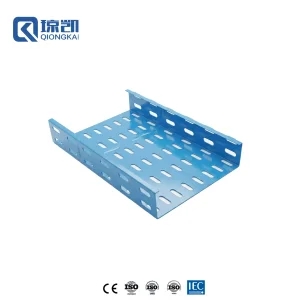
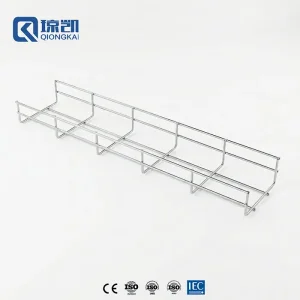
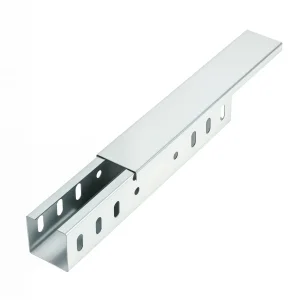
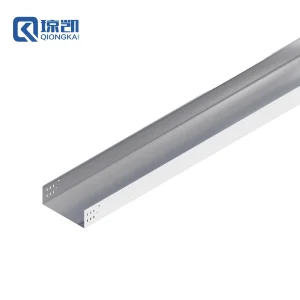
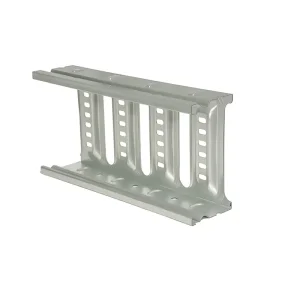
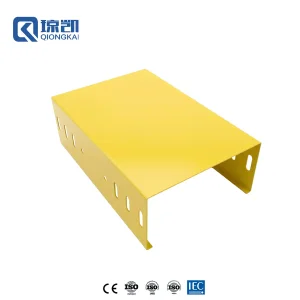
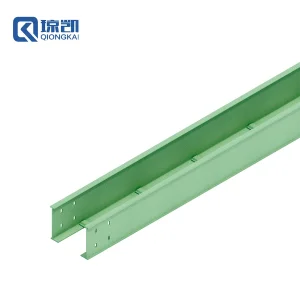
Engineered Cable Trunking, Mesh Trays & Specialized Ladders
Explore our complementary cable management profiles, heavy-duty perforated ladders, and ribbed trunking systems designed for complete mechanical integration with our electrical channel strut portfolio.
Ready to Optimize Your Infrastructure Strut Procurement?
Connect directly with Shanghai Qiongkai Industry's senior structural application engineering team. Send your Bill of Quantities (BOQ), CAD elevation drawings, or project specification sheets to receive a comprehensive technical proposal, structural load calculations, and competitive factory-direct commercial terms within 24 hours.