
High-Spec Cable Support Products & Certified Assemblies
Engineered structural profiles, reinforcement rib designs, and earthquake-rated accessories manufactured to strict dimensional tolerances from our automated Shanghai production base.
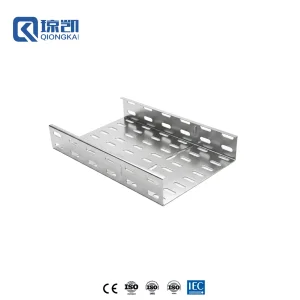
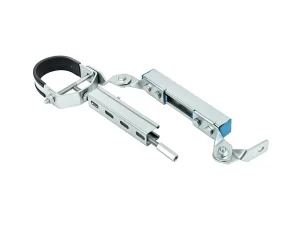
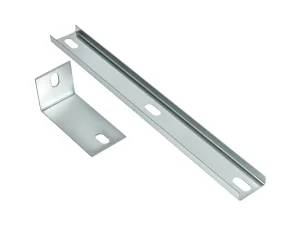
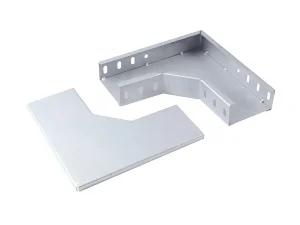
Engineering Physics: The Decisive Role of Sheet Thickness
Why sheet thickness (gauge) is the principal determinant of structural load capacity, deflection control, seismic endurance, and corrosion allowances in heavy industrial plant engineering.
Flexural Rigidity & Moment of Inertia
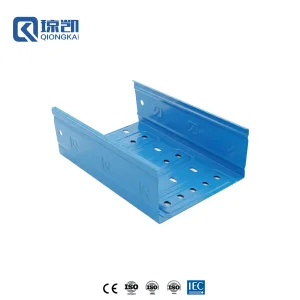
The flexural strength of a cable tray side rail is governed by the moment of inertia (Ix) and elastic section modulus (Z). A nominal increase from 1.5 mm to 2.5 mm wall thickness achieves an exponential increase in section modulus, reducing mid-span elastic deflection under heavy armored power cable clusters by up to 58%, far exceeding statutory deflection limits (span/200).
Sacrificial Zinc & Thickness Allowance
In aggressive C4 and C5 coastal/marine chemical environments, hot-dip galvanizing provides sacrificial cathodic defense. However, prolonged exposure causes gradual zinc exhaustion. Specifying heavy duty wall thickness (2.0 mm to 3.0 mm) ensures a vital sacrificial steel boundary layer that prevents structural rupture even after micro-corrosion penetrations.
Dynamic Wind & Seismic Bracing
Thin-walled trays undergo local flange buckling during seismic shear or dynamic wind events on outdoor piperacks. Heavy gauge material (≥ 2.0 mm) combined with ribbed embossing retains longitudinal web flatness, absorbs high cyclic peak loads, and meets rigid seismic qualification standards across international seismic zones.
Heavy Duty Thickness vs. Support Span Loading Analysis
Standardized mechanical parameters compliant with IEC 61537:2021, NEMA VE 1-2017, and BS EN 61537 engineering directives.
| Nominal Width (mm) | Side Rail Height (mm) | Recommended Thickness | Working Load (kg/m) @ 2.0m Span | Working Load (kg/m) @ 3.0m Span | Recommended Applications |
|---|---|---|---|---|---|
| 100 mm to 200 mm | 50 mm - 100 mm | 1.5 mm - 1.8 mm | 85 - 110 kg/m | 55 - 70 kg/m | Instrumentation, control cables, cleanrooms, data distribution |
| 300 mm to 400 mm | 100 mm - 150 mm | 2.0 mm | 160 - 210 kg/m | 110 - 145 kg/m | Medium voltage power risers, manufacturing utilities, HVAC plant rooms |
| 500 mm to 600 mm | 100 mm - 150 mm | 2.0 mm - 2.5 mm | 230 - 290 kg/m | 155 - 200 kg/m | Data center server power spines, substations, chemical processing lines |
| 800 mm to 1000 mm | 150 mm - 200 mm | 2.5 mm - 3.0 mm | 350 - 450 kg/m | 240 - 310 kg/m | Heavy industrial piperacks, thermal power stations, LNG export trains |
| Reinforced Rib Molded | 100 mm - 200 mm | 1.8 mm + Stiffener | Equiv. to 2.2 mm Plain | Equiv. to 2.2 mm Plain | Lightweight high-load projects, cost-optimized EPC greenfield setups |
* Data based on cold-formed low carbon steel with yield strength Re ≥ 235 MPa. Total working load incorporates safe working load (SWL) safety factor of 1.5 in accordance with IEC 61537 Class C/D deflection testing criteria.
Worldwide Industrial Evolution & Infrastructure Demand
Across the globe, electrical grid modernization, massive AI hyperscale data facilities, battery gigafactories, and hydrogen/LNG energy hubs are placing unprecedented structural demands on cable management systems.
Hyperscale AI & Cloud Data Centers
With compute clusters consuming tens of megawatts per hall, copper power busways and massive bundles of high-density fiber/copper cabling require rigid ladder and wire-mesh tray networks. Trays with inadequate side rail thickness will sag, impinging cooling airflow and risking cable sheathing degradation from point loading.
Offshore LNG & Petrochemical Megaprojects
From Ras Laffan, Qatar to the North Sea, ambient salinity combined with airborne chemical vapors severely accelerates pitting corrosion. Tier-1 global EPCs mandate heavy wall thickness (2.5 mm – 3.0 mm) in HDG (ISO 1461, ≥ 85 μm) or Stainless Steel 316L to safeguard multimillion-dollar critical safety feeds.
Renewable Utility Parks & Battery Storage
Photovoltaic utility farms and battery energy storage systems (BESS) require cable containment systems exposed to 30+ years of severe UV radiation, wide thermal cycling (-30°C to +65°C), and desert sand abrasion. Under-specifying steel thickness causes thermal buckling and splice-joint tear out under gusty crosswinds.
The Shanghai Industrial Cluster: Precision, Velocity, & TCO
How Shanghai Qiongkai Industry Co., Ltd. capitalizes on fully integrated manufacturing, cutting-edge automated metallurgy, and strategic maritime logistics to deliver unmatched value to international EPC contractors.
Continuous Automated CNC Roll-Forming
Unlike regional workshops that bend cold steel on manual press brakes resulting in internal stress fractures, Qiongkai utilizes continuous multi-pass roll-forming lines. This ensures perfectly uniform wall thickness along 6-meter tray sections with zero edge burrs, consistent curl diameters, and uniform yield stress distribution.
Direct Baosteel Raw Coil Procurement
Situated in the Yangtze River Delta industrial belt, Qiongkai procures premium raw hot-rolled and pre-galvanized coils directly from prime domestic steel mills (such as Baosteel). This direct raw-material supply chain shields our international clients from spot-market price volatility while guaranteeing uniform material thickness tolerances (±0.05 mm).
Strategic Deep-Water Port Proximity
Our 3 manufacturing facilities in Songjiang, Shanghai are located within an hour's drayage from Shanghai Yangshan Deep-Water Port and Waigaoqiao Port. This geographic proximity enables rapid container consolidation, lower inland transit overheads, and predictable weekly sailings across Europe, the Middle East, Southeast Asia, and the Americas.
Engineering Solutions Deployed in Harsh Field Conditions
Demonstrated performance across international landmark projects where cable tray thickness and material finishing met zero-failure criteria.
Shanghai Hongqiao International Airport
Deployment: Heavy duty CT series cable trunking and strut systems throughout passenger transit terminals, baggage handling zones, and underground service utility tunnels.
Engineering Challenge: High vibration induced by low-frequency aircraft taxiing and continuous passenger shuttle operations required custom 2.0 mm heavy-gauge trunking with specialized anti-loosening splice configurations to prevent resonance fatigue.
Qatar & Thailand Coastal LNG Infrastructure
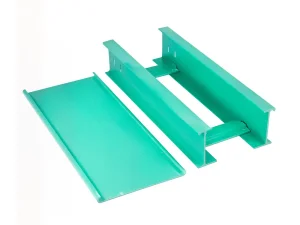
Deployment: Custom heavy duty pultruded FRP fiberglass ladder cable trays combined with 316L stainless steel hardware.
Engineering Challenge: Extreme surface temperatures exceeding 55°C combined with continuous chloride salt spray. The structural pultrusion thickness was boosted to 4.5 mm with vinylester resin matrices to achieve fire retardancy (ASTM E84 Class 1) and zero electrolytic galvanic corrosion.
Paraguay Agri-Industrial Megasite
Deployment: Cost-optimized reinforced molded pre-galvanized cable tray series with rib stiffeners.
Engineering Challenge: Extensive physical footprint requiring thousands of linear meters within strict capital expenditure boundaries. By adopting our patented continuous longitudinal reinforcing ribs, sheet thickness was optimized from 2.0 mm to 1.6 mm while maintaining exact structural load ratings, generating substantial freight and raw material savings.
Mitigating Procurement Risk: Overcoming Real-World Sourcing Hurdles
Essential guidance for procurement directors, quantity surveyors, and project engineers to avoid hidden costs and project delays.
1. Avoiding the "Under-Gauge" Trap
Unscrupulous intermediaries frequently quote 2.0 mm thickness based on hot-dip galvanized post-treatment dimensions rather than original black sheet base metal thickness (BMT). A 1.5 mm core with 100 μm of uneven zinc might measure 1.7 mm, masking a critical 25% structural deficit. Qiongkai provides traceable Mill Test Certificates (MTC) certifying exact Base Metal Thickness before hot dipping.
2. Flange Distortion During Galvanization
Thin cable trays (< 1.5 mm) submerged into molten zinc kettles at 450°C suffer violent thermal warping and twisting due to asymmetrical release of cold-rolling residual stresses. By utilizing minimum 2.0 mm steel with optimized perforation geometry and precise stress-relieving rungs, Qiongkai trays emerge laser-straight, ensuring rapid modular bolt-up on site without hydraulic re-straightening.
3. Complete Coordinated Hardware Systems
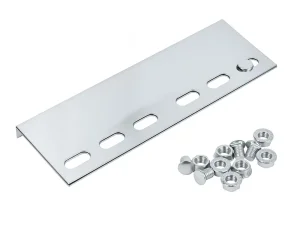
A heavy duty cable tray is only as strong as its connections. EPC contractors face enormous site delays when trays are sourced from one vendor and splice plates, expansion joints, and strut channels from another. Qiongkai designs and packs the complete load-matched package: from 41x82 back-to-back channels down to calibrated M10 flange bolts, guaranteeing seamless installation and structural continuity.
Engineering Inquiries: Cable Tray Thickness & Procurement
In-depth answers to common technical queries raised by consulting engineers, EPC contractors, and global supply managers.
What is the difference between Base Metal Thickness (BMT) and Total Coated Thickness (TCT)?
How do I determine the appropriate cable tray thickness for an outdoor industrial installation?
- Cable Load Density (kg/m): The cumulative weight of power and control conductors filling the tray cross-section.
- Support Span (m): The spacing between cantilever brackets or trapeze hangers (typically 1.5 m, 2.0 m, 3.0 m, or 6.0 m).
- Environmental Severity (ISO 12944): Corrosivity categories (C1 to C5-M). Higher corrosion zones demand extra sacrificial steel gauge allowance.
- Dynamic Environmental Loads: Anticipated wind velocities, ice accretion, and site-specific seismic ground acceleration factors.
Why does hot-dip galvanizing sometimes cause warping in thinner trays, and how does Qiongkai prevent it?
- Utilizing high-tensile structural steel grades with strictly controlled silicon and phosphorus content (Sandelin curve compliance).
- Employing multi-stage hydraulic stamping with balanced hole geometry that equalizes thermal expansion forces.
- Standardizing heavy-duty minimum 2.0 mm side rail profiles for components destined for hot-dip galvanizing, ensuring straightness within ±1.5 mm per 3-meter section.
Can reinforcing ribs substitute for thicker steel sheet to reduce project cost?
What international testing standards and third-party certifications apply to your cable trays?
- IEC 61537: Cable management – Cable tray systems and cable ladder systems (Deflection, Safe Working Load SWL, electrical continuity, and flame retardance).
- NEMA VE 1 / CSA C22.2 No. 126.1: Metal Cable Tray Systems (Structural loading classes 8A through 20C).
- ISO 1461 / ASTM A123: Standard specification for zinc (hot-dip galvanized) coatings on iron and steel articles.
- UL 568 & CE Marking: Meeting global electrical safety, grounding bonding, and structural CE compliance. Factory audits and EN 10204 3.1 material test certs are supplied on request.
Integrated Systems, Channels & High-Capacity Trays
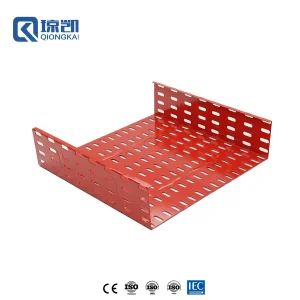
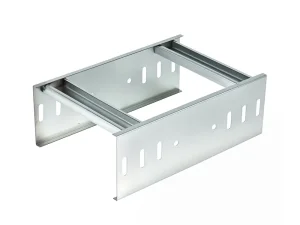
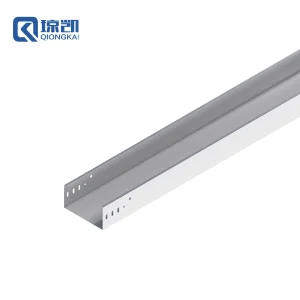
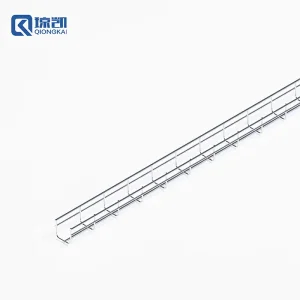
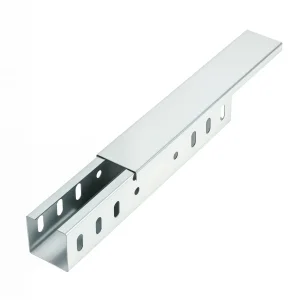
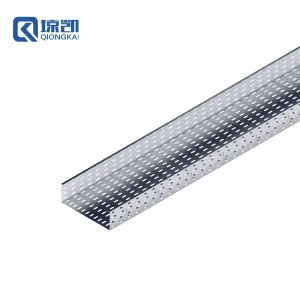
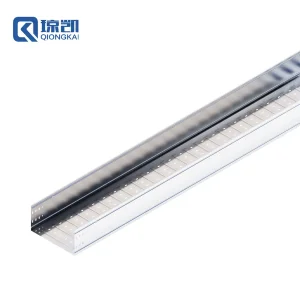
Explore our complete heavy-duty collection: powder-coated identify runs, wire-mesh baskets, stainless steel ladders, and reinforced pre-galvanized channels.
Request Certified Load Calculations & Direct Factory Quotation
Partner with Shanghai Qiongkai Industry Co., Ltd. for project-specific engineering analysis, BOQ bill-of-materials optimization, custom gauge profiling, and rapid port dispatch. Direct factory technical support from consultation to final delivery.