
Engineered Cable Routing Product Lineup
Explore our precision-fabricated cable trays, baskets, and channel solutions. Certified compliant with NEMA VE 1 and IEC 61537 standards, with comprehensive physical image verification and full mill test traceability.
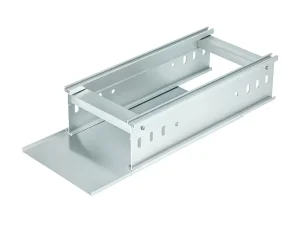
Pre Galvanized Ladder Type Cable Tray GI & HDG Customizable
View Specifications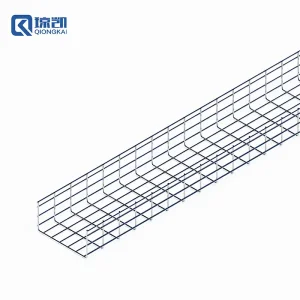
GI Galvanized Precision Wire Mesh Basket Tray 300×150 mm
View Specifications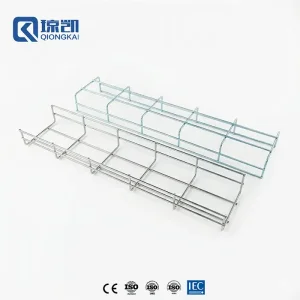
Electro Galvanized Carbon Steel & SS304/316 Basket Tray 100×50
View Specifications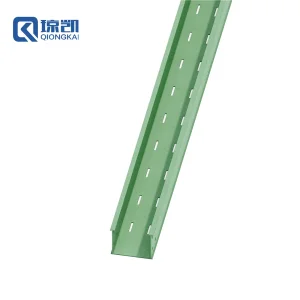
Wholesale FRP / GRP Perforated Cable Tray 200×100 Industrial
View Specifications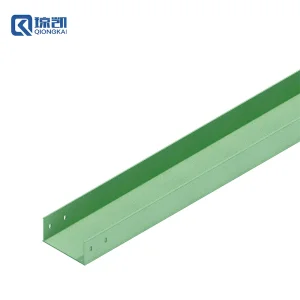
FRP Cable Trunking Solid Trough Channel 400×200 Corrosive Duty
View Specifications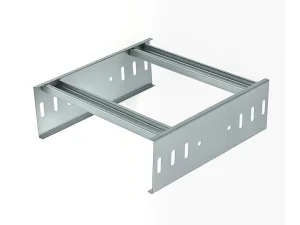
Pre-Galvanized Lightweight High-Load Industrial Cable Ladder
View Specifications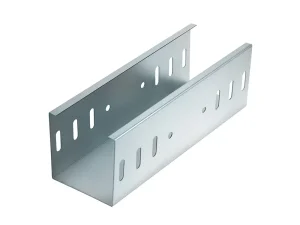
Wholesale Pre-Galvanized Enclosed Cable Trunking Duct System
View Specifications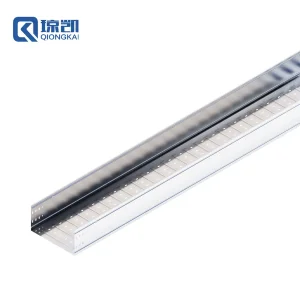
Heavy Duty Reinforced Molded Cable Tray Reduced Perforation 400×200
View SpecificationsThe Global Commercial Reality of Perforated Cable Management
Understanding why international EPCs, MEP engineering contractors, and panel builders search specifically for visual manufacturer evidence before issuing tenders or procuring cable containment structures.
Thermal Dissipation & Ampacity Retention
Perforated cable trays provide a critical balance between physical cable defense and thermodynamics. According to IEC 60364-5-52, running heavy power conductors in fully enclosed trunking triggers significant current derating factors (often lowering ampacity by 18% to 25%). Our calibrated slot perforation patterns deliver up to 32% free open area ventilation, preventing heat accumulation while resisting physical impact and localized deflection.
Search Intent: Why "Images" Dictate Quality
Procurement engineers searching for perforated cable tray images require unambiguous visual confirmation of tooling quality. High-resolution production imagery reveals whether perforation edges feature rounded, deburred hems that protect XLPE jackets during high-tension cable pulling, verifies the structural reinforcing rib profile along the tray base, and confirms uniform crystalline zinc spangling from hot-dip galvanizing baths.
Mitigating Premature Structural Failures
On heavy industrial construction sites, inadequate lateral stiffness causes tray buckling under wind shear, seismic shifting, or unexpected cable overload. Our molded return-flange geometry and heavy-gauge sidewalls ensure strict compliance with NEMA VE 1 deflection limits (span/200), ensuring that containment systems installed in complex facilities endure 25+ years without maintenance downtime.
China Manufacturing Scale: Precision, Velocity & Economy
How Shanghai Qiongkai Industry leverages upstream steel integration, automated roll-forming, and deep-water container logistics to solve the supply chain bottlenecks of global infrastructure projects.
Continuous Progressive Roll-Forming Lines
Unlike regional workshops relying on labor-intensive press brakes that introduce dimensional variances, Qiongkai deploys 12 automated continuous roll-forming lines. High-speed progressive punching heads perform slotting and edge notching synchronously at 45 meters per minute, guaranteeing hole-pitch tolerances within ±0.2 mm across 3-meter and 6-meter standard lengths.
Automated Hot-Dip Galvanizing Consolidation
Located adjacent to world-class galvanizing facilities in the Yangtze River Delta, our facility utilizes large-scale automated kettle dipping with strictly controlled aluminum-lead-zinc alloy ratios. Post-punching galvanization delivers continuous metallurgically bonded zinc-iron alloy coatings exceeding 85 μm (610 g/m²), fully satisfying ASTM A123, ISO 1461, and AS/NZS 4680 standards.
Logistical Proximity: Port of Shanghai
Situated in Shanghai Songjiang, our factory sits within 60 minutes of Yangshan Deep-Water Port and Waigaoqiao Marine Terminal. This location eliminates inland transshipment delays, ensures direct container stuffing with custom-engineered timber cradles to protect finishes, and enables expedited FOB/CIF shipping schedules to European, Middle Eastern, and Latin American ports.
Material Metallurgy & Finish Comparison Matrix
Specifying the exact material grade and surface chemistry prevents multi-million dollar asset corrosion. Reference our engineering standard matrix before submitting tender specifications.
| Material / Treatment | Applicable Standards | Protective Coating Spec | Atmospheric Category | Corrosion Resistance | Typical Industrial Target |
|---|---|---|---|---|---|
| Pre-Galvanized (PG / GI) | EN 10346, ASTM A653 | Zinc layer Z180 - Z275 (15–20 μm) | C1 – C2 (Dry Indoor) | Moderate | Commercial office towers, server racks, false ceilings |
| Hot-Dip Galvanized (HDG) | ISO 1461, ASTM A123, AS/NZS 4680 | Post-fabrication bath: 65–85 μm | C3 – C4 (Industrial/Marine) | Exceptional | Petrochemical plants, highway tunnels, power generation |
| Stainless Steel 304 | AISI 304, EN 10088-2 (1.4301) | Passive Chromium Oxide film (Cr ≥ 18%) | C3 – C4 (Cleanroom/Wash) | High (Chemical) | Food & beverage packaging, pharmaceutical manufacturing |
| Stainless Steel 316 / 316L | AISI 316L, EN 10088-2 (1.4404) | Molybdenum enriched (Mo 2.0–2.5%) | C5-M / CX (Offshore/Extreme) | Ultimate Halide | FLNG carriers, desalination stations, coastal ports |
| FRP / GRP Composite | ASTM D3917, UL 94 V-0 | Isophthalic / Vinylester Resin matrix | Extreme Acid / Alkali Gas | 100% Non-Metallic | Chlor-alkali cells, wastewater treatment, fertilizer sheds |
| Electrostatic Powder Coated | ISO 12944, ASTM D3359 | Epoxy-Polyester Resin 60–100 μm | C2 – C3 (Aesthetic / Color) | Shielded | Data halls (RAL5015 / RAL9005 circuit identification) |
Mission-Critical Deployments & Localized Applications
Real-world case architectures illustrating how customized tray geometries, slot matrices, and mounting accessories withstand severe mechanical and environmental stress.
Hyperscale AI Cloud Data Centers
Overhead wire basket and precision perforated steel trays manage dense Cat6A, optical fiber, and high-voltage DC busways. Qiongkai's anti-interference powder coatings and deburred slots prevent sheath abrasion during cable re-pulling, while reinforcing longitudinal ribs support up to 150 kg/m over 2.5-meter spans above server racks.
LNG Liquefaction & Offshore Platforms
Supplied directly to Qatar LNG projects and Gulf deep-water platforms, our custom SS316L and pultruded FRP perforated systems feature high flame-retardant oxygen index (OI ≥ 32). They resist continuous salt fog, sour gas (H₂S), and cyclical ultraviolet degradation without cracking or pitting corrosion.
High-Speed Rail & Metro Infrastructure
Deployed in high-vibration tunnel galleries like Shanghai Hongqiao International Airport's transport hub. Using hot-dip galvanized perforated trays anchored with seismic strut channels and vibration-damped clamping plates, the system absorbs track vibration harmonic waves, preventing bolt loosening and structural fatigue.
Future Trends & Global Procurement Protocols
How digital modeling, environmental product declarations (EPD), and rigid testing protocols govern modern large-scale cable tray procurement.
BIM Integration & Digital Twin Detailing
Global tier-one contractors now require manufacturer-accurate 3D BIM models (Revit / IFC) before procuring. Qiongkai supplies millimeter-accurate digital families for every perforated tray width (50mm–1000mm), reduction coupler, and vertical riser bend, preventing clash detection issues in congested MEP service corridors.
Green Metallurgy & Low-Carbon Steel Tracing
With the European Union CBAM (Carbon Border Adjustment Mechanism) taking effect, procurement tenders mandate mill-level emission accountability. Our coil steel is sourced directly from certified EAF (Electric Arc Furnace) and modern blast furnace producers with ISO 14064 verified carbon footprints and full scrap re-melt certificates.
Mandatory Safe Working Load (SWL) Proof
Never finalize an order based solely on steel gauge. Demand destructive load testing curves according to IEC 61537 Type II or NEMA VE 1 Type C. Our in-house load testing gantry validates Safe Working Loads up to 350 kg/m across multiple support spans with certified ultrasonic zinc layer and copper sulfate dip test reports.
Heavy-Duty & Specialized Support Components
Complete your containment assembly with heavy-gauge ladder profiles, blue-coded powder-coated runs, threaded hanger rods, and seismic-rated slotted angle iron systems.
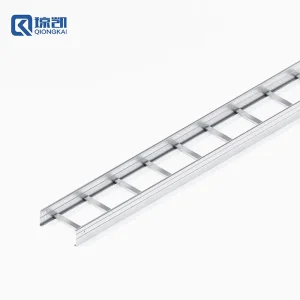
Heavy Duty Pre-Galv or HDG Cable Ladder 400×150 Structural
View Specifications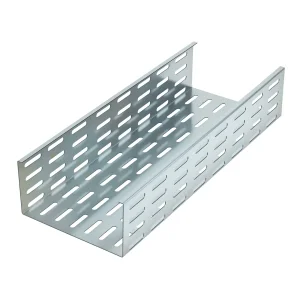
Pre-Galvanized Precision Perforated Cable Tray 200 mm
View Specifications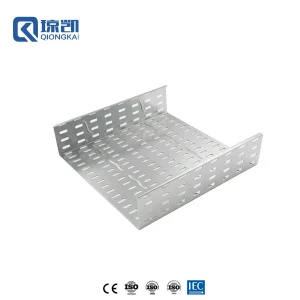
PG & HDG Carbon Steel Cable Tray with Reinforce Ribs 400×100
View Specifications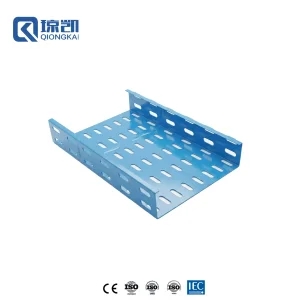
Powder Coated PG Tray with Reinforce Ribs RAL5015 Blue 200×50
View Specifications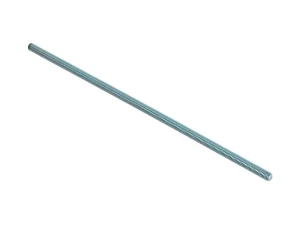
Engineered Threaded Metal Hanger Rod Suspension Hardware
View Specifications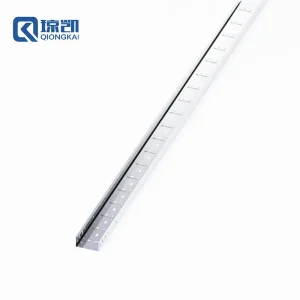
Cost-Saving Heavy Duty Molded Pre-Galvanized Tray 100×50
View Specifications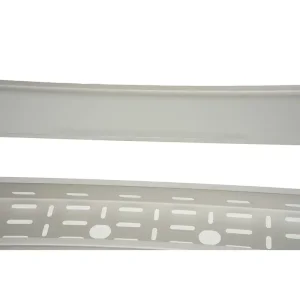
Customized Stainless Steel Cable Tray Pickled & Passivated
View Specifications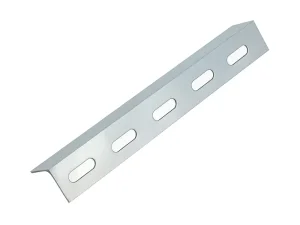
Pre-Galvanized Slotted Strut Channel Angle Iron Framing System
View SpecificationsFrequently Asked Technical & Procurement Questions
Direct, engineer-verified answers covering mechanical deflection, perforation ratios, welding certifications, export packaging, and international standards compliance.
Why are high-resolution physical images critical when selecting a cable tray supplier?
How does the perforation open-area percentage affect cable current derating (ampacity)?
What are the practical deflection limits for perforated cable trays according to NEMA VE 1 and IEC 61537?
How do you prevent galvanic corrosion between perforated trays and mounting strut channels?
What is the difference between pre-galvanized (mill-galv) and hot-dip galvanized after fabrication?
Can Qiongkai provide customized perforation patterns, hole diameters, and side heights?
Request Factory Proof, Technical Drawings & Pricing
Submit your Bill of Quantities (BOQ) or single-line routing diagrams. Our Shanghai engineering team will return a complete mechanical analysis, compliance schedule, visual quality pack, and landed CIF quotation within 24 hours.