
Perforated & Industrial Cable Support Portfolio (Series I)
Browse precision-engineered structural routing solutions manufactured with reinforced ribs, high-corrosion polymer coatings, and tailored ventilation perforation configurations.
Years Dedicated Manufacturing (Est. 2005)
Shanghai Smart Facilities (30,000 m²)
Continuous Roll-Forming Automated Lines
USD Peak Annual Global Export Turnover
Perforated Cable Tray Structural Dynamics & Thermal Aerodynamics
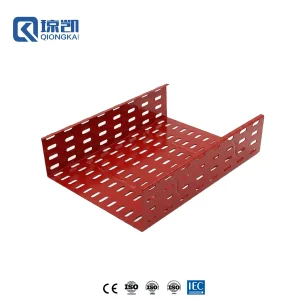
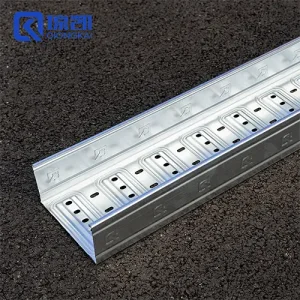
Perforated cable trays—often termed ventilated trough cable trays—represent the optimal engineering equilibrium between continuous cable base support, high mechanical load-bearing capacity, and dynamic heat convection. Unlike solid-bottom trunking that traps internal Joule heat generated by high-ampacity low-voltage power cables, perforated patterns provide an engineered 28% to 38% open-bottom ventilation factor. This active airflow substantially mitigates thermal insulation buildup, preserving conductor ampacity derating margins per NEC (National Electrical Code) Article 392 and IEC 60364-5-52.
Shanghai Qiongkai Industry Co., Ltd. produces precision continuous-punched perforated trays utilizing CNC high-speed progressive dies. Every perforation is engineered with radius-deburred rims to eliminate cable sheath abrasion during horizontal cable pulling. Integrated reinforcing longitudinal ribs cold-formed along the bottom tray bed heighten the section modulus (Z), significantly raising the allowable working load (AWL) without adding dead structural weight.
Engineering Deflection & Safe Working Load (SWL)
The structural rigidity of perforated cable trays is governed by the moment of inertia (Ix) across continuous support spans. Safe design requires deflection limits not exceeding L/200 of the span distance under full operational cable mass plus environmental ice or seismic acceleration forces.
| Material & Protective Finish | Corrosion Grade (ISO 12944) | Coating / Alloy Standard | Expected Lifespan | Primary Industrial Use-Case |
|---|---|---|---|---|
| Pre-Galvanized (PG / Mill Galv) | C1 – C2 (Low Dry Indoor) | EN 10346 / ASTM A653 (Z180 - Z275) | 15 – 25 Years | Commercial Office Towers, Raised Ceilings, Server Closets |
| Hot-Dip Galvanized (HDG) | C3 – C4 (High Outdoor / Industrial) | ISO 1461 / ASTM A123 (65–85μm min) | 35 – 50+ Years | Outdoor Rooftops, Heavy Manufacturing, Power Substations |
| Stainless Steel 304 / 316L | C5-M / CX (Marine, Chemical, Offshore) | ASTM A240 / EN 10088 (Pickled & Passivated) | 60+ Years | Desalination Plants, Marine Vessels, LNG Storage, Cleanrooms |
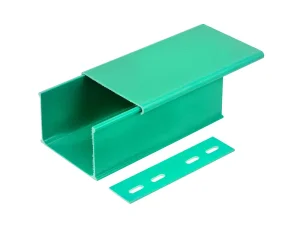
| Fiberglass Reinforced Polymer (FRP) | Non-Metallic Acid / Alkali Immunity | ASTM D3917 Pultruded Isophthalic / Vinyl Ester | 50+ Years | Severe Chemical Plants, Fertilizer Production, Coastal Piers |
| Powder Coated over Pre-Galv | C2 – C3 (Architectural Identification) | Electrostatic Thermoset Polyester (60–100μm) | 20 – 30 Years | Tier III/IV Data Halls, Fire Alarm Channels, Automotive Lines |
Perforated Tray Catalogue Pricing Architecture
Procurement managers and EPC estimators must account for complex cost variables. Cable tray unit prices are calculated via raw material coil indices, fabrication processing, galvanic coating weights, and container stowage density.
Raw Material & Thickness Sensitivity
The tray sheet thickness (ranging from 1.0mm for light instrumentation up to 3.0mm for heavy power feeders) represents 60% to 75% of the finished product FOB price.
- Direct link to Shanghai Steel Metal Exchange indexes
- High-yield cold-rolled coils (Q235B / SPCC / SS316)
- Tolerance-verified mill certs accompanying each batch
Surface Treatment & Zinc Layer Costs
Price divergence between Pre-Galvanized (PG) and Hot-Dip Galvanized (HDG) reflects the secondary thermal immersion dipping bath, manual acid pickling, and zinc mass application.
- PG (12–20 microns) offers lowest initial project CapEx
- HDG (65–85+ microns) delivers 40-year lowest OpEx
- Custom architectural RAL powders applied via automated guns
Nesting & Ocean Freight Optimization
Standard straight trays often result in high ocean volumetric freight penalties. Qiongkai designs interlocking tapered sidewalls and nested stacking arrays to maximize cubic meters.
- Up to 28 tons / 68 CBM stowed per 40ft High Cube container
- Reinforced seaworthy fumigated timber bundling
- Bundled tray kits with matching fishplates and fasteners
Macro-Industry Solutions: Engineered Deployment
Cable trays cannot be specified in isolation. They form the backbone of mission-critical electrical networks across diverse harsh climates, regulatory landscapes, and load classes.
Hyperscale Data Centers
Ultra-dense optical fiber and copper cable networks require smooth perforated tray bottoms to avoid pinch-point signal degradation and maintain plenum fire safety.
- Electro-Galvanized & Powder Coated
- RAL9005 Black & RAL7035 White color schemes
- Overhead ceiling grid & underfloor arrays
Offshore LNG & Petrochemical
Aggressive airborne salts, sour gas ($H_2S$), and chemical vapors demand absolute structural resistance against pitting corrosion and stress cracking.
- Proven supply to Qatar Offshore LNG projects
- Marine-grade SS316L & Pultruded FRP systems
- High resistance to hydrocarbon flame exposure
Clean Energy & Solar Parks
Utility-scale PV installations require durable outdoor perforated channels capable of surviving intense UV radiation, wide temperature deltas, and high wind shear.
- Hot-Dip Galvanized per ASTM A123 standard
- Zinc-Aluminum-Magnesium (ZAM) alloys available
- Fast snap-in splice connections for field labor reduction
Airports & Rail Transit
Public mass transport infrastructure mandates zero-halogen low-smoke fire suppression compliance, electromagnetic shielding, and anti-vibration integrity.
- Installed at Shanghai Hongqiao International Airport
- Corrosion-resistant CT series trunking & trays
- Seismic strut bracing for high tunnel dynamic loads
China Factory 4.0: Supply Chain Resilience & Efficiency
Operating out of Shanghai's Songjiang Port Science & Technology Industrial Corridor, Shanghai Qiongkai Industry Co., Ltd. delivers direct factory engineering velocity without middleman friction.
Automated CNC Tooling & Cold Forming
With 12 automated roll-forming lines and over 60 heavy-duty stamping machines, our facility shapes steel sheets seamlessly into straight channels up to 6 meters in unified length.
- Precise slot spacing eliminates field drill labor
- Continuous inline punching at 45 meters/minute
- Custom flange heights: 50mm, 75mm, 100mm, 150mm
Integrated System Coordination
Procurement teams eliminate multi-vendor interface risks by bundling perforated trays directly with matched 41-series strut channels, cantilever arms, threaded rods, and seismic bracing.
- Single-source engineering accountability
- Strut channels in 41x21, 41x41, 41x62, and 41x82 profiles
- Seismic clip assemblies tested to shake-table limits
Port Proximity & Rapid Lead Times
Direct access to Shanghai Yangshan Deepwater and Waigaoqiao Terminals enables streamlined container dispatch, reducing port drayage times and domestic transit risk.
- Standard orders shipped in 14 to 21 calendar days
- Custom-profile project runs delivered in 25–30 days
- Direct customs export documentation and CO issued
Localized Support & Compliance Assurance
Meeting statutory building codes across Europe, the Middle East, North America, and Southeast Asia demands traceable third-party testing protocols and verified metallurgy.
IEC 61537 / NEMA VE-1 Certification
Trays undergo cyclic deflection destruction testing to establish the Allowable Working Load (AWL) curve under safety factors of 1.5 (IEC) and 2.0 (NEMA VE-1).
- Electrical continuity resistance verified < 0.05 Ω/m
- Third-party testing via SGS, Intertek, and BV
- CE conformity for European Community installation
Dedicated Global Engineering Support
To prevent site errors and rework costs, our bilingual project engineers supply 1-on-1 technical submittal documentation directly to MEP consulting engineers.
- BOM / BOQ optimization from CAD architectural blueprints
- Load-versus-span finite deflection calculations
- Standardized 3D assembly and splice guidance plans
Strict Batch Quality Inspections
Every production batch is accompanied by an Inspection Certificate 3.1 detailing chemical composition, yield strength, tensile limits, and dry coating thickness.
- Cross-hatch adhesion testing on powder-coated stock
- Salt spray testing (ASTM B117) exceeding 720+ hours
- Dimensional caliper inspection on hole pitches
Technology Roadmap & Future Outlook (2025–2035)
Modern electrical containment is transitioning from passive bent-sheet structural metal to digitized, sustainable, and modular intelligent routing pathways.
BIM Level 3 Digital Twin Ready
Complete Revit .rfa family library with parametric LOD 400 models, enabling automatic collision detection and clash prevention in complex plant layouts.
Green Steel & EPD Certification
Advancing low-carbon scrap-electric-arc-furnace (EAF) steel sourcing to provide verifiable Environmental Product Declarations (EPD) for LEED Gold/Platinum assets.
Smart Sensor Integration
Developing snap-on IoT thermal and distributed fiber strain sensors along the tray bottom to monitor real-time cable run temperature surges and deflection anomalies.
Tool-Less Snap-Lock Splice
Next-gen click-and-lock splice mechanisms reducing mechanical installation time by 45%, requiring no bolts or nuts for light-to-medium electrical containment branches.
High-Performance ZAM Coating
Pioneering Zinc-Aluminum-Magnesium alloy steel sheet that provides self-healing galvanic cut-edge corrosion resistance in aggressive outdoor coastal environments.
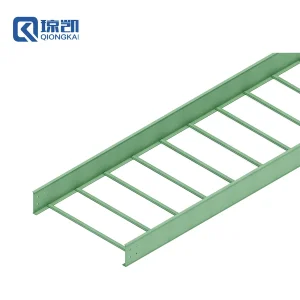
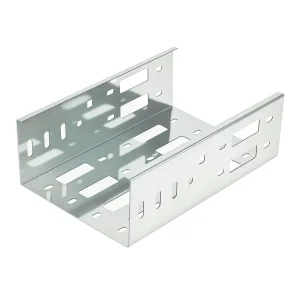
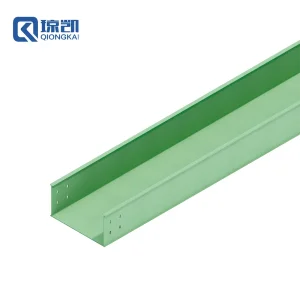
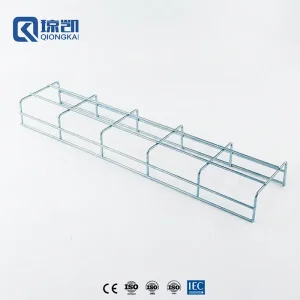
Perforated, Wire Mesh & Ladder Systems (Series II)
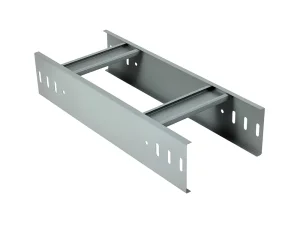
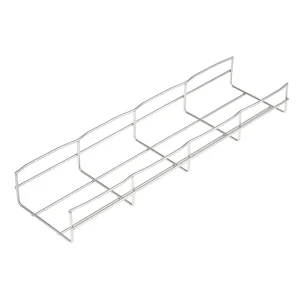
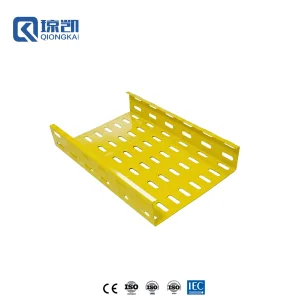
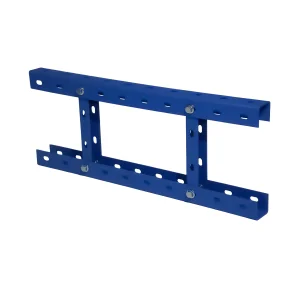
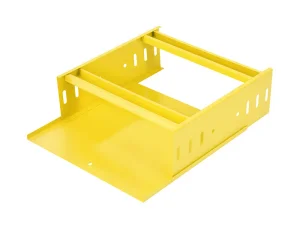
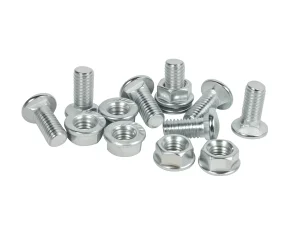
Complete your project Bill of Quantities with matching perforated ladders, heavy-duty wire mesh channels, custom-sized fittings, and precision hardware.
Frequently Asked Questions (Q&A)
Authoritative answers to the key commercial, structural, and metallurgic questions submitted during international cable management procurement and project tender reviews.
What specific factors differentiate perforated cable trays from solid bottom trunking?
Perforated cable trays incorporate regular engineered punch slots across the bottom plane (typically maintaining a 28% to 35% open ventilation area). This structural configuration delivers two vital advantages over solid bottom trunking: continuous convective heat dissipation that prevents power cable derating penalties, and significant total dead-weight reduction without sacrificing load rigidity due to cold-formed stiffener ribs. Additionally, the bottom perforations permit flexible cable dropping, field zip-tie fastening, and prevent indoor condensation moisture from pooling inside the tray raceway.
How is the price of perforated cable tray calculated for global project tenders?
Perforated cable tray pricing is constructed through a transparent multi-variable formula: base steel coil weight (calculated via width, sidewall height, metal thickness, and total running meters), dynamic zinc coating weight (such as Z275 pre-galvanized vs. 65μm to 85μm hot-dip galvanized bath immersion), tooling complexity (standard slot patterns versus custom stamping), and shipping packaging optimization. Direct factory procurement from Shanghai Qiongkai eliminates intermediary markups, offering volume tiered container discounts for full container loads (FCL).
Which international regulatory standards do Qiongkai cable trays comply with?
All Qiongkai cable support systems are fully engineered, tested, and certified against IEC 61537 (Cable management - Cable tray systems and cable ladder systems) and NEMA VE-1 (Metal Cable Tray Systems). For North American projects, systems adhere to NEC Article 392 load and grounding criteria. Surface galvanizing complies with ISO 1461 and ASTM A123, ensuring verified coating thicknesses, while raw materials carry EN 10204 Type 3.1 Mill Test Certificates.
What finish should be selected for high-salinity coastal or chemical environments?
For coastal regions within 5 km of the ocean (ISO 12944 category C4/C5-M) or chemical processing plants, pre-galvanized steel is inadequate. We recommend Hot-Dip Galvanized (HDG) with an 85μm minimum zinc layer, Marine-Grade Stainless Steel 316/316L (with molybdenum additions for chloride pitting prevention), or Fiberglass Reinforced Polymer (FRP/GRP). As proven in our offshore LNG supply references in Qatar and high-temperature environments in Thailand, FRP and SS316 provide the lowest total lifecycle cost of ownership (TCO).
Can custom dimensions, slot configurations, and return-flange profiles be manufactured?
Yes. With 12 automated production lines and around 60 heavy-duty punch forming machines across 3 manufacturing hubs, Qiongkai custom-builds non-standard widths (50mm to 1200mm), side heights (25mm to 200mm), and plate thicknesses (1.0mm to 3.0mm). We can engineer specialized slot geometries for specialized instrumentation ties, internal dividers for circuit segregation, and reinforced return flanges for seismic support.
What are the standard delivery lead times and packaging safeguards for ocean export?
Standard catalogue orders are fabricated, quality-inspected, and containerized within 14 to 21 working days. Because our factories are situated in Songjiang, Shanghai, goods reach Yangshan Deepwater Port or Waigaoqiao Terminal in hours. For export packaging, trays are nested to minimize ocean cube volume, strapped with steel tensile bands, protected with corrugated edge armor and moisture-resistant shrink film, and fixed onto fumigated export wooden pallets.
Request Complete Perforated Tray Catalogue & Price Matrix
Submit your project layout, cable schedules, or Bill of Quantities (BOQ). Our engineering desk provides comprehensive load deflection reports, system drawings, and factory direct quotations within 24 hours.