
Heavy-Duty Cable Trays & Structural Solutions (Batch I)
Explore initial core series configurations, precision pre-galvanized profiles, powder-coated raceways, and reinforced ladder segments engineered for global infrastructure.
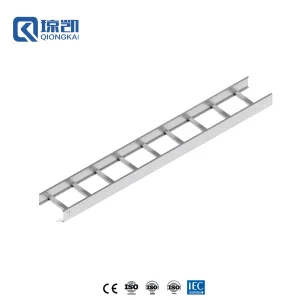
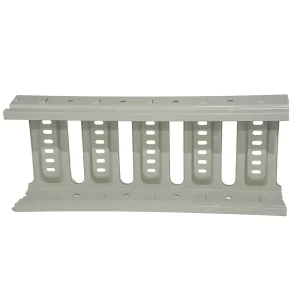
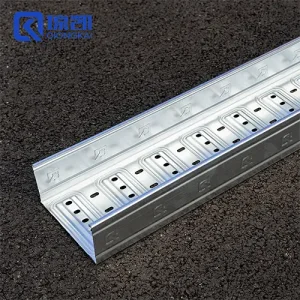
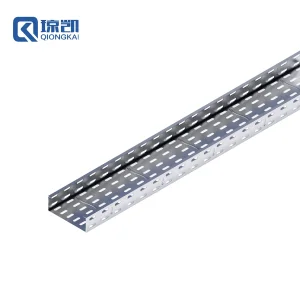
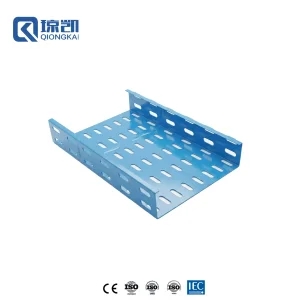
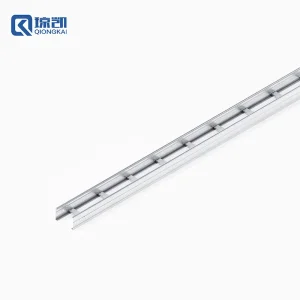
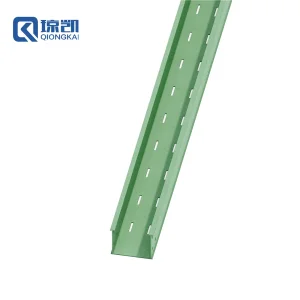
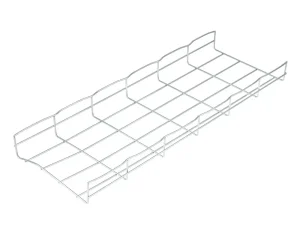
Perforated Tray Electrical Systems: Structural Load & Thermal Physics
Perforated cable trays serve as the primary containment backbone for mid-to-heavy electrical power routing and critical instrumentation in modern commercial, industrial, and cleanroom facilities. Engineered under IEC 61537 and NEMA VE-1 methodologies, a perforated tray balances maximum physical shielding against physical impact with controlled geometric aperture open-area percentages (typically between 28% and 38%).
Thermal dissipation remains the fundamental driver for selecting perforated profiles over solid-bottom trunking. In multi-conductor configurations carrying medium and high amperage, joule heating causes internal ambient temperatures within closed containment to climb rapidly: \(P_{\text{loss}} = I^2 R\). Perforated trays induce a chimney-effect convective airflow through precision-stamped slots, lowering conductor operating temperatures by up to 12°C. This prevents thermal ampacity derating, allowing system planners to maintain standard cable cross-sections and reduce copper mass across kilometer-scale projects.
E-E-A-T Principle Insight: Specifying perforated containment instead of closed raceways eliminates conductor derating penalties under NEC 392.80, translating directly to an average 14% to 19% reduction in total copper cable procurement costs.
Continuous Deflection Criteria & Structural Ribbing
The deflection profile of a perforated electrical tray under sustained working load is mathematically determined by its area moment of inertia (\(I_x\)) and modulus of elasticity (\(E\)). Under standard NEMA Class 12C or 20C requirements, allowable deflection must not exceed \(L/200\) to \(L/300\) of the installation span distance.
Advanced manufacturing addresses structural vulnerabilities by integrating cold-rolled longitudinal stiffening ribs along the base and return-flanged side channels. Even when 30% of the flat metal sheet is punched away to accommodate ventilation apertures, the continuous roll-formed corrugation elevates load-bearing resistance by up to 45% compared to non-ribbed sheet steel. This enables support bracket spans to widen from standard 1.5-meter configurations up to 3.0 meters, reducing auxiliary steelwork, threaded rod installations, and seismic bracing costs during MEP installation phases.
The Chinese Manufacturing Matrix: Scale, Precision & Direct Port Synergies
Strategic supply chain efficiencies driven by coastal industrial clusters in Songjiang, Shanghai, deliver uncompromised metallurgical fidelity and agile scalability for multinational megaprojects.
Tier-1 Raw Coil Procurement
Direct supply agreements with Baosteel, Shougang, and Ansteel ensure consistent tensile yield strengths (>235 MPa for Q235B up to 355 MPa for high-load sections). Strict metallographic testing prevents micro-fracturing at bend points and ensures consistent raw coil surface purity.
High-Precision CNC Tooling
Over 60 progressive multi-stage CNC stamping units generate ultra-clean perforation geometries with burr heights under 0.1mm. Smooth edge radii protect low-voltage communication jackets and high-voltage XLPE power cables from friction-induced shearing during pull-in operations.
Integrated Surface Chemistry
Automated continuous lines execute zinc electro-plating, pre-galvanization, hot-dip galvanizing (HDG to ISO 1461), and electrostatic architectural powder coatings. Direct vertical control prevents surface oxidation defects and ensures uniform coating thickness across production runs.
Deepwater Export Gateways
Located in the Songjiang industrial zone adjacent to Shanghai's deepwater ports (Yangshan and Waigaoqiao), shipments bypass domestic rail bottlenecking. Dedicated export packing teams implement nested bundling, saving up to 35% in container volume metrics for international ocean freight.
Perforated Tray Electrical Price Architecture: Structural Cost Drivers
Understanding the fundamental cost components protects procurement managers from cut-rate suppliers that compromise metal gauge, zinc density, or safety certifications.
| Profile Specification (Width x Depth x Gauge) | Finish Metallurgy | Standard Compliance | Target Load Rating | Estimated Export Price (FOB USD/Meter) |
|---|---|---|---|---|
| 100mm x 50mm x 1.0mm | Pre-Galvanized (PG - Z120) | IEC 61537 Class Light | 45 kg/m @ 1.5m Span | $3.80 - $5.20 |
| 150mm x 50mm x 1.2mm | Hot-Dip Galvanized (HDG - 65µm) | BS EN 61537 / ISO 1461 | 75 kg/m @ 1.5m Span | $6.90 - $8.80 |
| 200mm x 100mm x 1.5mm | Pre-Galvanized + Powder Coated (RAL) | NEMA VE-1 Class 8A | 110 kg/m @ 2.0m Span | $10.20 - $13.50 |
| 300mm x 100mm x 1.5mm | Hot-Dip Galvanized (HDG - 85µm) | NEMA VE-1 Class 12B | 145 kg/m @ 2.0m Span | $14.80 - $18.60 |
| 400mm x 100mm x 2.0mm | Hot-Dip Galvanized Heavy Duty | IEC 61537 Heavy Type | 220 kg/m @ 2.5m Span | $22.40 - $27.90 |
| 200mm x 100mm x 3.0mm (Wall) | FRP (Fiberglass Vinyl Ester Resin) | ASTM E84 Class 1 / UL 94-V0 | 120 kg/m @ 2.0m Span | $24.00 - $31.00 |
| 400mm x 100mm x 1.5mm | Stainless Steel 316L (Pickled & Passivated) | Marine Grade Offshore Spec | 160 kg/m @ 2.0m Span | $42.00 - $55.00 |
Primary Price Escalation Variables
1. Steel Index Volatility: Cold-rolled coil (CRC) accounts for approximately 62% to 68% of the baseline net production expense. When quoting on enterprise projects spanning several quarters, our factory applies indexation linked directly to Shanghai Metals Market (SMM) benchmarks, offering price locks against sharp spikes.
2. Zinc Deposition Weight: Cheap commercial trays frequently carry low-grade Z60 or Z80 coatings (60g to 80g zinc per square meter), leading to red rust degradation within 18 months in humid environments. Our factory standards apply Z180–Z275 (180g–275g/m²) for pre-galvanized lines and minimum 65µm–85µm (450g–600g/m²) for post-fabrication batch hot-dip galvanizing, ensuring 25+ year outdoor service lives.
Fabrication Complexity & Nested Logistics
3. Advanced Die Tooling & Slot Pitch: Complex patterns requiring multiple stamping operations increase press cycle duration and die maintenance. High-density perforated arrays feature optimized punch sequences that minimize sheet warping without requiring manual roller leveling.
4. Volumetric Freight Engineering: Perforated cable trays are physically rigid and prone to "shipping air" when packed un-nested. By manufacturing precision-engineered graduated widths (e.g., matching runs of 100mm, 200mm, 300mm, and 400mm), our export logistics team stacks trays directly inside one another. This doubles or triples the tonnage loaded per 40ft High Cube container, reducing per-meter sea freight costs significantly.
Engineering Solutions Across Specialized Modern Environments
From hyperscale cloud server matrices to offshore gas liquefaction infrastructure, perforated cable containment must meet specialized mechanical, chemical, and electromagnetic requirements.
Tier IV Data Center White Space
Data facilities demand high-density fiber and category data lines isolated from high-capacity busway harmonics. Powder-coated perforated trays (custom RAL colors) deliver continuous airflow across structured cabling runs, preventing heat retention while providing high physical shielding against EMI interference.
Offshore LNG & Petrochem Plants
Continuous chloride mist and hydrogen sulfide environments cause rapid pitting corrosion in standard steel containment. Our custom-molded FRP (Fiberglass Reinforced Polymer) and SS316L perforated profiles ensure zero chemical degradation under severe C5-M/CX marine conditions, matching design parameters proven on major Middle East LNG developments.
Modern Agrotechnology & Livestock
Enclosed livestock housing contains elevated concentrations of airborne ammonia, methane, and high relative humidity. Standard electroplated finishes fail in months. We engineer heavy-duty hot-dip galvanized and organic powder-coated barrier containment tested to withstand aggressive bio-corrosion, as deployed in industrial agricultural complexes in South America.
Metro Transit & Aviation Hubs
Public infrastructure projects demand high-load electrical pathways that adhere to strict fire survivability standards (such as German DIN 4102-12 / E30 to E90 circuit integrity). Installed across international aviation hubs like Shanghai Hongqiao, our CT series heavy trunking and reinforced perforated channels support reliable evacuation and power operation under fire conditions.
Utility-Scale Photovoltaics & BESS
Commercial solar fields and battery storage facilities encounter constant UV exposure, wide thermal swings, and localized condensation. Our hot-dip galvanized perforated systems incorporate specialized rounded punch slots that simplify tie-down cable management while providing the mechanical rigidity needed to resist heavy wind and snow loads.
Enterprise BOQ Optimization: Overcoming Common Sourcing Traps
Strategic cable containment procurement balances compliance with long-term cost efficiency. Working directly with an experienced manufacturing team helps project owners avoid common engineering pitfalls.
1. Resolving Over-Specification vs Under-Specification
Engineering plans frequently call for heavy-gauge stainless steel in indoor, climate-controlled environments where pre-galvanized or powder-coated mild steel easily meets the project life cycle, needlessly inflating Capex budgets. Conversely, relying on thin electroplated finishes in unconditioned humid sub-stations often results in premature corrosion within two years. Our sales engineers review site-specific environmental conditions (ISO 9223 corrosivity categories C1 through CX) to align material selections with genuine site needs.
2. Verifying Earthing Continuity & Splice Electrical Resistance
Under IEC 61537 Section 9.3, a cable tray system must maintain safe electrical bonding across every joint without requiring external jumper cables, keeping total resistance below 50 mΩ across splice connections. Lower-tier manufacturers often rely on simple overlap plates without proper contact serration, risking compliance failures during site handover. We provide integrated spring-nut fasteners and copper-bonded link plates that streamline field assembly while ensuring stable, low-resistance connections.
3. Complete Auxiliary BOM Consolidation
Sourcing tray runs from one fabricator and structural support channels, seismic braces, couplers, and reducers from multiple secondary suppliers introduces sizing tolerances and installation delays. We supply complete, factory-matched systems: including 41-series strut channels, engineered unistrut brackets, hold-down clips, and pre-fabricated radius elbows that bolt directly into place on site.
4. Rigorous Mill Certification & Traceability
International infrastructure projects require comprehensive documentation for every container released from the factory. We issue complete quality dossiers with every shipment: including 3.1 mill test certificates verifying chemical heat analysis, elcometer zinc-thickness reports, salt-spray chamber data, and factory load-deflection test records.
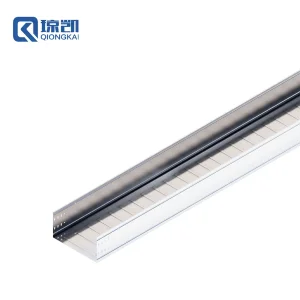
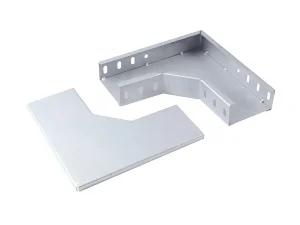
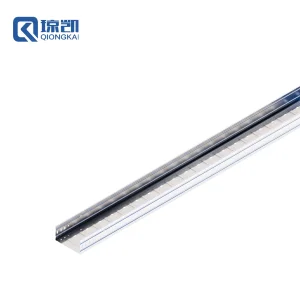
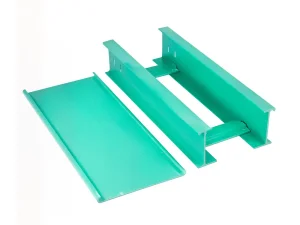
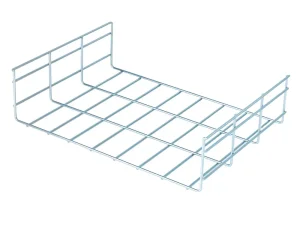
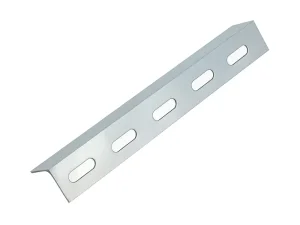
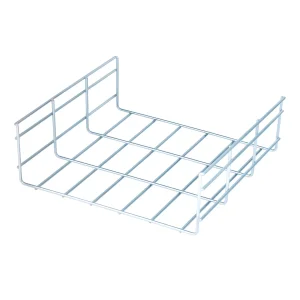
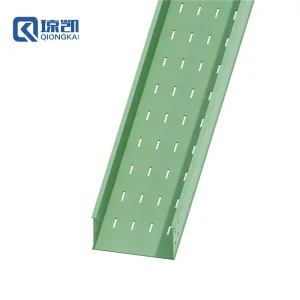
Specialized Cable Trays, Fittings & Support Profiles (Batch II)
Explore wide-span heavy trunking channels, pre-galvanized elbow fittings, slotted angle channels, wire mesh grids, and high-corrosion composite FRP series.
Frequently Asked Questions: Technical Sourcing & Compliance
In-depth answers addressing structural certification, metallurgy choices, international logistics, and installation efficiency.
What is the difference between Pre-Galvanized (PG) and Hot-Dip Galvanized (HDG)?
Pre-galvanized (PG) trays are roll-formed from steel coils that were continuously zinc-coated at the steel mill (typically Z120 to Z275 g/m²). This finish is ideal for indoor, climate-controlled commercial buildings and data halls. Hot-dip galvanizing (HDG to ISO 1461 / ASTM A123) takes place after all cutting, stamping, and welding steps are complete. The finished steel tray is submerged in molten zinc at 450°C, producing an alloyed zinc-iron barrier layer 65µm to 85µm thick. HDG is the standard specification for outdoor industrial plants, marine environments, and chemical processing facilities.
How do perforated trays perform regarding electromagnetic compatibility (EMC)?
Perforated carbon steel trays provide reliable passive electromagnetic attenuation. Under IEC 61537 guidelines, metallic trays with small, uniform slot perforations deliver between 20dB and 45dB of magnetic and radio-frequency shielding across the 100 kHz to 30 MHz range. This level of attenuation prevents cross-talk between high-voltage power feeds and low-voltage control lines, provided the tray run maintains bonded continuity to the main electrical earth.
When should FRP be specified instead of Hot-Dip Galvanized or Stainless Steel?
FRP (Fiberglass Reinforced Polymer) should be selected where strong acids (such as sulfuric or hydrochloric acids), chlorine gas, or severe sea spray are present. While HDG steel relies on a sacrificial zinc layer that depletes in corrosive environments, FRP uses an inert vinyl ester or polyester composite matrix that is immune to electrochemical rust. FRP is also electrically non-conductive, spark-resistant, and weighs about 40% less than steel, reducing structural loading on offshore structures and chemical pipe racks.
How does perforation hole design impact overall structural load ratings?
Carefully engineered perforation designs avoid open slots that run continuously across the base, which can create localized stress lines. Instead, standard configurations use staggered slots with return radiuses and continuous longitudinal stiffening ribs. These ribs raise the section modulus, restoring mechanical rigidity so the perforated profile supports working loads comparable to solid-bottom trunking of the same sheet gauge, while maintaining required airflow and drainage.
Can you manufacture custom dimensions and non-standard perforation patterns?
Yes. Our Shanghai manufacturing facilities operate 12 production lines and over 60 heavy-duty forming presses. We build custom side heights from 35mm to 200mm, widths from 50mm to 1200mm, and material thicknesses from 0.8mm to 3.0mm. We also configure unique slot patterns and mounting holes for specialized instrumentation, data hubs, and overseas transit projects.
What are standard production lead times and minimum order quantities (MOQ)?
For standard pre-galvanized and hot-dip galvanized cable trays, our standard MOQ is 500 linear meters per profile size. Typical factory turnaround for a standard 40-foot container (around 2,500 to 4,000 meters, depending on width combinations) ranges from 14 to 20 business days from drawing sign-off. We also keep common finishes and strut channels in stock for rapid dispatch on fast-track maintenance and expansion projects.
How are cable trays packed to avoid transit damage on long ocean voyages?
Trays are packed using nested configurations: smaller widths fit inside larger channels, interleaving protective non-woven liners to prevent finish abrasion. Bundles are bound with heavy-duty galvanized steel strapping, fitted with corner edge guards, and mounted on treated fumigated wooden blocks or custom steel shipping skids. This packing method protects coatings during transit and allows site crews to offload containers efficiently using standard forklifts.
Do your perforated tray systems comply with international fire survivability standards?
Yes. Our reinforced steel perforated cable trays and solid cable trunking are manufactured to meet DIN 4102-12 functional circuit integrity standards (E30, E60, and E90 fire resistance ratings). When paired with certified fire-rated cables, our containment systems maintain mechanical stability and electrical continuity for up to 90 minutes at temperatures exceeding 1000°C, ensuring emergency power and smoke exhaust systems continue operating during critical incidents.