Flagship Vertical Tray & Structural Support Systems
Explore heavy-duty pre-galvanized, hot-dip galvanized, and specialized structural cable management items manufactured strictly per NEMA VE-1 and IEC 61537 standards.
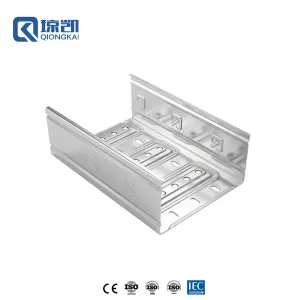
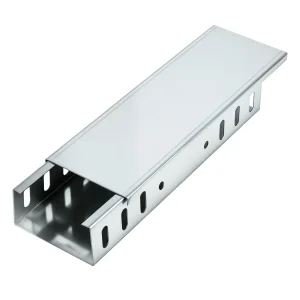
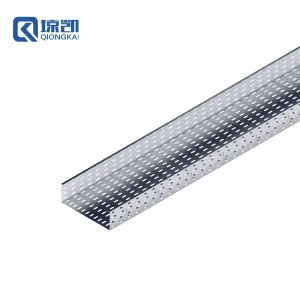
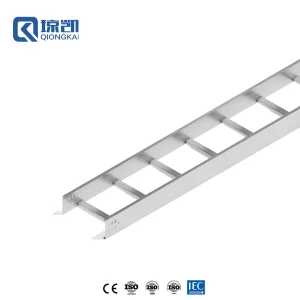
Vertical Cable Tray Support Mechanics & Engineering Dynamics
Unlike horizontal tray runs where gravity aids uniform tray seating, vertical installations subject brackets, rungs, and anchors to intense tensile dead loads, lateral seismic displacement, and cable bundle elongation slippage.
Axial Tensile Load & Cable Cleat Friction
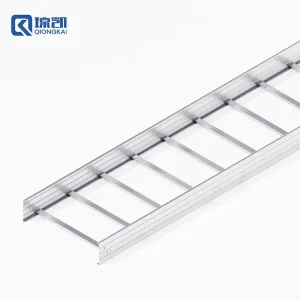
In high-rise electrical shafts and wind turbine towers, vertical cable weight exerts cumulative downward friction on ladder rungs. Qiongkai designs slotted unistrut cantilever supports and heavy gauge rungs capable of resisting cyclic gravitational shear exceeding 4.5 kN per support point without deflection exceeding L/200.
Seismic Bracing & Lateral Sway Mitigation
Compliant with GB 50981-2014 and ASCE 7-16 seismic criteria, vertical tray risers require rigid 4-way lateral and longitudinal anti-vibration bracing. Our back-to-back 41×82 and 41×62 strut channels equipped with serrated flange nuts lock the riser assembly tightly against structural concrete shafts.
Thermal Elongation & Building Creep Expansion
Long continuous vertical runs across 20+ stories experience thermal expansion gradients (ΔT up to 45°C). We engineer slotted vertical expansion splice plates that allow controlled axial travel while sustaining strict structural rigidity, avoiding buckled sidewalls and sheared fastener heads.
Protective Coatings & Structural Alloy Matrix
Choosing the correct surface treatment eliminates premature maintenance overhead. Our Shanghai ISO 9001 certified facilities supply verified metallurgical finishes matched to site-specific corrosive atmospheric classifications (C1 through CX).
| Material / Treatment | Standards Compliance | Yield Strength (MPa) | Coating Mass / Spec | Environmental Durability Life |
|---|---|---|---|---|
| Pre-Galvanized Steel (GI / PG) | EN 10346, ASTM A653 | ≥ 250 MPa | Z180 - Z275 (18-20 μm) | 15-20 yrs (Indoor Dry HVAC & Data Halls) |
| Hot-Dip Galvanized (HDG) | ISO 1461, ASTM A123 | ≥ 275 - 355 MPa | ≥ 65 - 85 μm (500-610 g/m²) | 35-50 yrs (Industrial Plants, Outdoor, EPC Ports) |
| Austenitic Stainless Steel (SS316L) | ASTM A240, EN 10088 | ≥ 290 MPa | Natural Passivated (Cr-Ni-Mo) | 60+ yrs (Marine, Offshore LNG, Desalination) |
| Fiberglass Reinforced Polymer (FRP) | ASTM D3917, GB/T 28289 | Tensile ≥ 180 MPa | Vinylester / Isophthalic Resin Matrix | 40+ yrs (Sulphur Chemical, Acid Vapor, Fertilizer) |
| Thermoset Powder Coat (Epoxy/Poly) | GB/T 18593, Qualicoat | Base Metal Spec Dependent | 60 - 90 μm (Custom RAL Shades) | 15-25 yrs (Commercial Architectural Identification) |
Chinese Manufacturing Ecosystem & Wholesale Economics
Leveraging direct Shanghai steel mill partnerships (Baosteel, Shougang) and integrated automated roll-forming eliminates broker premiums, guaranteeing competitive vertical cable tray support pricing and expedited delivery schedules.
Port-Proximity Logistics Advantage
Situated in Songjiang Science & Technology City, Shanghai, Qiongkai's manufacturing center is under 60 minutes from Waigaoqiao Port and Yangshan Deep-Water Port. Container stuffing, anti-corrosion ocean export bundling, and fast customs clearance save up to 12% in inland freight overhead.
Automated Multi-Station Roll Forming
Our 12 automated cold roll forming lines produce continuous profiles without tooling deflection. Standard 3-meter and 6-meter vertical strut channels, cantilever arms, and stamped reinforcement ribs achieve dimensional tolerances within ±0.3mm across multi-container production batches.
Complete EPC Engineering Verification
We review contractor structural schedules, Bill of Quantities (BOQ), and BIM models. Qiongkai engineers assist with deflection stress validation, finite element analysis (FEA), and mill test certificates (MTC 3.1) ensuring seamless site consultant acceptance.
Vertical Cable Tray Support Wholesale Price Spectrum
Vertical support hardware pricing is determined by steel gauge thickness, post-fabrication galvanizing weight, and structural seismic anchoring complexity. Reference typical FOB wholesale benchmark brackets below:
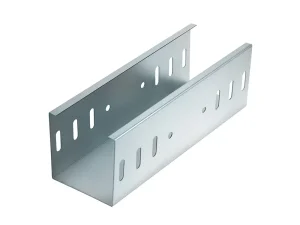
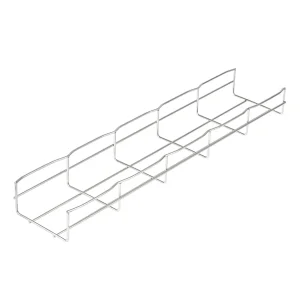
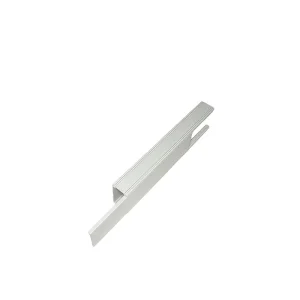
Suited for 100mm to 300mm light vertical runs. High-speed stamped 2.0mm/2.5mm steel with pre-punched slotted base plate.
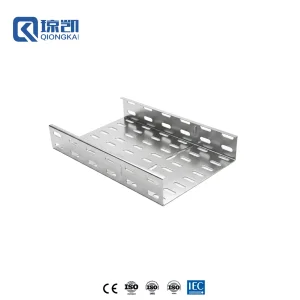
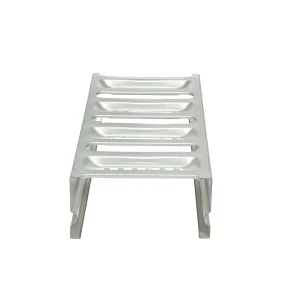
Engineered for 400mm-800mm risers. Hot-dip galvanized post-weld (≥65μm). Welded gusset gusseting supporting up to 8.5 kN dead load.
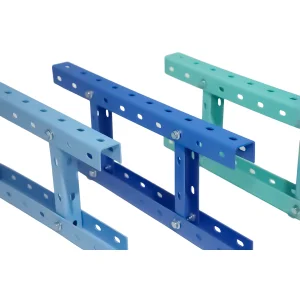
Back-to-back reinforced slotted unistrut with serrated clamp jaws and dynamic shear-resistant base fixtures.
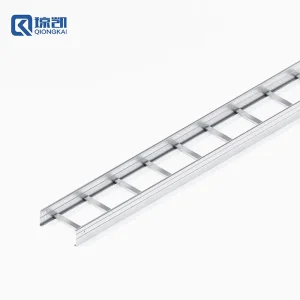
Austenitic molybdenum-alloy vertical ladder clamps and heavy-gauge stanchions for offshore rigs and chemical plants.
Engineered On-Site Deployments Across Global Infrastructure
Review real-world vertical cable pathway executions engineered and manufactured by Shanghai Qiongkai Industry.
Shanghai Hongqiao International Airport
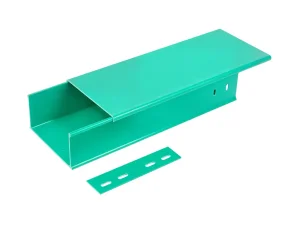
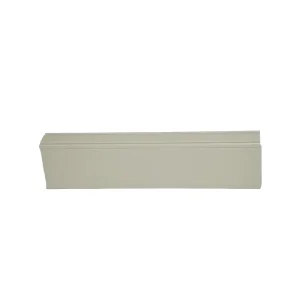
Deployment: Corrosion-resistant CT Series Vertical Cable Trunking and heavy riser support channels throughout subterranean transit interchanges. Provided continuous screening against electrical magnetic interference (EMI) with heavy seismic wall brackets.
Offshore LNG Terminal Platforms (Qatar)
Deployment: Custom heavy-gauge profiled sections and SS316 vertical ladder support brackets installed across high-salinity flare towers and liquefaction processing stacks. Zero red-rust degradation across prolonged thermal cycles.
Hyperscale Cloud Data Halls (Frankfurt, Germany)
Deployment: Powder-coated RAL9005 black slotted unistrut vertical risers carrying fiber optic pathways from main distribution frames to multi-story server floors. Designed for zero-snag cable pulls and continuous grounding continuity.
Frequently Asked Technical & Sourcing Questions
Essential guidance addressing engineering approvals, structural spacing, and container freight optimization.
Under NEMA VE-2 standards, vertical cable tray runs must be supported at intervals not exceeding 3.0 meters (10 feet), with immediate anchors placed within 600mm of floor penetrations, ceiling drops, or directional transitions to resist cumulative cable load shear.
Vertical cable ladder installations utilize heavy-duty rungs paired with rubber-lined cable cleats or multi-cable unistrut pipe clamps. Clamps are installed at every rung or every alternating rung depending on single-core armored cable weight.
Yes. Utilizing internal tooling and laser cut fabrication, we engineer tailored wall stand-off brackets, trapeze drops, and custom corner framing for confined electrical shafts where off-the-shelf brackets collide with HVAC or plumbing services.
Every container shipment includes comprehensive Mill Test Certificates (EN 10204 3.1), hot-dip galvanizing coating thickness reports (ISO 1461), load deflection test verification certificates, and fumigation certificates for sea transport.
Specialized Tray, Trunking, Grid & Telecom Management Solutions
Source directly from our Shanghai manufacturing lines to complete your project's horizontal-to-vertical cable transitions.