
Featured Cable Tray & Support Profiles
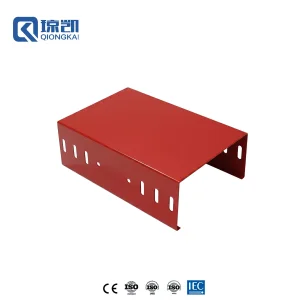
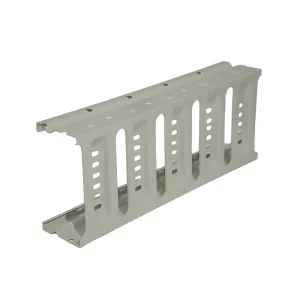
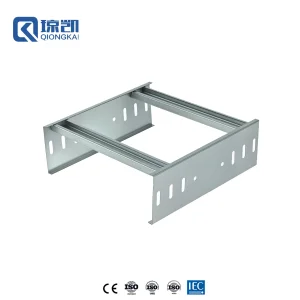
High-tensile pre-galvanized, powder-coated, and hot-dip galvanized tray designs optimized for heavy industrial loads and rapid field deployment.
Global Landscape of Cable Tray Support Design
Structural integrity, international codes, and mechanical resilience in modern commercial, energy, and hyperscale infrastructure.
In high-density industrial and civil installations, a cable tray assembly is only as dependable as its structural support architecture. As global electrification, industrial automation, and hyperscale artificial intelligence data halls surge, the demand on electrical raceway systems has evolved from passive pathway containment to mission-critical structural engineering. Specifying engineers and procurement executives can no longer view support brackets, trapeze hangers, and strut channels as secondary commodities. Instead, structural compliance under NEMA VE 1 / VE 2, IEC 61537, and seismic design standards such as ASCE 7-22 dictate overall facility uptime, safety margins, and asset lifecycles.
Across North America, Europe, the Middle East, and Asia-Pacific, structural load classifications demand integrated design between the tray profile (ladder, perforated, wire mesh, or solid trunking) and the supporting substructure. Shanghai Qiongkai Industry Co., Ltd., leveraging over two decades of dedicated manufacturing prowess since 2005, operates at the intersection of high-precision metallurgical cold-forming and structural engineering. By engineering the cable tray, strut channels (41×21, 41×41, 41×62, 41×82), seismic brackets, and cantilever arms as one cohesive structural ecosystem, we eliminate component mismatch, premature mechanical failure, and excessive labor during field erection.
Structural Methodologies in Support Design
Analyzing load distribution, support span optimization, and bracket engineering for maximum mechanical integrity.
Trapeze Support Engineering
Trapeze hanging systems utilize dual threaded rods coupled to slotted horizontal strut channels (41×41mm or 41×62mm). This configuration offers superior symmetrical load distribution across two suspension points, mitigating torsional shear stress on concrete anchor points and accommodating multi-tier tray stacking in tight MEP utility corridors.
Cantilever Bracket Dynamics
Engineered for wall-mounted or structural steel vertical flange mounting, cantilever brackets must resist immense bending moments ($M = F \times d$). Qiongkai incorporates triangular gusset plates and cold-stamped reinforcing ribs that increase section modulus ($Z$), delivering 35% higher yield resistance compared to conventional flat bent plates.
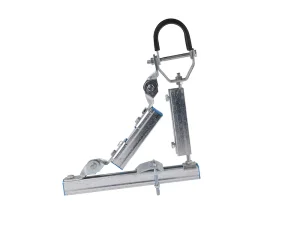
Triaxial Seismic Bracing
Compliant with GB 50981 and international seismic codes, our lateral and longitudinal sway bracing systems dissipate dynamic seismic energy. Utilizing high-strength back-to-back strut channels (41×82mm) and heavy-duty seismic hinge connectors, raceway assemblies maintain structural cohesion under extreme accelerations.
Chinese Factory Efficiency & Global Logistics Scale
How Shanghai Qiongkai leverages vertical integration, automated robotics, and direct port connectivity to deliver superior total cost of ownership.
Global procurement directors face persistent friction in standardizing cable management components: erratic lead times, fragmented supplier tiers, inconsistent hot-dip galvanizing zinc thickness, and escalated freight overheads. Operating from the Songjiang Port Science and Technology City of Shanghai, Shanghai Qiongkai Industry Co., Ltd. solves these bottlenecks through deep vertical integration.
With 3 dedicated production facilities spanning over 30,000 square meters and 12 fully automated assembly lines, our plant houses over 60 heavy-duty hydraulic punch presses, CNC cold-roll-forming profiles, automated mesh resistance welding stations, and high-efficiency electrostatic powder coating booths. This infrastructure allows Qiongkai to manufacture up to 1,500 metric tons of cable support systems monthly.
Direct logistical proximity to Shanghai’s Yangshan Deep-Water Port and Waigaoqiao Port enables rapid container stuffing, bundled sea-freight optimization (interleaving tray sizes to minimize volumetric dead space), and streamlined export documentation for prompt transit across Europe, the Middle East, Southeast Asia, and the Americas.
Zero-Intermediary Pricing
Direct mill-scale procurement of premium carbon steel coils (Q235B/Q355B) and direct OEM delivery ensure maximum cost advantage for EPC contractors.
Agile Tooling & Customization
Rapid tooling adjustments for custom side-rail heights (50–200mm), proprietary punching patterns, and custom-engineered strut channels within 72 hours.
Accelerated Turnaround
High-speed automated roll-forming machines yield 20+ meters of precision-profiled channel per minute, ensuring compressed project execution windows.
Full Mill Traceability
Every batch includes complete EN 10204 3.1 Material Test Reports (MTR), zinc coating thickness verification, and mechanical yield documentation.
Engineered Application Scenarios & Field Case Studies
From high-salinity offshore gas terminals to hyperscale cloud data centers, our support designs perform in harsh environments.
Hyperscale Data Halls
Deployment: Data Centers & Telecommunication Hubs.
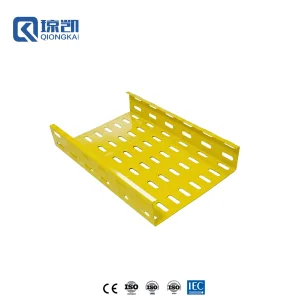
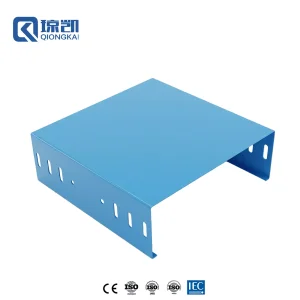
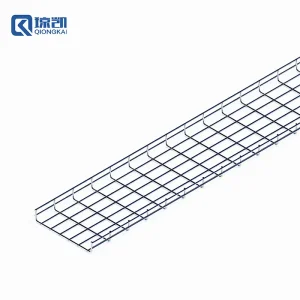
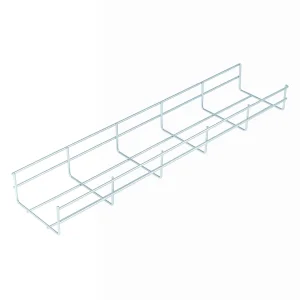
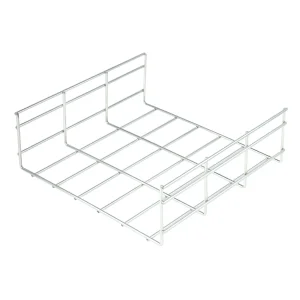
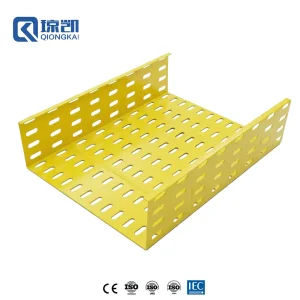
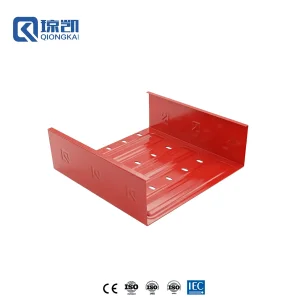
Engineering Solution: Electro-galvanized wire mesh basket trays paired with color-coded powder-coated cable trunking (RAL5015 / RAL1080). Minimizes electromagnetic interference (EMI), ensures rapid fiber drop-outs, and maximizes under-floor and ceiling airflow heat rejection.
Offshore LNG & Marine
Deployment: Offshore LNG Platform, Qatar.
Engineering Solution: Custom profiled section support channels manufactured from marine-grade 316L stainless steel and pultruded FRP. Delivers extreme resistance to chloride pitting, sulfuric spray, and coastal humidity, maintaining structural stability across a 30-year design life.
International Airports
Deployment: Shanghai Hongqiao International Airport.
Engineering Solution: Heavy-duty, high-capacity CT series cable trunking with integrated fire-barrier coatings and reinforcing ribs. Handles immense primary power cable bundles across massive terminal spans with zero mid-span sagging.
Corrosive Agro-Industry
Deployment: Large Agricultural Facility, Paraguay.
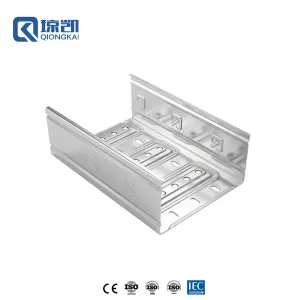
Engineering Solution: Pre-galvanized high-yield steel cable trays featuring custom punched side-plate reinforcements. Engineered to operate in high-ammonia, high-humidity environments on an optimized project budget.
Corrosion Resistance & Finish Engineering Guide
Comprehensive technical data for selecting the appropriate coating and metallurgy based on environmental ISO 12944 atmospheric corrosivity categories.
| Material / Surface Finish | Specification Standard | Zinc / Coating Thickness | Corrosivity Category (ISO 12944) | Typical Industrial Environment | Service Life Expectancy |
|---|---|---|---|---|---|
| Pre-Galvanized (PG / Mill Galv) | EN 10346 / ASTM A653 | 15 – 20 µm (Z275) | C1 – C2 (Low) | HVAC ceiling plenums, commercial offices, IT server racks | 15 – 20 Years |
| Electro-Galvanized (EG) | BS 7371-12 / ASTM B633 | 8 – 12 µm | C1 (Very Low) | Dry indoor data centers, controlled telecommunications rooms | 10 – 15 Years |
| Hot-Dip Galvanized (HDG) | ISO 1461 / ASTM A123 | 65 – 85 µm (500+ g/m²) | C3 – C4 (Medium/High) | Outdoor substations, power plants, refineries, highway bridges | 35 – 50+ Years |
| Stainless Steel (SS304) | AISI 304 / EN 1.4301 | Passivated Natural | C3 – C4 (Chemical) | Food processing, dairy, pharmaceutical facilities, cleanrooms | 50+ Years |
| Stainless Steel (SS316 / SS316L) | AISI 316L / EN 1.4404 | Passivated (2-3% Moly) | C5-M (Marine Extreme) | Offshore drilling rigs, coastal desalination plants, marine docks | 60+ Years |
| Fiberglass Reinforced Polymer (FRP) | ASTM D3917 / Pultruded | Isophthalic / Vinyl Ester | C5-I (Aggressive Acid) | Battery storage, electroplating lines, chemical effluent conduits | 40+ Years |
| Electrostatic Powder Coated | Qualicoat / ASTM D3451 | 60 – 100 µm (Epoxy/Poly) | C2 – C3 (Aesthetic) | Color-coded infrastructure (RAL colors: Red Fire, Yellow High-Volt) | 20 – 25 Years |
Emerging Trends in Cable Management Architecture
How modularity, Building Information Modeling (BIM), and sustainable manufacturing are transforming cable tray installations worldwide.
BIM LOD 400 Digital Twins
Modern engineering consultants specify raceway components natively compatible with Revit and Navisworks. Qiongkai provides comprehensive BIM object libraries with exact mechanical center-of-gravity and weight profiles, enabling zero-clash MEP coordination prior to structural steel delivery on job sites.
Modular Boltless Splice Systems
Job-site labor accounts for over 65% of total installed raceway costs. Next-generation tray profiles incorporate integrated snap-fit couplers, pre-punched fishplates, and tool-less spring-steel clamps that reduce electrical continuity bonding and physical assembly duration by up to 40%.
Decarbonized & Green Steel
Aligning with global ESG mandates, our factories are transitioning toward scrap-recycled Electric Arc Furnace (EAF) carbon steel feeds. Combined with closed-loop trivalent chromium passivation and solvent-free powder coatings, we deliver low embodied-carbon cable trays without compromising mechanical yield.
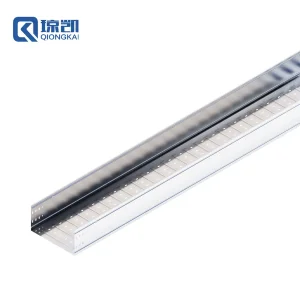
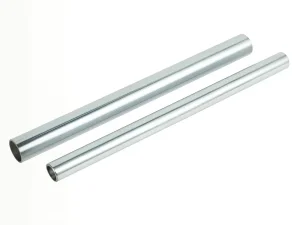
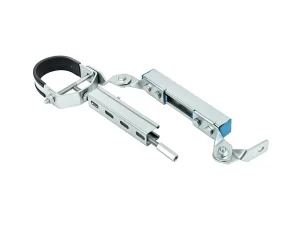
Specialized Seismic, Strut & Wire Mesh Solutions
Heavy-duty seismic bracing, stainless steel mesh, and engineered conduit supports ready for worldwide dispatch.
Engineering & Sourcing Questions Answered
Essential technical guidelines for EPC engineers, electrical contractors, and overseas procurement officers.
How do you calculate the maximum support span for heavy cable trays?
Support spans are dictated by NEMA VE 1 load classes (e.g., Class 12C, 20C) and IEC 61537 deflection formulas. Standard spans range between 1.5m to 3.0m for industrial facilities. The formula $w = (8 \times f \times Z \times \sigma) / L^2$ calculates allowable uniformly distributed load ($w$), where $L$ represents span distance, $Z$ is section modulus, and $\sigma$ is allowable bending stress. Our engineering department provides structural load curves for every profile configuration upon request.
What is the structural difference between PG and HDG coatings?
Pre-galvanized (PG) steel is continuously zinc-coated at the steel mill before fabrication to roughly 15-20 µm. When slit or punched, exposed sheared edges rely on galvanic sacrificial protection. Hot-dip galvanization (HDG) immerses the fully fabricated tray into molten zinc at 450°C, forming an impermeable multi-layer metallurgical zinc-iron alloy of 65-85 µm thickness, completely sealing all holes, welds, and punched ribs for severe outdoor and marine environments.
Can Shanghai Qiongkai manufacture custom strut channel thicknesses and punch slots?
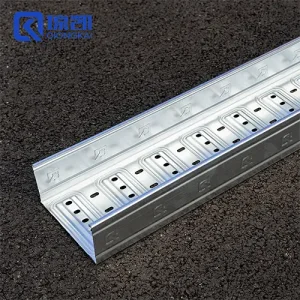
Yes. We operate 12 automated cold-roll forming lines supporting steel sheet thicknesses from 1.0mm up to 3.0mm. We manufacture standard 41×21, 41×41, 41×62, and 41×82 profiles in plain, continuous slotted, or back-to-back configurations with custom slot pitches, embossed measurement marks, and anti-seismic internal serrated return lips.
How does thermal expansion affect long outdoor cable tray runs?
Long outdoor tray systems experience significant thermal expansion and contraction ($\Delta L = L \times \alpha \times \Delta T$). For steel, the thermal expansion coefficient ($\alpha$) is approximately $12 \times 10^{-6} \text{ m/m/}^\circ\text{C}$. For aluminum or long steel runs exceeding 30 meters, slotted expansion splice plates and sliding hold-down clamps must be installed at calculated intervals to prevent structural buckling and anchor shear failure.
What quality testing and certification records accompany export consignments?
Every export shipment undergoes stringent QA/QC protocols. Deliverables include EN 10204 Type 3.1 Material Test Reports (chemical analysis and tensile yield), magnetic eddy-current coating thickness logs, salt spray test reports (ASTM B117), weld integrity visual inspections, and electrical continuity bonding verification reports.
How are international shipping volume and freight costs optimized?
Cable management systems can incur high freight penalties due to volumetric dead space if packed incorrectly. Qiongkai designs interlocking nested dimensions (e.g., nesting 100mm, 200mm, 300mm, and 400mm widths inside each other), secured with heavy-duty steel banding, corner protectors, and moisture-barrier shrink wrap on fumigated timber skids, maximizing 40ft High Cube container utilization up to 98% capacity.
Engineered Support Systems Tailored to Your Bill of Quantities
Collaborate directly with Shanghai Qiongkai’s technical engineering team. We review architectural drawings, calculate mechanical load requirements, provide BIM Revit families, and manufacture complete cable support ecosystems with certified export compliance.