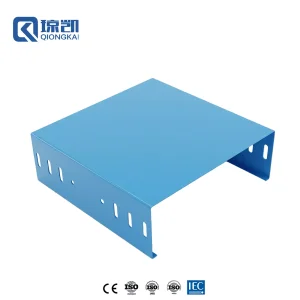
Precision Industrial Containment Formats
Select engineered cable routing assemblies manufactured directly across our ISO-certified Shanghai plants. Real-time factory direct availability and tailored dimensional specifications.
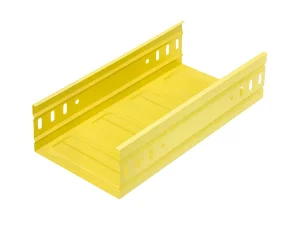
Fireproof Yellow Pre-Galvanized Powder-Coated Molded Cable Tray
View Specifications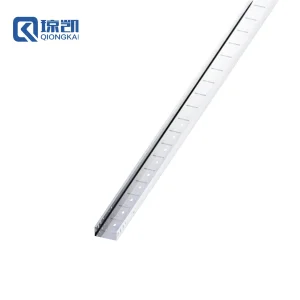
Heavy-Duty Reinforced Molded Pre-Galvanized Cable Tray (100*50)
View Specifications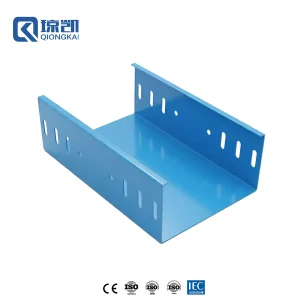
Powder-Coated Carbon Steel Pre-Galv Trunking Channel (RAL5015 Blue 200*100)
View Specifications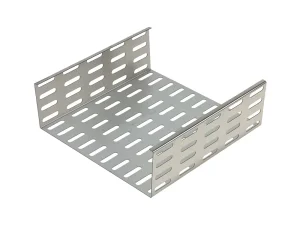
High-Aesthetic Stainless Perforated Cable Tray 300mm (SS304)
View Specifications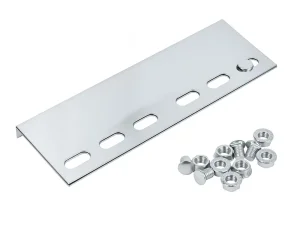
Engineered Pre-Galvanized Cable Tray Structural Connections & Splices
View Specifications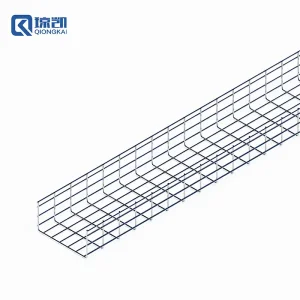
Industrial Welded GI Galvanized Wire Mesh Basket Tray (300*150)
View Specifications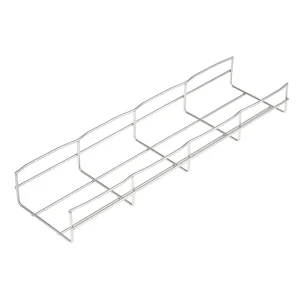
Precision Hygienic Stainless Steel Sanitary Cable Channel (50mm)
View Specifications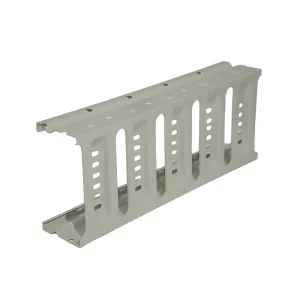
Customizable High-Strength Powder-Coated Ladder Perforated Tray
View SpecificationsThe International Commercial Ecosystem of Mild Steel (MS) Cable Trays
A macro-economic review of mild steel containment deployment across global utility megaprojects, data centers, and advanced manufacturing campuses.
Global Infrastructure Pressures
Mild Steel (MS) cable trays remain the definitive standard for industrial load-bearing electrical routing worldwide. The ongoing modernization of national power grids, renewable energy integration (solar PV and wind substation interconnections), and rapid industrial automation have surged demand for structural steel containment. Fabricated from commercial cold-rolled or hot-rolled carbon steel coils (IS 2062, ASTM A1011, Q235B), MS systems deliver unmatched tensile strength and deflection resistance compared to aluminum or non-metallic pathways.
Manufacturing Economies of Scale
The manufacturing hub centered in East Asia, notably led by Shanghai Qiongkai Industry's specialized industrial footprint (over 30,000 m² across 3 factories with 12 continuous roll-forming lines), has redefined global unit economics. Advanced automated tandem punch presses and cold-roll section formers achieve tight dimensional tolerances while lowering processing waste. This allows large-scale infrastructure projects across Europe, the Middle East, and Latin America to procure high-load containment at substantial savings relative to localized small-batch metal fabrication.
Commodity Volatility & Pricing Models
MS cable tray pricing fundamentally correlates with global hot-rolled coil (HRC) indexes and metal surface treatment commodities, specifically zinc spot prices for Hot-Dip Galvanizing (HDG) and thermoplastic powders. Transparent manufacturers structure price lists through baseline steel weight per meter formulas plus post-processing surcharges. Understanding thickness variances (1.2mm through 3.0mm) and protective coating thicknesses (from 15µm electroplate to 85µm+ HDG) is crucial for buyers to evaluate tender quotes accurately.
Structural Typology, Finishes & Price Determinants
Direct technical correlations between profile architecture, corrosion treatment chemistry, and overall project lifecycle expenditure.
| Profile Design Class | Typical Gauge (Thickness) | Standard Load Span | Protective Finish Matrix | Relative Cost Index | Primary Industrial Application |
|---|---|---|---|---|---|
| Perforated Bottom Tray | 1.2mm – 2.0mm | 1.5m – 2.5m | Pre-Galvanized (PG) / Powder-Coated | Baseline (1.0x) | Commercial basements, light industrial, data centers |
| Heavy-Duty Ladder Tray | 1.5mm – 3.0mm | 3.0m – 6.0m | Hot-Dip Galvanized (HDG) / Powder | 1.35x – 1.60x | Power generation, mining, heavy manufacturing, oil & gas |
| Solid Bottom Trunking (Trough) | 1.0mm – 2.0mm | 1.5m – 2.0m | Pre-Galvanized / Epoxy Powder Coated | 1.10x – 1.25x | EMI/RFI shielded instrumentation lines, clean rooms |
| Welded Wire Mesh Basket | 3.5mm – 6.0mm wire | 1.5m – 2.0m | Electro-Galvanized (EG) / SS304/316 | 0.90x – 1.20x | Server halls, telecom drops, food & beverage packaging |
| Reinforced Ribbed Molded Channel | 1.5mm – 2.5mm | 2.0m – 3.5m | Dual-Coat PG + Polyester Powder | 1.25x – 1.45x | Transit hubs, railway corridors, high-vibration sites |
Surface Treatment Longevity
Corrosion resistance dictates operational longevity. Pre-galvanized sheet (standard zinc mass Z120–Z275 g/m²) is optimized for non-condensing indoor environments. For exposed, high-humidity, or marine environments, post-fabrication Hot-Dip Galvanizing complying with ASTM A123 or ISO 1461 provides metallurgical zinc-iron alloy bonding exceeding 65–85 microns, yielding 30+ years of zero-maintenance lifecycle performance.
Structural Form & Deflection Mechanics
Adherence to NEMA VE-1 deflection limits (typically L/200 span/deflection criteria) is paramount. Qiongkai designs incorporate continuous roll-formed return flanges and engineered base corrugation ribs. These profile additions significantly increase section modulus without adding dead-weight steel, generating substantial savings on freight and structural overhead support ironwork.
Accessories & Total Cost of Installation (TCO)
The raw price list of straight tray segments represents only 60% of containment capital spend. The true installation cost lies in couplers, horizontal bends, vertical risers, reducers, and channel supports. Qiongkai's integrated modular snap-in accessories and pre-punched fishplates reduce field-cutting and welding labor by up to 45%, accelerating overall project delivery.
Engineered Solutions Across Challenging Terrains
Empirical case studies showcasing structural adaptations from extreme Middle Eastern desert temperatures to European coastal infrastructure.
Aviation Hub: Shanghai Hongqiao International
Deployment: Continuous-run CT series corrosion-resistant cable trunking and return-flange pre-galvanized trays.
Engineering Challenge: Strict smoke containment specifications and rapid seismic transition damping across heavily trafficked terminal transit concourses.
Outcome: Delivered over 45,000 meters of specialized enclosed channels guaranteeing full EMI screening for sensitive radar and baggage routing electronics.
Offshore & LNG Facilities: Qatar Desert-Coast
Deployment: Hybrid containment comprising custom-profiled support sections and extreme-corrosion FRP-lined heavy gauge steel trays.
Engineering Challenge: Ambient surface temperatures exceeding 52°C, intense UV solarization, and airborne hypersaline marine fog.
Outcome: Zero-degradation containment verified under third-party audit across 5 years of continuous chemical refining operations.
Heavy Agriculture Facility: Paraguay Agribusiness
Deployment: Cost-optimized heavy-duty pre-galvanized and powder-coated steel ladder containment systems.
Engineering Challenge: High atmospheric ammonia levels combined with restricted regional capital expenditure thresholds.
Outcome: Custom double-coated epoxy powder barrier over pre-galvanized mild steel yielded a 35% cost reduction over pure 304-grade stainless options while resisting organic biocorrosion.
Technical Roadmap: The Next Era of Containment Engineering
The cable support sector is advancing beyond passive steel stamping into high-performance, digitally modeled structural infrastructure:
Automated BIM/Revit Parametric Integration
Full-spectrum digital twins of Qiongkai MS trays, strut channels, and fittings allow mechanical consultants to run clash-detection analyses and verify weight loading dynamically prior to structural fabrication.
High-Strength Micro-Alloy Steels
Transitioning toward high-yield low-alloy (HSLA) steel compositions enables a 20% gauge reduction without compromising structural moment capacity, directly lowering shipping container weight and carbon footprint.
Eco-Passivated Zinc-Aluminum-Magnesium (ZAM)
Adoption of next-generation continuous metallic coatings (ZAM) offering cut-edge self-healing protection that matches batch HDG corrosion performance at lower thermal and energy expense.
Frequently Asked Questions for Project Buyers
Authoritative technical answers to common questions regarding specifications, certification standards, international logistics, and bill of quantities (BOQ) optimization.
What determines the exact price per meter for MS cable tray systems?
- Raw Material Thickness (Gauge): Ranging typically from 1.0mm to 3.0mm carbon steel sheets. Every 0.2mm variance significantly affects structural steel weight per meter.
- Width and Flange Height: Dimensional cross-section (e.g., 50x50mm up to 1000x150mm) defining total perimeter development of the roll-formed profile.
- Surface Metallurgy: Pre-Galvanized (PG) forms the baseline; Electro-Galvanized (EG) is comparable; Hot-Dip Galvanizing (HDG) adds weight-dependent zinc bath surcharges (typically $250-$450 per metric ton based on LME zinc prices); Thermoset powder coating adds cost based on RAL specification and prep chemistry.
- Perforation Complexity: Specialized stamping patterns, return-edge safety curls, and embossed stiffening ribs impact production speed.
Which international standards apply to Qiongkai MS Cable Tray production?
- IEC 61537: Cable management — Cable tray systems and cable ladder systems (testing electrical continuity, safe working load SWL, and impact resistance).
- NEMA VE-1 / CSA C22.2 No. 126.1: Metal Cable Tray Systems (defining load classes, deflection coefficients, and structural testing standards).
- ISO 1461 / ASTM A123: Standard specifications for zinc (hot-dip galvanized) coatings on iron and steel articles.
- BS EN 60529: Ingress protection ratings for covered trunking and solid bottom channels.
When should I specify MS Cable Tray over Stainless Steel or Aluminum?
How does Qiongkai support custom profiling, seismic zoning, and project BOQs?
What are the sea-freight packing and logistics protocols for global export?
Engineered Accessories, Trunking & Modular Channels
Complete your routing layout with factory-compatible seismic brackets, precision conduits, structural fittings, and high-performance perforated containment channels.
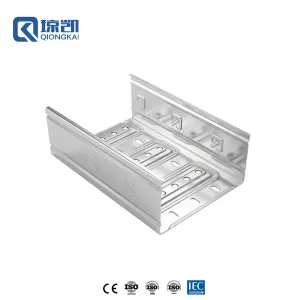
Reinforced Molded Pre-Galvanized Cable Tray (Side Plate Stiffener 300*100)
View Specifications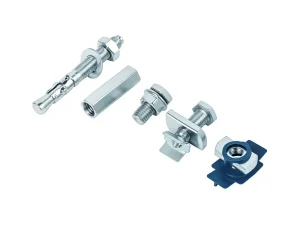
Seismic-Resistant Strut Support Hardware & Bracing Accessories
View Specifications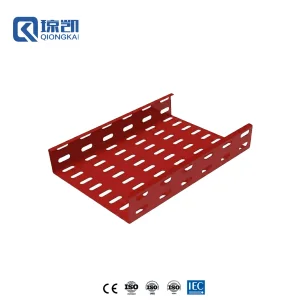
Powder-Coated PG Tray with Stiffening Ribs (RAL3020 Red 200*50)
View Specifications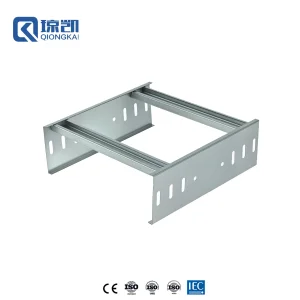
Industrial Powder-Coated Ladder-Type Cable Tray (200*100 Gray)
View Specifications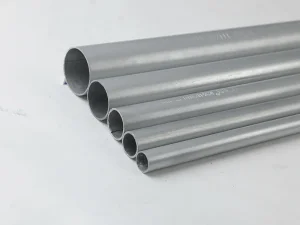
Heavy-Duty Galvanized Metallic Rigid Conduit Pipe (DN20 / DN25)
View Specifications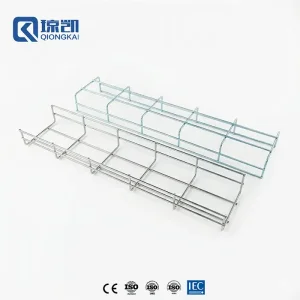
Carbon Steel EG & Stainless Wire Mesh Grid Basket (100*50)
View Specifications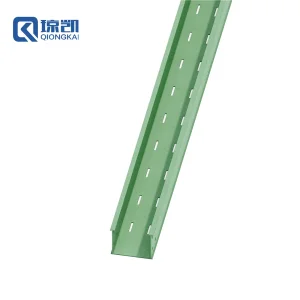
Corrosion-Proof Pultruded FRP Perforated Cable Tray (200*100)
View Specifications