Engineered Cable Ladders & Modular Containment Solutions
Explore heavy-duty ladder trays, perforated channels, and corrosion-resistant trunking engineered across our 3 Shanghai manufacturing plants.
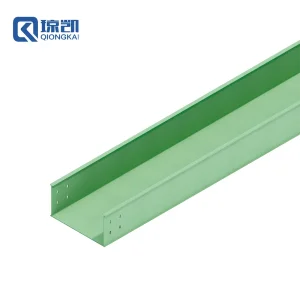
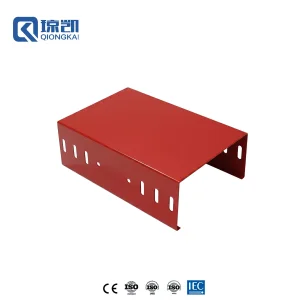
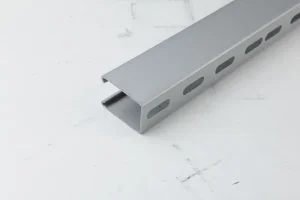
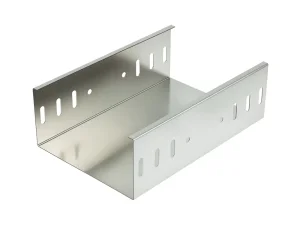
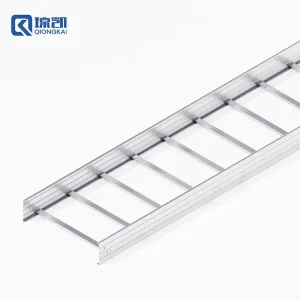
Hot-Dip Galvanized Cable Ladder Engineering Dynamics
A comprehensive examination of why heavy-duty HDG cable ladders remain the undisputed backbone for large-scale power conveyance and extreme environmental installations.
Over the past twenty years, electrical distribution architecture has undergone a radical transformation. As industrial processes automate and renewable generation scales exponentially, transmission current densities and conductor bundle diameters have surged. Standard wire baskets and light sheet-metal perforated trays, while sufficient for dry commercial server closets, are physically incapable of supporting high-amperage, cross-linked polyethylene (XLPE) power feeders over expansive structural spans. This transition has solidified the engineered Cable Ladder Hot Dip Galvanized (HDG) system as the mission-critical conduit of choice across modern infrastructure.
Metallurgical Bonding: Why Hot-Dip Batch Galvanizing Outclasses Electro-Plating & Pre-Galv
Pre-galvanized (mill-galvanized) coil provides standard atmospheric corrosion protection via a thin layer of zinc (typically 12 to 20 microns / 100–180 g/m²). However, during fabrication, post-stamping, punching of slots, welding of rungs, and shearing of side rails expose raw carbon steel edges. In contrast, Hot-Dip Galvanizing after fabrication (ASTM A123 / ISO 1461) involves completely submerging the fully welded ladder structure into molten zinc maintained at approximately 450°C (842°F).
This immersion induces an exothermic intermetallic reaction between the iron in the carbon steel (such as Q235B or Q355B) and the molten zinc bath. The resulting protective coat consists of four distinct intermetallic microstructural phases:
- Eta (η) Layer: 100% Zinc exterior layer; ductile, impact-absorbing, and resilient to site handling damage.
- Zeta (ζ) Layer: 94% Zn, 6% Fe alloy; distinct columnar crystals harder than the structural base steel (up to 209 DPH).
- Delta (δ) Layer: 90% Zn, 10% Fe alloy; hexagonal crystalline structure conferring severe mechanical abrasion resistance.
- Gamma (Γ) Layer: 75% Zn, 25% Fe alloy; a sub-microscopic metallurgical barrier physically interlocked with the iron substrate.
Because the ladder is galvanized after robotic rung swaging or structural seam welding, every internal void, drainage hole, punched connection slot, and joint receives uninterrupted, uniform coverage. This eliminates galvanic edge creep, crevice corrosion, and rust-bleed along weld seams.
Thermal Heat Dissipation
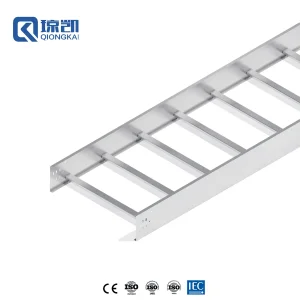
Cable ladders feature open rungs with spacing typically configured at 225mm, 250mm, or 300mm centers. This open structural design permits free convective air flow around heavy high-voltage conductors, preventing localized temperature elevation, mitigating thermal derating penalties, and optimizing overall conductor transmission efficiency.
Cathodic Self-Healing Protection
Should field installers scratch, drill, or abrade the ladder during mechanical installation, zinc acts as a sacrificial galvanic anode. In the presence of atmospheric electrolytes, zinc ions preferentially sacrifice themselves to protect exposed iron, sealing breaks up to 2mm in width without iron oxide spread.
Unmatched Structural Spanning
Configured with heavy I-beam or deep roll-formed C-channel side stringers (depths of 100mm, 125mm, 150mm, or 200mm), hot-dip galvanized ladders easily bridge structural spans between 3 meters and 6 meters under continuous loads exceeding 150 kg/m per NEMA VE-1 deflection guidelines.
Wholesale Hot Dip Galvanized Cable Ladder Price Modeling
Understanding the empirical cost architecture behind wholesale quotation models: raw steel indexation, zinc dipping economics, and freight efficiency metrics.
For international Engineering, Procurement, and Construction (EPC) directors, supply chain leads, and wholesale electrical distributors, budgeting cable management requires a granular deconstruction of wholesale cost drivers. Unlike lightweight standard products sold per unit, cable ladder hot dip galvanized pricing is intrinsically tied to four volatile industrial commodities:
- Structural Steel Spot Indices (HRC / Q235B / Q355B): Representing 55% to 65% of the net factory gate cost. High-yield carbon steel plate prices directly govern side rail and rung stamping base lines.
- Zinc Bath Spot Ingot Costs (LME - London Metal Exchange): Hot-dip galvanizing relies on high-purity SHG (Special High Grade) 99.995% zinc. Zinc bath energy costs (gas-fired furnace operation) constitute 20% to 28% of finished production expenses.
- Fabrication Complexity & Welding Automation: Robotic MIG welded rungs versus hydraulic mechanical swaging alters labor hours and post-weld slag cleaning cycles.
- Container Space Utilization (CBM vs Mass Weight): Assembled welded ladders consume significant container volume. High-volume export models often deploy knockdown nested designs or matched size nesting (e.g., nesting 600mm width ladders inside 800mm units) to cut maritime freight costs by up to 35%.
Wholesale Price Index: Estimated Price Range by Size & Duty Profile
The following benchmark table reflects wholesale manufacturing costs based on 3-meter section lengths, mild carbon steel construction, and average zinc immersion coating ≥ 65–85 μm (ISO 1461 compliance). Note: Figures are indicative wholesale benchmark ranges FOB Shanghai Port.
| Profile Specification | Side Rail (H×T mm) | Width Range (mm) | Zinc Coating Standard | Estimated Wholesale Price (USD/m) | Primary Industrial Sector |
|---|---|---|---|---|---|
| Light-Medium Industrial Ladder | 100 × 1.5 mm | 150 – 300 mm | ISO 1461 (≥ 65 μm) | $11.50 – $18.20 | Commercial, Rooftop HVAC, Light Processing |
| Standard Industrial Heavy Duty | 100 × 2.0 mm | 300 – 600 mm | ISO 1461 (≥ 75 μm) | $17.80 – $28.50 | Manufacturing, Substation Busways, Power Plants |
| Heavy Duty Infrastructure Ladder | 150 × 2.0 mm | 400 – 800 mm | ASTM A123 (≥ 85 μm) | $26.40 – $42.00 | Airports, Metro Rail, Mining Ore Conveyors |
| Extra Heavy Duty / Long Span Ladder | 150 × 2.5 mm | 600 – 1000 mm | ASTM A123 (≥ 85 μm) | $39.00 – $64.50 | LNG Terminals, Petrochemical Refineries, Marine |
| Ultra Heavy Industrial Power Rung | 200 × 3.0 mm | 600 – 1200 mm | Custom (≥ 100 μm) | $58.00 – $92.00 | Heavy Smelting, Hydroelectric Dams, Offshore |
Total Cost of Ownership (TCO): HDG vs Alternative Metallurgies
When evaluated over a 30-to-50-year project life cycle, Hot-Dip Galvanized carbon steel remains the most economically rational investment for Class C3 to C4 corrosivity zones. While Pre-Galvanized (PG) steel boasts an initial material savings of roughly 25% to 35%, its expected life outdoors or in unconditioned industrial corridors is often under 5 to 7 years before catastrophic structural oxidation occurs. Conversely, Stainless Steel 316L delivers impeccable corrosion resistance but carries an initial capital expenditure premium of 350% to 500% over HDG. For 80% of outdoor and industrial plants, specifying ASTM A123 Hot-Dip Galvanized ladders ensures the optimal balance of mechanical yield strength, zero field maintenance, and low initial capital expenditure.
Engineered System Solutions Across Global Mega-Projects
Demonstrated reliability engineered into landmark aviation, offshore gas extraction, utility infrastructure, and hyper-scale data centers.
Aviation & Mass Transit
Shanghai Hongqiao International Airport: Supplied corrosion-resistant trunking and heavy-duty cable containment runs for critical ground power distribution and passenger terminal substations, maintaining strict zero-failure vibration tolerances.
Offshore Oil & Gas / LNG Facilities
Qatar Offshore LNG Project: Engineered custom heavy-gauge profiled sections and HDG/FRP hybrid structural supports resilient against extreme coastal salinity, desert thermal swings, and hydrocarbon vapors.
Hyperscale Cloud Data Facilities
Deploying heavy-load overhead runway ladders engineered for massive multi-tier fiber-optic trunks and dual-feed busway feeds. Powder-coated HDG hybrids ensure electrostatic dissipation and zero zinc whisker shedding into data halls.
Severe Agro-Industrial Plants
Large-Scale Industrial Facility, Paraguay: Engineered optimized heavy-duty cable ladder systems capable of resisting continuous high-ammonia atmospheric emissions and constant high-pressure organic washdowns.
Tropical High-Humidity Corridors
Industrial Plants, Thailand: Supplied specialized FRP-lined steel ladders and ultra-thick HDG ladder runs designed to withstand monsoon cycles, high fungal exposure, and ambient relative humidity consistently exceeding 90%.
Global Standards Compliance & Factory Capabilities
Headquartered in Shanghai Songjiang Port Science and Technology City, our 3 specialized manufacturing factories operate 12 automated roll-forming and welding lines with 60+ heavy-duty machines.
Operating since 2005, Shanghai Qiongkai Industry Co., Ltd. coordinates every phase of manufacturing directly from raw coiled carbon steel slit-cutting to automated structural stamping, CNC bending, robotic rung assembly, and post-galvanizing passivation. By eliminating trading intermediaries, international clients receive end-to-end traceability, verified Mill Test Certificates (MTC), and certified third-party testing.
International Standards Architecture
Our hot dip galvanized cable ladder systems are engineered, manufactured, and audited against the world's most rigorous electrical and structural safety benchmarks:
NEMA VE-1 / CSA C22.2
Strict structural load capacity ratings (Class 12A, 12B, 12C, 20A, 20B, 20C). Verification of safe working load limits under designated span distances with defined safety deflection factors (L/200).
IEC 61537 / BS EN 61537
Full European standard compliance validating electrical continuity, bonding resistance (< 50 mΩ), thermal endurance, non-flammability of fittings, and safe working load (SWL) verification.
ASTM A123 / ISO 1461
Specification for zinc coatings on iron and steel products. Mandatory magnetic and eddy-current thickness testing, knife adhesion tests, and chemical bath quality checks to guarantee total passivation.
Factory Inspection & Pre-Shipment Validation Protocols
Before any container leaves our Songjiang production facility for dispatch via Shanghai Yangshan or Waigaoqiao shipping ports, each production lot undergoes standardized non-destructive and destructive testing:
- Magnetic Coating Thickness Verification: Tested per ISO 2178 across 10 discrete sample points per 3-meter section to ensure nominal coating density exceeds 65–85 μm.
- Preece Test (Copper Sulfate Immersion): Performed to confirm zinc layer uniformity and complete absence of pinhole substrate penetrations.
- Salt Spray Environmental Testing: 720 to 1000+ hours in neutral salt spray (ASTM B117) chambers with zero blistering or red rust breakthrough.
- Deflection & Dynamic Destruction Testing: Physical hydraulic weight simulation on finished ladder spans to confirm structural failure thresholds far exceed specified working loads.
Technical Roadmap: Next-Gen Cable Containment Systems
How advances in metallurgy, digital twinning, and low-carbon manufacturing are shaping the next generation of industrial cable ladders.
Zinc-Aluminum-Magnesium (ZAM) Alloys
Incorporating micro-alloyed coatings containing 3% Aluminum and 1.5% Magnesium into structural steel coils. ZAM delivers up to 4 times the corrosion resistance of traditional galvanized coatings with accelerated autogenous edge-healing capabilities in high-chloride marine environments.
Parametric BIM & Digital Twin Libraries
Full digitization of all Qiongkai ladder sections, bends, crosses, reducers, and seismic strut attachments into Autodesk Revit and Tekla BIM families. Facilitates Clash Detection and precise prefabricated spooling before delivery to the project site.
Carbon-Audited Closed-Loop Galvanizing
Modernizing hot-dip operations with waste-heat recycling, acid recovery systems, and automated flux conditioning. Reduces Embodied Carbon (Scope 1 and 2 GHG emissions) per metric ton of fabricated cable containment to comply with green building criteria (LEED / BREEAM).
Frequently Asked Questions: Wholesale HDG Cable Ladders
Addressing the technical, commercial, and logistic questions raised by procurement managers, structural consultants, and MEP engineers.
What is the standard zinc coating thickness for Hot Dip Galvanized cable ladders?
Under international benchmarks ASTM A123 / A123M and BS EN ISO 1461, steel components with material thicknesses between 1.5mm and 3.0mm require a minimum average coating thickness of 65 μm to 75 μm (approx. 460 to 535 g/m²). For heavy industrial side rails exceeding 3.0mm, the required coating thickness increases to 85 μm (600 g/m²). Custom dipping cycles can achieve 100+ μm upon client specification.
How does Hot-Dip Galvanizing differ from Pre-Galvanized (PG) cable ladders?
Pre-galvanized (PG) ladders are manufactured from continuously zinc-coated mill coils (15–20 μm thick). When cut, punched, and welded, the cut edges and weld points lose their zinc protection and become susceptible to oxidation. Hot-Dip Galvanized (HDG) ladders are completely fabricated, slotted, and welded from raw steel first, and then immersed into molten zinc. This creates an alloyed, metallurgical bond over 100% of the surface with 4 to 5 times the thickness of PG.
What factors most influence the wholesale price per meter of cable ladder?
Wholesale prices depend primarily on: (1) Current market steel plate coil costs (Q235B/Q355B); (2) Total steel mass governed by side rail height (100mm to 200mm) and sheet thickness (1.5mm to 3.0mm); (3) Rung spacing (typically 225mm to 300mm centers); (4) Spot LME zinc prices; and (5) Freight packing efficiency (nested sections significantly lower container shipping costs).
Are rungs mechanically swaged or robotic welded prior to galvanizing?
Shanghai Qiongkai produces both configurations based on engineering specifications. Robotic double-sided MIG welding ensures ultimate rigidity for high dynamic load installations, while automated mechanical hydraulic cold-swaging provides exceptional torsional flexibility and clean geometry. Both methods are completed prior to immersion in the galvanizing bath to guarantee complete corrosion coverage.
What is the standard production and shipping lead time for wholesale orders?
Standard containerized orders (20GP or 40HQ) typically require 15 to 25 working days from approved shop drawings to port loading. Supported by 12 assembly lines and an annual capacity reaching 50M+ USD, Qiongkai maintains raw steel buffer stocks to quickly accommodate fast-track infrastructure and emergency plant expansion projects.
Can you provide matching HDG strut channels, seismic bracing, and fittings?
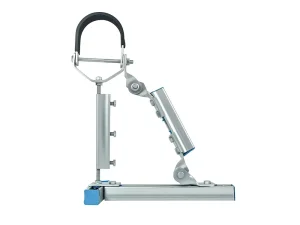
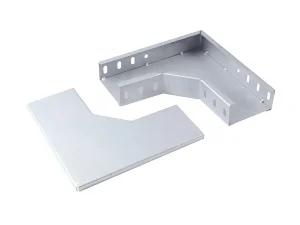
Yes. A complete cable management system requires coordinated structural supports. We engineer and manufacture matching 41×21, 41×41, 41×62, and 41×82 slotted strut channels, splice plates, expansion joints, 90-degree horizontal bends, tees, crosses, and seismic brackets all hot-dip galvanized to match your ladder specification.
Industrial Containment, Struts & Cable Route Accessories
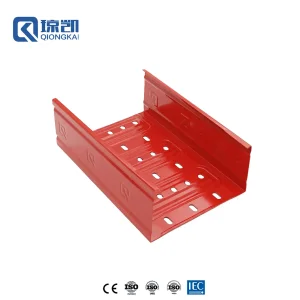
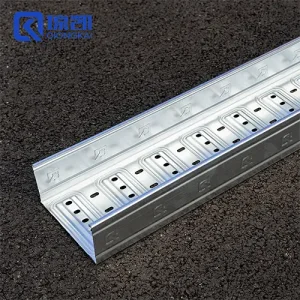
Complete your installation with heavy-duty reinforced molded trays, seismic channel framing, wire mesh baskets, and pre-galvanized conduit runs.