
Precision Modular Trays & Structural Accessories
Engineered to international electrical building codes (IEC 61537, NEMA VE 1 / VE 2, and UL 568), providing seamless coupling, structural rigidity, and accelerated job-site installation.
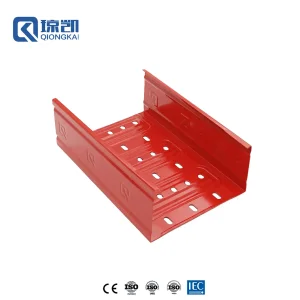
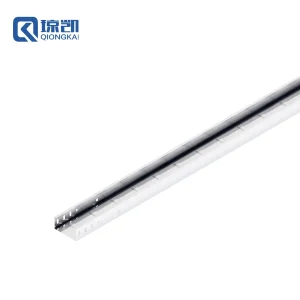
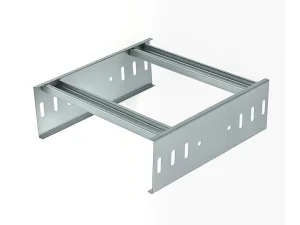
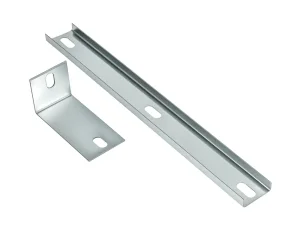
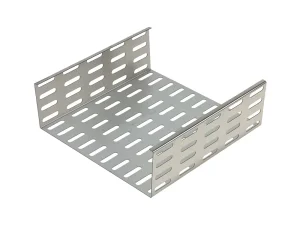
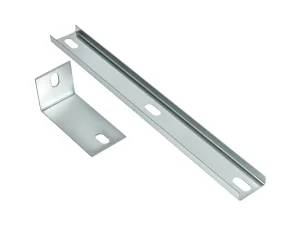
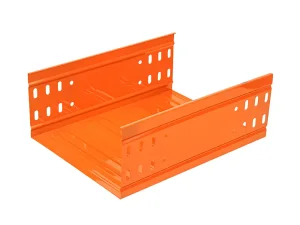
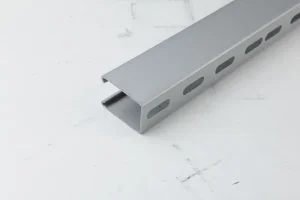
Evolutionary Dynamics in Cable Management Architecture
Transitioning from basic passive containment toward high-strength, seismically rated, and electrically continuous infrastructure systems.
The Macro Paradigm Shift: Engineered Modularity over Field Fabrication
In modern electrical design, the cable tray system is no longer viewed simply as a sheet-metal carrier for wires. With the exponential surge in hyperscale computing, offshore wind generation, chemical processing complexes, and automated manufacturing, cable support systems function as safety-critical structural assets. Field welding and ad-hoc mechanical alterations have become obsolete due to prohibitive labor costs, inconsistent field weld metallurgy, and hazardous hot-work restrictions. Instead, global EPCs (Engineering, Procurement, Construction) demand fully engineered, modular accessories—such as slotted strut channels, pre-formed bend couplers, hold-down clamps, seismic bracing joints, and snap-in divider strips—that bolt together seamlessly with guaranteed mechanical tolerances.
Furthermore, stringent adherence to IEC 61537 (Cable management — Cable tray systems and cable ladder systems) and NEMA VE 1 / VE 2 standards dictates that accessories must preserve total electrical continuity for earth-fault path dissipation while resisting structural deflection under maximum cable fill and dynamic seismic acceleration. When catastrophic electrical short-circuits occur, the peak electromagnetic repulsive forces between three-phase conductors can instantaneously exceed thousands of Newtons per meter. Without laboratory-validated cleat supports, reinforced splice plates, and calibrated hold-down accessories, entire tray runs risk catastrophic torsional collapse.
Thermal & Ampacity Modeling
Higher cable power densities require scientifically calculated ventilation ratios. Precision-perforated tray beds and molded ladder rungs prevent hot-spot conductor degradation, reducing line resistance and energy waste in high-ampacity distribution risers.
Seismic & Wind Resilience
Compliant with ASCE 7-22 and Eurocode 8 seismic parameters. Slotted back-to-back 41×82 struts combined with multi-axis seismic brackets prevent sway-induced tray ruptures during seismic events or severe wind shears on exposed rooftop runs.
Corrosion Longevity Engineering
Multi-environment metallurgy tailored to C1–C5 coastal and marine zones (ISO 12944). Utilizing batch Hot-Dip Galvanizing, Marine Stainless (SS316L), Pultruded Fiberglass (FRP), and Architectural Thermoset RAL Powder coatings.
Mission-Critical Sectors & Demanding Specifications
Global procurement directors require tailored containment configurations to mitigate risk across diverse industrial ecosystems.
AI & Cloud Data Centers
Hyperscale facilities require extreme cabling cleanliness, electro-magnetic shielding, and high-volume fiber routing. Electro-galvanized (EG) wire mesh trays and powder-coated runway ladders prevent zinc whisker short circuits inside white spaces.
Offshore Oil, Gas & LNG
Exposed to extreme airborne chlorides and hydrogen sulfide fumes. SS316L molybdenum-bearing stainless steel and heavy pultruded FRP composite trays resist aggressive pitting corrosion (PREN > 25) on drilling decks and floating storage hulls.
Solar PV & BESS Plants
Utility-scale solar fields require outdoor ultraviolet endurance and thermal cycling resilience across 25+ year design lives. Heavy-duty hot-dip galvanized (HDG > 85μm) slotted trunking and cable rungs withstand high UV and sandstorm wear.
Pharma & Food Processing
Sanitary washdown environments demand zero entrapment zones. Pickled and passivated SS304/SS316 perforated and wire mesh systems allow caustic clean-in-place (CIP) steam sanitization without chemical degradation or microbial harbors.
Intelligent Roll-Forming, Automation & Supply Chain Resilience
Shanghai Qiongkai Industry leverages two decades of smart manufacturing to ensure dimensional accuracy, structural consistency, and rapid global delivery.
The Engineering Engine: Automated Fabrication from Coil to Container
Operating across 3 modern production facilities spanning over 30,000 square meters in Songjiang, Shanghai, Qiongkai utilizes 12 continuous high-speed cold-roll forming lines and approximately 60 heavy-duty hydraulic and mechanical stamping presses. Our smart manufacturing protocols integrate automated servo feeders that punch precision slot and perforation geometries within a continuous tolerance of ±0.2 mm. This robotic precision ensures that every length of strut channel (41×21, 41×41, 41×62, and 41×82) and matching L-bracket, flat connector, and splice plate locks seamlessly on-site without reaming or structural rework.
Our deep integration within the Yangtze River Delta metallurgical industrial cluster grants Qiongkai unmatched raw material hedging and supply chain elasticity. From structural prime carbon steel (Q235B / Q355B) to high-tensile austenitic stainless steel (AISI 304 / 316 / 316L), materials arrive with full Mill Test Certificates (EN 10204 3.1). With seamless access to Shanghai Yangshan Deep-Water Port and Waigaoqiao Terminals, factory-loaded 40ft High Cube containers clear customs and load onto ocean freighters within 48 hours of final automated bundling.
Robotic Continuous Welding
Our heavy-duty ladder rungs and back-to-back 41×82 struts undergo automated pulsed robotic welding, ensuring continuous penetration, zero spatter, and structural deflection compliance under NEMA 20C load classes.
Eco-Friendly Surface Coating
Our electrostatic powder coating line utilizes automated multi-stage phosphate washing and closed-loop recovery systems. It achieves uniform 60–120μm film thickness in custom RAL specifications with exceptional scratch and UV resistance.
Rigorous In-House QA Lab
Every production batch is verified via calibrated universal tensile load rigs, magnetic thickness gauges for zinc coatings, cross-hatch adhesion testing, and continuous neutral salt spray chambers (ASTM B117).
Metallurgical & Finishing Selection Guide
A reference engineering table detailing mechanical properties, corrosion resistance thresholds, and recommended project locations.
| Material / Treatment | Reference Standards | Zinc / Coating Thickness | ASTM B117 Salt Spray | Operating Temp Range | Primary Industrial Application |
|---|---|---|---|---|---|
| Pre-Galvanized (PG) | EN 10346, ASTM A653 | 12 – 20 μm (Z180–Z275) | 72 – 120 Hours | -20°C to +120°C | Commercial office fit-outs, suspended ceiling plenum, dry electrical rooms |
| Electro-Galvanized (EG) | ASTM B633, BS 7371 | 8 – 15 μm | 48 – 96 Hours | -20°C to +100°C | Indoor telecom data halls, wire mesh basket trays, low-humidity server suites |
| Hot-Dip Galvanized (HDG) | ISO 1461, ASTM A123 | 65 – 100 μm (Batch Immersion) | 720 – 1,500+ Hours | -40°C to +200°C | Heavy outdoor industrial, power substations, open chemical plants, mining |
| Stainless Steel 304 | AISI 304, EN 1.4301 | Natural Passivated Oxide | 1,000+ Hours | -196°C to +550°C | Food and beverage processing, clean rooms, pharmaceutical washdowns |
| Stainless Steel 316 / 316L | AISI 316L, EN 1.4404 | Passivated (2-3% Mo) | 3,000+ Hours | -196°C to +600°C | Offshore drilling rigs, marine LNG, seawater desalination, coastal chemical |
| Pultruded FRP Composite | ASTM D3917, UL 94 V-0 | Isophthalic / Vinyl Ester Resin | Immune to Chlorides | -50°C to +130°C | Severe chemical battery plants, corrosive wastewater handling, tropical acid vapor |
| Thermoset Powder Coat | Qualicoat, ISO 12944 | 60 – 120 μm Polyester/Epoxy | 500 – 1,000 Hours (Over PG) | -30°C to +110°C | Circuit identification (RAL 3020 Red for Fire, RAL 5015 Blue for Data), architectural aesthetic |
Field Case Studies & Localized Engineering Solutions
Verified installation track records demonstrating performance across demanding worldwide operational environments.
Shanghai Hongqiao International Airport
Supplied extensive corrosion-resistant CT series trunking and seismic-rated modular channel networks across underground transit tunnels. Successfully mitigated extreme vibration caused by heavy passenger rail and runway load dynamics.
Ras Laffan LNG Liquefaction Terminal
Engineered customized 316L stainless steel cable ladder accessories and high-performance FRP supports capable of enduring ambient temperatures reaching +55°C, high UV radiation, and hyper-saline Persian Gulf seawater spray.
Chonburi Outdoor Industrial Complex
Supplied specialized FRP-lined high-load steel cable trays designed for outdoor chemical processing pipelines. Addressed tropical monsoons, high humidity, and airborne acid vapors without structural coating delamination.
Industrial Swine & Agri-Processing Complex
Engineered a cost-effective, heavy-duty pre-galvanized and reinforced molded tray assembly designed to resist biogenic ammonia vapor emissions, delivering reliable power cabling on a strict capital budget.
Northern Italy Smart Logistics & Solar Park
Delivered custom hot-dip galvanized (HDG) perforated trays with factory-matched channel accessories, satisfying stringent European CE electrical directives and ensuring zero-defect installation across rooftop arrays.
Heavy Structural Channels, Baskets & Conduits
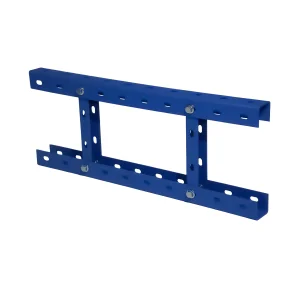
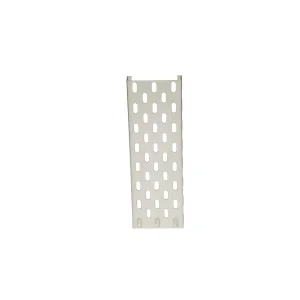
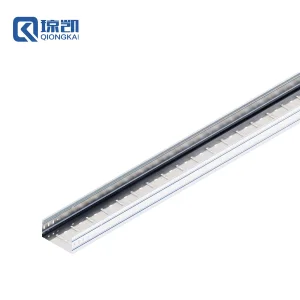
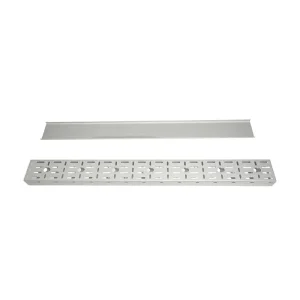
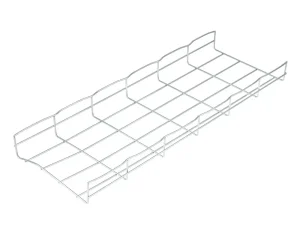
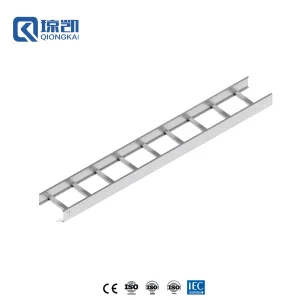
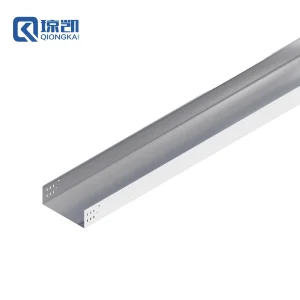
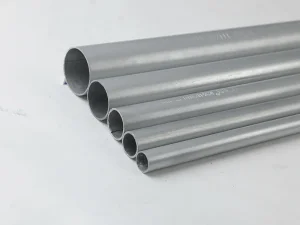
Round out your cable infrastructure bill of materials with heavy-duty structural channels, wire mesh grids, stainless perforated trays, and industrial conduits.
Frequently Asked Engineering & Procurement Questions
In-depth responses regarding compliance, structural calculations, finish selections, and international export logistics.
What specific accessory components are critical to ensure electrical continuity in cable tray runs?
Under IEC 61537 Section 9.3 and NEC Article 392.6, cable tray assemblies may function as Equipment Grounding Conductors (EGC) provided the electrical impedance across junctions does not exceed strict micro-ohm thresholds. To guarantee electrical continuity without relying on external copper bonding jumpers at every connection, procurement teams must specify serrated lock-nut fasteners, high-contact bonding splice plates, and unpainted or copper-bussed connection points.
In powder-coated or FRP systems, standard splice hardware does not provide electrical continuity. In these applications, Qiongkai supplies tin-plated copper grounding jumpers with UL-listed bimetallic terminal lugs to bridge every tray length and prevent hazardous static voltage accumulation or ground-fault arcing.
How do you prevent galvanic corrosion when mounting dissimilar metals (e.g., SS316 trays on galvanized struts)?
Galvanic corrosion occurs when two metals with differing electrochemical potentials are in physical electrical contact in the presence of an electrolyte (such as atmospheric moisture or salt spray). Stainless steel (passive) is significantly more noble than zinc-coated carbon steel. Direct contact will rapidly sacrifice the zinc layer on the strut, leading to premature red rust.
To eliminate this failure mode, Qiongkai engineers non-conductive isolation kits. These include UV-resistant nylon or EPDM isolation pads, non-conductive flanged bushings, and vulcanized neoprene washers that physically separate the stainless steel tray flange from the galvanized strut channel and carbon steel fasteners.
How does NEMA load class classification affect the selection of support brackets and channel spans?
NEMA VE 1 categorizes cable tray systems by their Safe Working Load (SWL in lbs/ft or kg/m) over designated support spans (typically 6, 8, 10, 12, or 20 feet). For instance, a NEMA 12C rating indicates the tray must support 100 lbs/ft (149 kg/m) over a 12-foot (3.66 m) span with a safety factor of 1.5. As support spans increase, the deflection of the tray and its cantilever brackets follows beam deflection mechanics:
Δ = 5wL⁴ / 384EI (for distributed load under simple support).
If supports are spaced beyond calculated maximum deflection limits (typically L/200), trays can sag, pulling cables taut and risking joint separation. Qiongkai's application engineering team calculates moment of inertia (I) and section modulus (Z) to verify whether single 41×41 channels, reinforced back-to-back 41×82 struts, or gusseted triangular brackets are required.
Can Qiongkai fabricate custom non-standard profiles, radius bends, and reducer plates?
Yes. With over 60 heavy-duty CNC units and dedicated tooling workshops, Qiongkai manufactures custom widths (from 50mm up to 1200mm), variable side flange heights (50mm, 75mm, 100mm, 150mm, 200mm), and non-standard gauge thicknesses (1.0mm to 3.0mm). For complex physical routing obstructions, we engineer custom internal/external radius bends (300mm, 600mm, 900mm radius), horizontal tees, 45°/90° crosses, and eccentric/concentric reducer plates tailored directly to client 3D BIM models (Revit/STEP files).
What quality documentation and export testing certifications accompany each shipment?
Every commercial export order is backed by an inspection document package, including:
- EN 10204 3.1 Inspection Certificate confirming material chemical heat analysis and mechanical tensile yield strength.
- Coating Thickness Calibration Reports measuring dry film thickness (DFT in μm) across random lot samples.
- ASTM B117 / ISO 9227 Salt Spray Test Data for anti-corrosion verification.
- Third-Party Witness Inspection Reports (SGS, TÜV, Bureau Veritas) upon client request prior to container sealing.
What are the lead times and container loading optimizations for sea freight delivery?
Standard catalog components (standard PG/HDG strut channels, standard wire mesh runs, and recurring brackets) are maintained in semi-finished buffer inventory with typical dispatch times of 7 to 10 days. Customized roll-formed orders or specialized SS316L/FRP assemblies typically require 2 to 3 weeks for full production runs of multiple 40ft High Cube containers.
Our automated nesting software organizes product nesting inside shipping containers—sliding smaller channel sizes inside larger tray troughs and strapping with anti-scratch timber dunnage and heavy plastic shrouds. This maximizes freight payload up to the 26–28 metric ton container limit, driving down international sea freight cost per meter.
Engineering Your Global Cable Routing Infrastructure
Connect directly with Shanghai Qiongkai's senior technical team. Receive comprehensive product catalogs, custom CAD/BIM drawing libraries, structural load analysis, and competitive factory-direct pricing for your next project.