
Precision-Formed Strut Channels & High-Capacity Cable Trays
Engineered cold-formed channel sections, threaded hanging rods, seismic gussets, and perforated containment solutions manufactured with continuous automated precision.
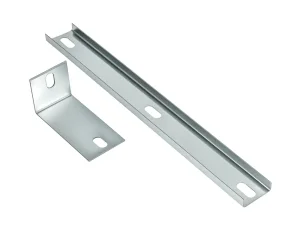
Wholesale Pre Galvanized L typed bracket and Bracket Manufacturer, Supplier
View Specifications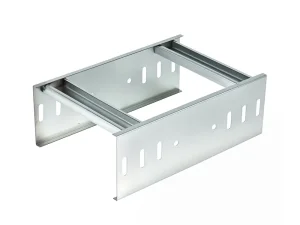
Buy 304 and 316 stainless steel ladder type cable tray customizable perforated design Manufacturer, Factory
View Specifications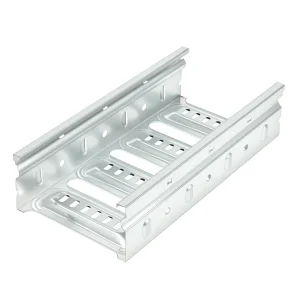
Buy Pre Galvanized High load capacity cable tray Factory, Price
View Specifications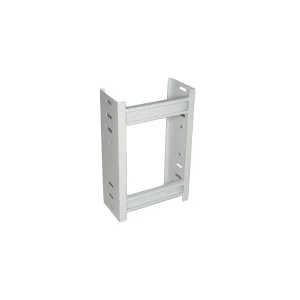
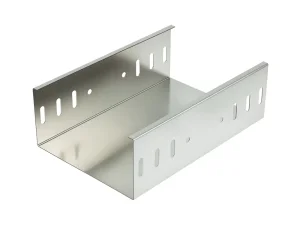
Buy Stainless Cable Tray With Perforation Supplier, Factories
View Specifications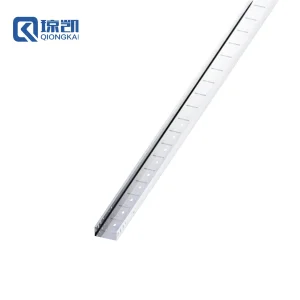
Wholesale Cost Saving Heavy Duty Reinforced Molded Pre Galvanized Cable Tray with less perforation 100*50 Suppliers, Factory
View Specifications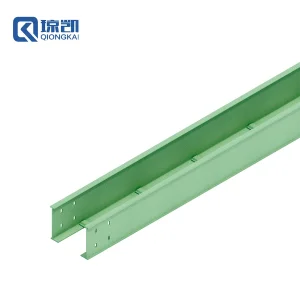
Structural Mechanics of Cold-Formed Unistrut Framing
Analyzing structural beam deflection, section modulus, cold-working strain hardening, and dynamic channel-nut interlock performance under extreme tensile loading.
Profile Geometry & Section Modulus
Standardized 41mm width architecture including 41×21mm, 41×41mm, 41×62mm, and 41×82mm (back-to-back welded double profiles). Cold-roll forming introduces localized work hardening along internal bend radii, elevating yield strength ($f_y$) beyond 33 ksi (230 MPa) to 50 ksi (345 MPa), significantly maximizing the cross-sectional moment of inertia ($I_x$) against bending axis deflection.
Return Lip & Spring Nut Interlocking
The inward-curved return lips feature precision cold-formed serrations designed to interlock with the case-hardened gripping grooves of spring channel nuts. This provides a positive mechanical bite that resists longitudinal slip forces ($V_{slip}$) up to 6.8 kN (1,500 lbs) per bolt point, preventing structural slippage under continuous mechanical vibration, thermal cycling, or seismic displacement.
Deflection Limit Criteria ($L/200$ vs $L/360$)
For MEP trapeze runs supporting rigid electrical conduits, heavy cable trays, or chilled water pipework, maximum allowable mid-span deflection is calculated under Uniformly Distributed Loads (UDL). While standard structural building codes mandate a deflection limit of $\delta \le L/200$, mission-critical hyperscale data center runs adhere to a stringent $\delta \le L/360$ threshold to prevent joint strain on high-voltage raceways.
Achieving specified friction-grip capacities relies on certified bolt tightening torque. For grade 5 or 8.8 structural fasteners engaged with electro-galvanized or hot-dip galvanized spring nuts: M6 fasteners require 8 N·m; M8 fasteners require 19 N·m; M10 requires 42 N·m; and M12 structural bolts require 77 N·m. Over-torquing can deform the strut’s internal return lips, whereas under-torquing creates severe risks of slip-through during seismic acceleration cycles.
Material Science, Alloy Compositions & Surface Metallurgy
Comparative analysis of sacrificial zinc barriers, austenitic stainless steel passivated alloys, and non-metallic pultruded composites across harsh industrial corrosive atmospheric categories (ISO 12944 C1 to CX).
| Material / Treatment | Applicable Standards | Coating / Layer Thickness | Corrosion Category (ISO 12944) | Typical Industrial Target Environments |
|---|---|---|---|---|
| Pre-Galvanized (PG / Mill Galv) | ASTM A653 / EN 10346 | Z180 - Z275 ($14 - 20\ \mu\text{m}$) | C1 - C2 (Dry Indoor) | Commercial office plenums, data hall false floors, HVAC utility runs. |
| Hot-Dip Galvanized (HDG) | ASTM A123 / ISO 1461 | $65 - 85\ \mu\text{m}\ (460 - 610\ \text{g/m}^2)$ | C3 - C4 (Industrial Outdoor) | Refineries, power substations, open-air bridge infrastructure, rooftop racking. |
| Austenitic Stainless Steel 304 | ASTM A240 / EN 10088-2 | Self-healing $Cr_2O_3$ passive layer | C3 - C4 (Chemical / Clean) | Food and beverage processing lines, pharmaceutical manufacturing, indoor pools. |
| Marine Stainless Steel 316 / 316L | ASTM A240 / EN 1.4404 | Molybdenum-stabilized ($2-3\%\ Mo$) | C5 - CX (Marine Coastal) | Offshore oil rigs, coastal desalination plants, LNG import terminals, splash zones. |
| Fiberglass Reinforced Polymer (FRP) | ASTM D3917 / UL 94 V-0 | Pultruded Isophthalic / Vinyl Ester | CX (Severe Chemical) | Battery manufacturing facilities, electroplating workshops, chlorine washdown areas. |
| Electrostatic Powder Coated (RAL) | ASTM D3451 / ISO 2810 | $60 - 90\ \mu\text{m}$ Polymer resin | C2 - C3 (Aesthetic / Color ID) | Mission-critical data center cable routing (A/B dual-bus separation via color code). |
Sacrificial Anodic Protection of HDG
In hot-dip galvanized steel, zinc acts as a sacrificial anode. If the strut profile is cut, punched, or scratched in the field, zinc carbonates and hydroxides migrate across exposed bare iron edges via galvanic action, halting under-film corrosion creeping and preventing structural embrittlement throughout a 30- to 50-year external service lifespan.
Mitigating Dissimilar Metal Galvanic Corrosion
When installing stainless steel cable trays or copper ground wires onto galvanized carbon steel Unistrut, dielectric isolation pads, non-conductive nylon washers, or zinc-nickel coated fasteners must be utilized. Direct contact between dissimilar metals with an electrolytic potential difference exceeding 0.15V will accelerate rapid galvanic degradation of the zinc layer.
China Factory 4.0: Automated Precision & Export Resilience
Operating from Shanghai Qiongkai Industry's specialized manufacturing bases, integrating raw coil continuous leveling, high-speed multi-stage CNC piercing, cold roll forming, and automated bundle packaging.
16-Station In-Line Roll-Forming
Each profile undergoes gradual, stress-free cold forming through 16 to 22 sequential hardened alloy tooling roll stations. This eliminates micro-cracking at channel corners, maintains uniform wall thickness tolerances within $\pm 0.08\text{ mm}$, and preserves perfect 90-degree flange orthogonality across lengths up to 6 meters.
Continuous Optical Laser Inspection
In-line optical measurement arrays continuously monitor channel opening width ($22.2\text{ mm}\ \pm 0.38\text{ mm}$ per MFMA standards), return lip height, and slot center-to-center pitch in real-time. Any automated dimensional drift triggers immediate robotic servo calibration, guaranteeing zero-defect fit-up on job sites.
Shanghai Deepwater Port Logistics
Located in Songjiang Science & Technology City, Shanghai, our production clusters operate within an 80-minute transit radius to Yangshan Deep-Water Port and Waigaoqiao Terminals. Direct maritime connectivity delivers compressed shipping lead times, integrated custom container stuffing, and uninterrupted global container dispatch.
Macro-Industry Solutions & Engineered Case Deployments
From extreme tropical humidity to mission-critical aviation infrastructure, explore how Qiongkai support assemblies perform across demanding physical environments.
Hyperscale Cloud Data Centers
High-density optical fiber pathways and copper power distribution require modular trapeze framing with minimal structural dead load. Custom electrostatic powder-coated 41×41mm struts and basket wire mesh trays ensure zero airflow obstruction and rapid overhead re-cabling for hyper-growth server halls across North America and Europe.
Offshore LNG Terminal (Qatar)
Delivered custom heavy-gauge stainless steel 316L slotted profiles and matching hardware for an offshore LNG liquefaction facility in Qatar. Designed to withstand continuous salt fog, cyclic desert winds, and high ambient chloride concentrations, maintaining structural integrity without pitting or crevice corrosion.
Aviation Hub: Shanghai Hongqiao
Supplied corrosion-resistant CT series enclosed cable trunking and rigid support channel brackets for the Shanghai Hongqiao International Airport modernization project. Addressed stringent public safety fire ratings, electromagnetic shielding (EMC), and vibration attenuation within sub-runway transit tunnels.
Tropical High Heat (Thailand)
Engineered an advanced hybrid cable containment system utilizing fiberglass-lined (FRP) steel cable trays and UV-stabilized composite strut brackets for an outdoor industrial complex in Thailand, successfully insulating power cabling from extreme ambient heat and tropical rainfall degradation.
Agro-Industrial Livestock (Paraguay)
Developed a high-strength, value-engineered heavy-duty cable tray and hot-dip galvanized bracket system for a sprawling agricultural livestock plant in Paraguay. Solved intense biogenic ammonia gas and hydrogen sulfide corrosion challenges within tight project CAPEX constraints.
European Infrastructure (Italy)
Exported multi-container batches of high-tolerance HDG cable trays, spring nuts, cantilever brackets, and perforated profiles fully certified to European CE and IEC 61537 standards, seamlessly integrating with European contractor BIM assembly grids.
Global Enterprise Procurement, TCO & Quality Traceability
Evaluating total cost of ownership (TCO), customized cut-to-length prefabrication, nested container logistics, and comprehensive EN 10204 Type 3.1 chemical/physical traceability.
Cut-to-Length Factory Prefabrication
Field-cutting heavy steel strut channels destroys protective galvanizing, generates fire hazards, and incurs high domestic labor costs. Qiongkai offers precision factory pre-cutting, chamfering, and automated CNC slot punching according to your Bill of Quantities (BOQ), eliminating on-site hot work permits and reducing MEP installation schedules by up to 35%.
Nested Shipping Volume Optimization
Freight rates directly dictate landed material costs. Our engineering team calculates optimal profile nesting geometry—interleaving 41×21mm channels within 41×41mm channels, and bundling smaller cable trays within larger raceways. Reinforced steel-strapped crating with VCI anti-corrosion barrier wrapping maximizes shipping container volumetric utilization above 92%.
MTC EN 10204 Type 3.1 Traceability
Every wholesale production heat is accompanied by an authenticated Mill Test Certificate verifying yield strength, tensile elongation, carbon equivalent values, and zinc coating mass ($g/m^2$). Complete raw material heat number stamping ensures end-to-end transparency demanded by tier-1 global EPC auditing bodies.
Technical Roadmap & Future Outlook: Next-Gen Modular Support
Pioneering the transition from manual on-site assembly to industrialized pre-engineered modular MEP framing, digital twins, and sustainable low-carbon steelmaking.
BIM Level 3 & Parametric Digital Twins
Full integration of Autodesk Revit and IFC native families at LOD 400 (Level of Development). Engineers can download precise digital twin models containing dynamic structural load calculations, exact bolt centers, clash-detection volumes, and automated bill-of-material scheduling, eliminating costly design discrepancies prior to steel fabrication.
DfMA (Design for Manufacture & Assembly)
Shifting construction job sites into clean assembly hubs. Multi-service modular corridor racks combine electrical cable trays, fire suppression piping, HVAC ducting, and communication raceways into a single factory-assembled modular Unistrut space-frame, crane-lifted into commercial skyscrapers to compress MEP cycle times.
Low-Carbon "Green Steel" Production
Committed to reducing Scope 1 and Scope 2 embodied carbon footprints. Transitioning coil procurement toward Electric Arc Furnace (EAF) processing powered by renewable energy, and pioneering trivalent chromium ($Cr^{3+}$) passivated eco-galvanizing lines that comply with EU RoHS and REACH environmental directives.
Localized Support & International Compliance Assurance
Strictly compliant with American, European, and International structural building codes, ensuring zero-barrier project approval across global jurisdictions.
MFMA-4 Standard
Complies with Metal Framing Manufacturers Association guidelines for channel dimensions, mechanical loading, structural tolerances, and spring nut pull-out safety factors.
IEC / EN 61537
International standard governing cable management systems, validating electrical continuity, safe working load (SWL) deflection thresholds, and fire test resistance.
Seismic ASCE 7 / IBC
Rigid and cable-braced seismic restraint configurations calculated to resist severe lateral earthquake accelerations in accordance with the International Building Code.
ISO 9001 / 14001
Internationally accredited quality and environmental management systems overseeing raw material receipt, process controls, and final export dispatch auditing.
Heavy-Duty Trays, Molded Aluminum & Trunking Systems
Complete cable management lines engineered to bolt directly onto Unistrut trapezes, wall cantilevers, and structural ceiling framing assemblies.
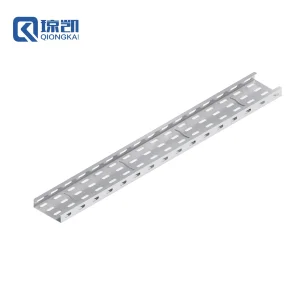
Wholesale Reinforced Medium duty Pre-galvanized Hot-dip-galvanized Perforated Cable Tray 100*25 Factory, Price
View Specifications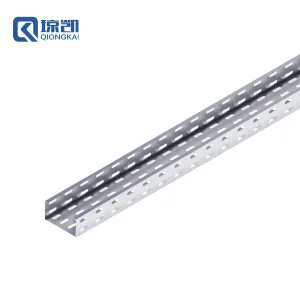
Wholesale Pre-galvanized Hot-dip-galvanized Perforated Cable Tray 100*50 Factory, Factories
View Specifications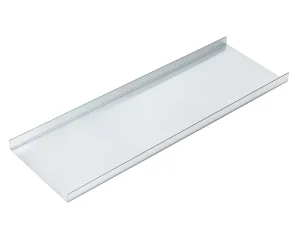
Buy Pre-Galvanized Cable Tray Cover Cable Protection Manufacturers, Supplier
View Specifications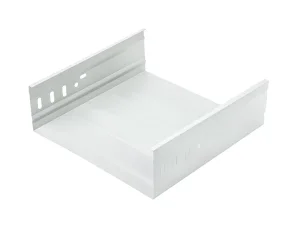
Wholesale Lightweight tenacity aluminium molded cable tray Suppliers, Price
View Specifications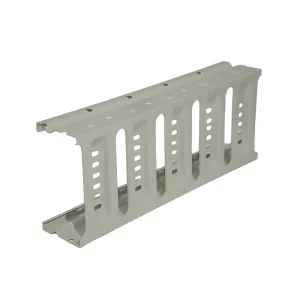
Buy Powder Coated Customizable Ladder Perforated Cable Tray Manufacturer, Factory
View Specifications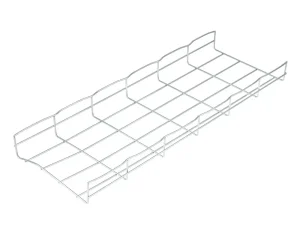
Wholesale Pre Galvanized grid cable tray 100mm Supplier, Factories
View Specifications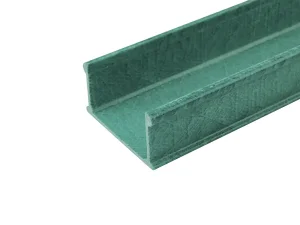
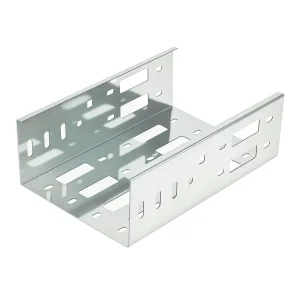
Wholesale Custom Size Pre Galvanized Perforated Cable Tray Factory, Price
View SpecificationsFrequently Answered Engineering & Procurement Questions
In-depth responses covering channel deflection limits, slip resistance, seismic bracing geometry, and factory-direct procurement terms.
How is the allowable beam load calculated for standard 41×41mm strut channel?
Allowable beam load calculations follow the American Iron and Steel Institute (AISI) Specification for the Design of Cold-Formed Steel Structural Members and MFMA-4 Section 5. Under a simply supported, uniformly distributed load (UDL) across span length $L$ with maximum allowable bending stress of 25,000 psi (172 MPa), the allowable load $W$ is determined by:
W = (8 × S × F_allow) / L
Where $S$ is the section modulus about the major axis ($X-X$) and $F_{allow}$ is allowable flexural design stress. For deflection-sensitive MEP runs (such as optical data trays), mid-span deflection $\delta = (5 \times W \times L^3) / (384 \times E \times I)$ is verified to ensure it does not exceed $L/200$ or $L/360$. For instance, a 41×41mm channel (12 gauge, 2.5mm thick) spanning 1,500mm safely supports a central concentrated load exceeding 3.8 kN.
What is the difference between solid, slotted, and half-slotted channel profiles?
Solid unperforated strut provides maximum torsional rigidity and the highest section modulus, making it preferred for structural framing columns, seismic sway braces, and high-load cantilever brackets. Slotted channels (typically featuring $14\times28\text{ mm}$ or $11\times25\text{ mm}$ punched elongated slots on 50mm centers) introduce slight reductions in cross-sectional steel area (approximately $5-8\%$ decrease in moment of inertia), but provide critical on-site flexibility for continuous through-bolt fastening, threaded rod drop alignment, and conduit clamp integration without requiring field drilling.
How do spring channel nuts create pull-out and slip resistance without welding?
Channel nuts utilize case-hardened gripping teeth machined along parallel grooves. When an M10 or M12 hex bolt is torqued into the nut through a fitting bracket, the nut’s teeth bite deeply into the cold-formed inward return lips of the strut channel. This mechanical bite creates two distinct holding forces: Pull-out Strength (resistance against axial tension pulling the nut directly out of the channel opening, exceeding 9 kN / 2,000 lbs for 12-gauge profiles) and Slip Resistance (resistance against sliding longitudinally along the channel axis, rated between 4.5 kN and 6.8 kN depending on bolt torque).
How does Qiongkai prevent white rust on hot-dip galvanized parts during ocean transit?
White rust (zinc hydroxide) forms when freshly galvanized steel is exposed to stagnant moisture and deficient air circulation in ocean freight containers passing through equatorial temperature swings. Qiongkai mitigates this by enforcing three protection barriers: (1) Full automated immersion in environmentally friendly water-soluble passivation baths creating an inorganic conversion film; (2) Bundling with non-hygroscopic polymer spacers to prevent capillary water trapping; and (3) Wrapping master pallets in heavy-gauge VCI (Vapor Corrosion Inhibitor) membrane film accompanied by silica gel desiccants inside the container.
Can Qiongkai manufacture bespoke channel dimensions or custom punching profiles?
Yes. Operating 12 continuous roll-forming lines and over 60 CNC stamping presses across 3 manufacturing hubs in Shanghai, our tool-and-die workshop engineers custom profile geometries. Past bespoke solutions include heavy-duty 41×62mm and 41×82mm continuous sections, custom back-to-back spot-welded configurations, non-standard slot patterns for marine offshore LNG platforms in Qatar, and reinforced ribbed cable tray systems engineered to project specifications.
How do Unistrut support systems comply with seismic bracing standards (ASCE 7)?
Under ASCE 7 and IBC Chapter 16 guidelines, non-structural MEP components must resist lateral and vertical seismic acceleration forces ($F_p$). Qiongkai supplies engineered seismic bracing systems composed of rigid strut diagonals or high-tensile pre-stretched aircraft cable kits connected via 45-degree seismic hinge brackets. The entire assembly transfers lateral inertial loads directly back to the building’s primary structural slabs or beams, preventing catastrophic pendular failure of suspended MEP runs during an earthquake.
What mill documentation and quality certificates are provided with wholesale export shipments?
Every commercial wholesale shipment is accompanied by complete inspection documentation, including: (1) Mill Test Certificate conforming to EN 10204 Type 3.1 certifying steel chemical composition and tensile mechanical properties; (2) Magnetic eddy-current coating thickness test reports verifying zinc layer density according to ASTM A123 / ISO 1461; (3) Dimensional inspection records verifying profile tolerances and slot alignment; and (4) Third-party salt spray test certification (ASTM B117) upon request.